
#On the Third Revision
"If it tolls true, it tells the truth." Inscription on the lintel of the Stamp-Chapel of Mainz, attributed to Saint Cadrin the Measured.
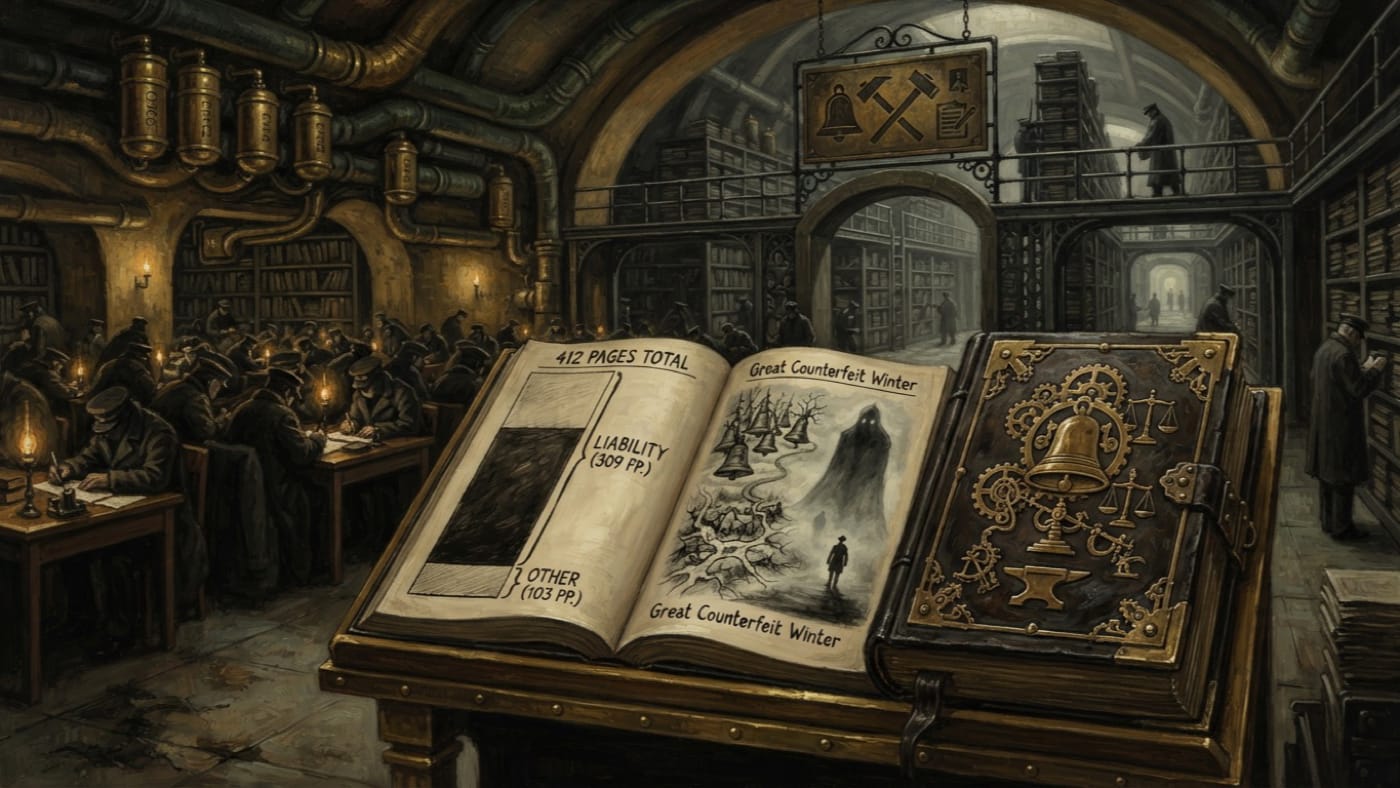
The workshop manual of the Route-Stampers, Concerning the True Toll and Its Faithful Reproduction, appears in the record at its Third Revision, A.S. 178. It runs to four hundred and twelve pages. Three hundred and nine of those pages concern liability.
The figure first appeared in this Codex at the foot of a filing stamp beneath the entry on the Route-Stamper, which is where the Bureau keeps the facts it would prefer you skimmed. I have carried it up into the nave. Three hundred and nine over four hundred and twelve is exactly three quarters. I did the division on the back of a requisition slip, and then, being a Hieromnemon and no fool, I did it again. That leaves one hundred and three pages for everything else. The record does not say what they hold or in what order, and I will not invent a table of contents for a book whose proportions have already confessed.
Author unrecorded. Printer unrecorded. The earlier Revisions left no date I would put my seal beside. The Third survives as a title, a year and a page count, which is more than most saints receive.
#On the Making of a True Toll
An indulgence-token is a palm of brass that says a man may walk. Its face carries the forge's crest, the route designation, a serial, the date of issue and the seal of the authorising Gate Prefect. The reverse is left bare for the cancellation stamp. Inside, seated in wax and wire, sits the bell-hour core: a sliver of consecrated bell-metal tuned to the route's Bellway cadence. It ticks and tolls as the bearer travels. The warden at the next gate can hear his permission, and so can the minor road-spirits and river-wights, which a correct interval keeps off the verge. I say minor on purpose. The token is a fence against vermin. It has never been a wall against the larger works of the Great Deceiver, and any smith who sells it as one deserves to be put out on the verge himself.
Every forge knows the order of the making. The smith verifies the bearer's identity and confirms the route. He strikes the crest and serial and binds the serial to a ledger entry. He seats the core and tunes it against the fork, then presses the wax. Last, the token goes down the pacing lane, across the chalk hour-marks on the floor, carried in a smith's hand at a walker's stride, and the smith listens. There are brass filings on the bench and red wax under his nails. He keeps a micro-hammer for the last adjustment and strikes the fork once, and only once.
The smiths will tell you, unasked, what a careful forge does beyond that sequence. Stamp the serial deep enough to survive mud. Keep one truth die untouched in its cloth, so the auditor has something honest to compare against. Never reuse wax from a burned token. These are the profession's practices. I cannot certify whether the manual records them, or on which page, so I do not claim it.
The real difficulty is what the token proves. Any engraver can cut a crest, and any patient thief can copy a serial. Appearance is the cheapest thing a token has, and the Winter taught the Church, at full price, what appearance is worth. The true toll is the only part of the object that cannot be faked for the eye. It has to be heard. That is the faithful reproduction of the title. The fiftieth token in a lot must sound as the first did, and the first must sound as the cadence was published, so that a warden at a gate in the fog can trust a sound he has never heard before.
#On the Allocation of Responsibility
From here the three hundred and nine pages begin to make sense. The sense is my own reading, and I stamp it as such.
The Bureau of Commerce charters the trade and licenses the forges. The Bureau of Records holds a veto over both and need not explain when it uses it. The Bureau of Bells supplies the sanctioned cadence and consecrates the bell-metal, or hands the consecration to whoever in the district owns a censer and a pen. The Gate Prefect watches the kiosk, and the Commerce Auditor watches the Prefect. The Bureau of Pilgrimage has opinions about pilgrim tokens but holds no charter over the profession.
Now look at what a single token asserts. Its core sounds true. Its serial is real and entered in the ledger. The journey it permits was authorised. Those are three separate truths, sworn by three separate hands under three separate Bureaus, and all carried in one pocket. When the bearer turns up three days later in a ditch off the Bellway, nobody asks whether he died. They ask which truth failed, and whose ledger it belonged to.
A manual for making brass would not need three hundred pages to say who is to blame. A manual written for men who will be blamed needs every one of them.
The traveller does not read it. The traveller is read.
#On the Winter and the Later Revision
The Great Counterfeit Winter came in about A.S. 160. By the Bureau of Records' reconstruction, forgers working out of Lyon, Marseille and at least two frontier towns never identified made tokens whose cores were tuned a hair off the authorised cadence. They looked correct and stamped correct. To an untrained ear they even sounded correct. Over a week's march, the error carried the bearer about three hundred yards outside the Bellway's protection, and the deaths that followed were logged as environmental. The purge consumed fourteen forges and the whole of the Lyon Stampers' Guild. The Guild's master die was melted and recast as a bell for the Chapel of Saint Cadrin in Strasbourg, where it still tolls the hour.
The Codex entry on the Route-Stamper stated that the Synod chartered the profession under Commerce after the Great Counterfeit Winter.
The profession's Commerce Charter dates to A.S. 114, some forty-six years before the Winter. The Winter did not create the charter's authority. It tested that authority, and the purge was the authority being enforced. Commerce has always licensed the forges. Records has always held the veto.
The manual reached its Third Revision eighteen years after the Winter, in A.S. 178. The profession's hierarchy was revised that same year. I note that the dates match and refuse to draw the inference. They are separate records. Nothing filed with this office says the Winter commissioned either revision, or that one revision required the other. The Bureau does not reward the scholar who mistakes a shared year for a shared hand.
#On Approved Cadence and the Road
A faithful reproduction has to be faithful to something, and on that question the profession splits three ways.
The Cadence Purists tune to the harmonics the Bureau of Bells publishes each quarter, whatever the road, weather or season. The Bell Codex ratified the current bell standard in A.S. 115, one year after Commerce chartered the trade. The Purists treat the published figures as canon set in brass. Their tokens are orthodox. On a fogged mountain road some of their bearers also fall behind, and on a Bellway, falling behind is measured in yards.
The Route Pragmatists tune for the road in front of them, adjusting for terrain, for weather, and for the hum of a river-ford. The Bureau of Bells calls this heterodoxy. The Bureau of Engineering calls it field calibration. Their bearers tend to arrive, which settles nothing in a doctrinal court.
The Silent-Core Crew reproduces everything except the voice. The crest passes inspection and the serial may even be real, but the core is muted or pitched below hearing. It is the most faithful forgery in the trade and the least faithful token. Its customers want to be on the road and missing from it at the same time, and they pay well for the privilege. A smith who is caught pays with his die and a posting to trench notary work.
So which of them reproduces the true toll? The Purist copies the published sound. The Pragmatist copies its purpose. The Crew copies the brass that holds it. Each could find a sympathetic page somewhere. I have not been invited to rule, and I am too well paid to volunteer.
#On the Tests and the Remaining Liability
A finished token sounds different after midnight. The Bureau of Engineering blames temperature drift in the bell-metal. The smiths say that after midnight the token is talking to something other than the road. Both accounts lead to the same practice: after midnight, a random sample from the day's lot goes into the quiet box to be heard. In the Cantor Foundry district of Rheinscarp I heard a Calibrator call one such token "wet" and drop it in the bin for melting. Something, he said, had answered. I record his word and name nothing.
The bell-eclipse is a separate matter, and the two should not be confused. The midnight test examines tokens already made. The taboo forbids making any at all while the city's bells are silent between the canonical hours, because a token born in that silence "walks into the wrong world." Doctrine calls this superstition. Bells calls it unconfirmed guidance. Nobody stamps during the silence.
There is one more distinction, between dead cores and muted ones, and the gate cannot always make it in the rain. A core that has drifted or cracked is a fault. A core muted on purpose is a crime. Both walk in silence, and the road does not trouble itself with intent.
The Codex entry on the Route-Stamper stated that tokens do not miscount.
Tokens are manufactured against miscounting. They still drift. Their cores crack or are swapped. Serials get duplicated, dies get counterfeited, and now and then the resonance is unclean. The sentence was accurate as a statement of the Bureau's confidence and has been reclassified as such.
That leaves the smith at the window and the walker beyond it. The Blank-Cutter in Strasbourg who told this Codex about a mother whose child had no papers also told me that he stamps. He did not tell me how often Records cross-references the cancellation log, and I have not found out. Every token he issues, whether true or merciful, carries a serial bound to his forge's ledger. Three hundred and nine pages stand ready to tell the Bureau whose forge that is.