
#On the Classification
Complex contraband is the Bureau's name for goods that arrive correct. The seal is genuine. The quantity matches. The manifest bears lawful wax, and the hand that pressed it will swear to the pressing. And the goods have changed, in ways no tariff schedule anticipated and no clerk is paid to describe.
Ordinary contraband is concealment: brandy under the flour, a forbidden psalter sewn into a saddle, coin that should have gone to the tithe. Customs men understand it. They have understood it since the first toll chapel learned to charge for absolution. Complex contraband conceals nothing. It submits to inspection, passes the tally, and waits.
The class belongs to the Merchant Problem, War's designation for caravans out of the Macedon Escarpments whose correctly documented cargo and apparently correct personnel arrive altered. The Merchant Problem is the whole convoy. Complex contraband is what the convoy carries. The distinction matters to the clerk who must decide which file receives the crate, and to nobody else.
#On the Goods That Pass
The catalogue is short and specific, as the dangerous catalogues always are.
There is lamp oil that burns with voices. The record says voices, plural, and says nothing about what they say. Chapels burn lamp oil. So do field surgeries, signal posts and the barracks of Bastion-Constantinople, which receive their oil through the Escarpments because the alternative is darkness and a longer road.
There is a reliquary bracket that draws confessions from sleeping men. The published account records them as confessions. Whether they were true, whose sins they concerned, and who sat up through the night writing them down, it declines to settle. A bracket holds a reliquary to a wall. One would think so small an office could be trusted to anything.
There is salt that weighs one pound less whenever a widow touches its sack. Only a widow, and only one pound. Any quartermaster who wished to test it would first need the marital history of every loader on the dock, an inquiry the Bureaus would pursue with great relish and no result.
There are contract sheets that remain blank until placed beside a birth certificate. The Bureau of Records keeps contract readers for agreements of demonic tenor, specialists who study buried clauses until some of them go mad. A blank sheet gives them nothing to read. That is the insult. The paper waits until a particular life is set beside it.
The last entry concerns buckles stamped with no heraldic device, which horses recognise and refuse. The horses have filed no report. Of every party to the Merchant Problem, they are the only one whose testimony nobody has yet tried to buy.
#On the Correct Manifest
Legate-Inspector Theron Vast commands the Macedon checkpoints, and his examination is the most exacting on the southern roads. The manifest is read aloud. The cargo is tallied. Seals are warmed and never broken. Drivers are scent-washed, escorts are questioned apart from one another, and animals are inspected for unnatural obedience. Mirrors are uncovered for three breaths. The clerk recites a prayer in reverse order to confirm that the clerk's own memory still runs in sequence.
Each step tests something real. None of them tests the salt.
This is the governing indecency of the class. A successful documentary check proves that the document is successful. Authentic wax certifies that a lawful hand sealed a lawful sheet. A matching devotional roster certifies that the names on the roster correspond to the names on the wagon. A correct animal count certifies arithmetic. A driver who remembers his oath, his wife's second name and the tooth he cracked at thirteen has proved that he possesses a memory. These are observations of record and identity. The Church has never held that a correct inventory is a clean one, and Vast has never let his clerks pretend otherwise.
The Bureau of War once let its clerks pretend.
A.S. 192 Bureau of War language described Macedon route documentation as "doctrinally secure."
Retracted as a description of anything beyond the documents. The phrase certified manifest custody, seal continuity and chapel recordkeeping. It never certified travelers, cargo, animals, reflections, or the spiritual condition of anything the manifest described.
#On the Ninth Checkpoint
When the Bureaus cite a case, they cite the seizure at Checkpoint Nine in A.S. 196.
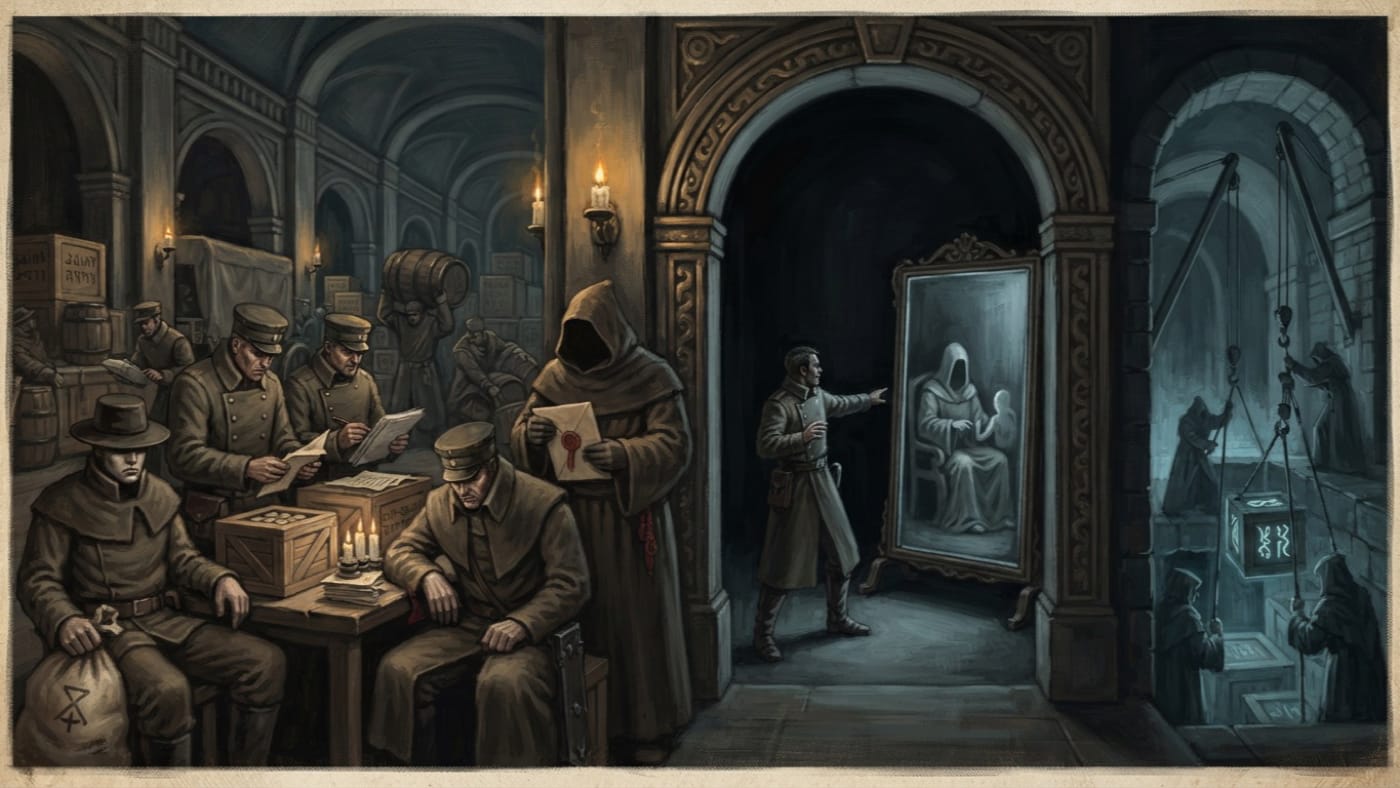
CHECKPOINT NINE SEIZURE ABSTRACT, A.S. 196 Cargo: devotional candles, linen, nail stock, three saint-capsules. Manifest: correct. Escort: correct. Driver: correct until mirror-black room exposure. Observation: reflection remained seated after driver stood. Secondary observation: reflection requested legal counsel. Disposition: cargo sealed for Harbor third sub-vault; driver transferred to █████████; mirror buried face-down under lime.
Students of the abstract tend to read it from the lime back to the candles, and to assume that each commodity must have done something dreadful. The record makes no such claim. It does not say the candles wept, the linen stained or the nails spelled anything. It lists four kinds of ordinary freight that the chapels and carpenters of Constantinople consume by the cartload, and then it records a single discrepancy in a mirror.
The driver stood. His reflection remained seated. Then the reflection asked for legal counsel.
My office has received a great many petitions. Few have been so procedurally sound. Whatever sat in that glass understood that it was in custody, understood that custody carries rights, and chose the one right a checkpoint clerk was least equipped to refuse. The clerk made no attempt to answer. The clerk wrote it down.
All of the cargo went to the Harbor under seal, from the candles to the capsules. The abstract does not divide the blame among them, and Records has not divided it since. The driver's destination was withheld and remains withheld. The mirror was buried face-down under lime, the only line in the abstract that reads like someone acting on instinct.
#On Custody and Influence
A seizure has a road of its own. Initial custody rests with the route checkpoint, where the goods are tallied again by men who would rather not. Secondary custody is the Harbor of Chains, third sub-vault, under Mother-Cryptor Sabine. The routing authority is the Bureau of Records. Earlier copies of the stamp said otherwise and have been corrected.
The Bureau of Purity conducts quarterly sweeps of the Harbor, and they do not reach Sabine's level. Purity has been told that the third sub-vault holds records of historical interest, Classification: Maximum, and has found the phrase sufficient. I have read the index to those deep records. I am not permitted to describe its length.
Officers always ask first who makes these goods, and the record says least about it. The influences on the corridor are known. Their workshops are not. The Crimson Concord, whose doctrine preaches coexistence with demons, works the Escarpments through administrative intimacy: lawful-looking passage, earned credibility, small exceptions, supply arrangements so helpful that the quartermaster says thank you. The Velvet Choir travels the same roads on Velkara's business of infiltration. Velmora, whose assigned front lies at Sibiu, reaches the corridor through debt, coin, contract and dependency, and has taught its tariff sheets to balance a little too neatly.
These three patterns of influence are filed separately because they are attested separately. None of them has been proved the source of any specimen above. Within Synod territory, demons can neither possess men nor compel their choices. A driver who carries altered cargo has been tempted, indebted, deceived or simply hired. The Bureaus would prefer a single enemy with a single seal. The road offers them a market.
#On the Present Application
In A.S. 187, Theron Vast proposed full closure of the Macedon routes pending doctrinal review of every active manifest. As of A.S. 201, the proposal remains under review. It has outlived several of its reviewers.
The routes stay open because Constantinople eats through them. Candles, linen, nail stock, lamp oil, salt and buckles: item for item, the catalogue of complex contraband lists what the southern anchor of the Southern Theater cannot do without. Sealing the corridor against the altered goods would starve the garrison of the unaltered ones. So the checkpoints examine, sequester and forward, the convoys roll on behind them, and every crate that reaches the Harbor arrives with its paperwork in perfect order.