
#On the Need for a Charter
"Wax lies in rain." — Route-Stamper proverb, older than the instrument that licensed the men who say it.
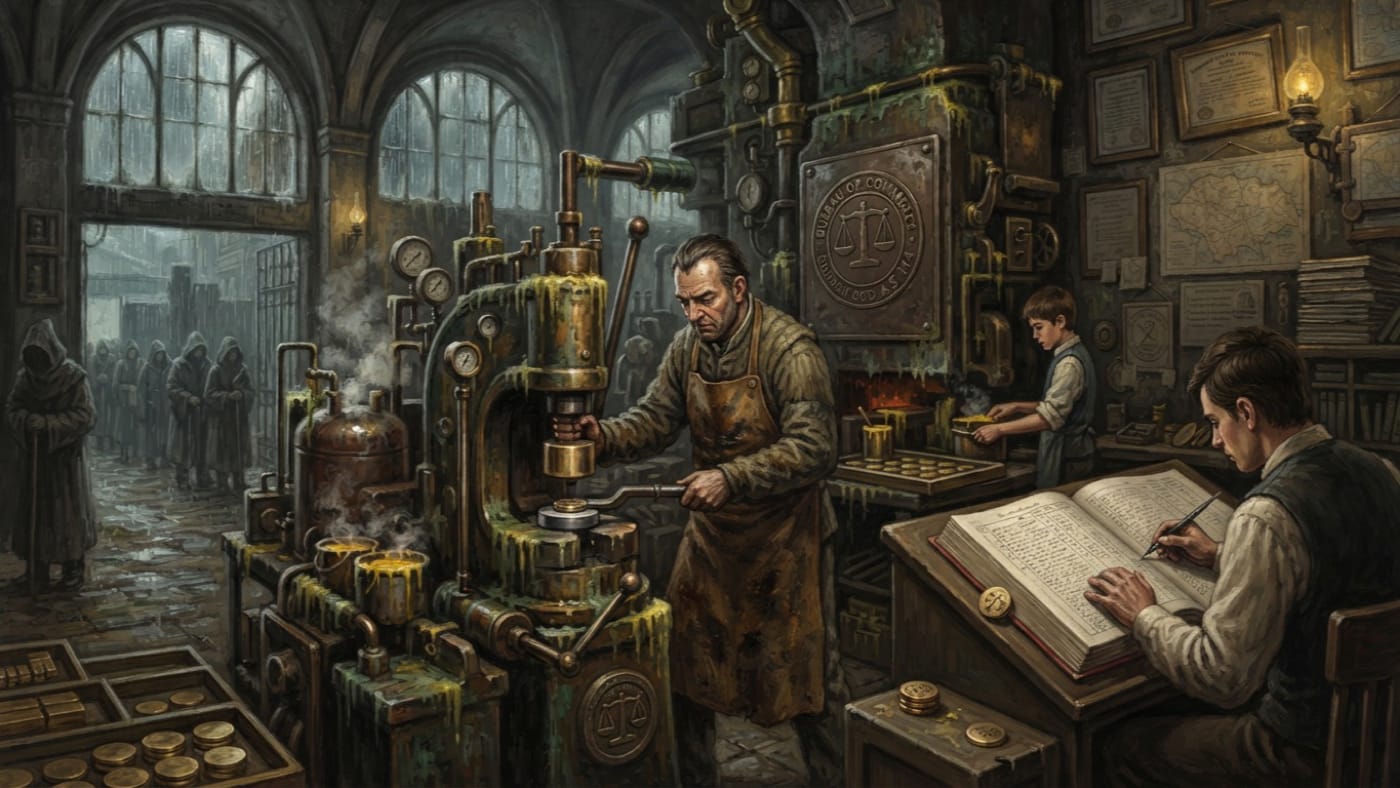
The trade came first. Before the Bureau of Commerce issued its Charter in A.S. 114, smiths in gate-yards and river towns were already pressing brass for travellers, seating bell-slivers in wax and swearing to one another in guild halls that their work was true. Some of it was. The Synod had inherited paper permits, and paper fails in exactly the conditions where a permit matters most: rain, mud, smoke, and a crowd at a gate with the hour running out. Paper smears and burns, and any clerk with a steady hand and a grievance can copy it. A brass token with a captive bell-hour has none of these faults. The guilds knew it, and they charged accordingly.
What the guilds could not supply was a sovereign to answer for them. A guild's oath binds its members and, by courtesy, their customers. Nobody else is bound. The Charter of A.S. 114 took a craft that certified movement and put it under an authority that could certify the craft. Every token struck afterward carried, behind its crest and serial, the implied countersignature of a Bureau.
I note, for the record and for no other reason, that the Bureau of Doctrine approved the vita of Saint Cadrin the Measured in A.S. 112, and the Commerce Charter followed two years later. The profession got its patron and its licence within a single administrative breath. Doctrine draws no inference from this. It files the two dates side by side and leaves the drawer open.
#On the Authority to Permit
The arrangement is simple to state and impossible to live under. Commerce licenses the forge, and the Bureau of Records keeps a veto over it. A Commerce Auditor may inspect a smith's dies, ledgers and pacing lane, find all three in order and grant the licence with the wax still soft. The next morning a Records Adjudicator may close the same forge, and owes neither the smith nor the Auditor an explanation. The parent entry, Route-Stamper / Indulgence-Token Smith, already states this asymmetry. I state it again because smiths keep asking me whether it can really be true. It is.
Below that division the offices are stacked like the tiers of a reliquary. The Gate Prefect has local political oversight. His seal is struck into every token issued under his gate, and his runners turn up at any forge whose queue has backed into the street. The Commerce Auditor holds the region and sends out the hour-patterns that say which routes are open and which cadences are authorised. The Bureau of Bells answers for sanctioned cadence and for the consecration of bell-metal. That jurisdiction is technical and liturgical, and the Charter recognises it without presuming to grant it. Bell administration was no novelty in 114: the Office of Bells had been constituted since A.S. 52, and a year after the Charter the Bell Codex ratified the current standard. The Bureau of Pilgrimage manages pilgrim routes and the permissions and trade attached to pilgrim tokens. It neither founded this profession nor chartered it, and it has never let either fact restrain its opinions.
A licensed forge therefore answers to five offices. One of them can create it, one can destroy it, and three can make it wish it had never been created.
#On the Five Ranks
The Charter fixed the profession in five ranks. The ladder now hung in every licensed forge is that ladder as revised in A.S. 178. The particulars of the revision are not before me, so I describe the ladder as it stands and will not pretend to know which rung was moved.
At the bottom is the Blank-Cutter, or Wax Runner. He trims foundry blanks, warms the wax, carries trays, and is trusted with nothing capable of lying. Above him is the Stamp-Hand, or Serial Clerk, who strikes the serial and binds it to its ledger entry. This is the first rank whose mistakes become records, which makes it the first rank whose mistakes can become crimes. Next comes the Tuner, whose whole qualification is an ear. Then the Indulgence Smith, who holds the die.
The die is the forge. A smith without a die is a man with burned thumbs. A die without a smith is evidence.
At the top stands the Bell-Hour Calibrator, who adjusts cores for terrain, weather and demon risk. He is the one called in when the published cadence and the actual road disagree. That happens more often than the Bureau of Bells publishes.
The ranks run from hand to page to ear to custody to judgement. Each step up takes the smith further from the brass and nearer the ledger, and that is the direction of every promotion in the Synod.
#On Permission Made Measurable
Follow one token. Its life is short and documented at every step.
A traveller presents at the window. The forge checks the traveller's identity against their papers and their eligibility against the day's hour-pattern. The Indulgence Smith strikes the crest from the master die: issuing forge, route designation, date of issue and the Gate Prefect's seal. The Serial Clerk stamps the serial and enters it in the ledger beside the bearer's name. The Tuner seats the bell-hour core and tunes it to the route's Bellway cadence. Wax closes the pocket. Someone walks the token down the pacing lane to hear that it tolls true at the expected stride. The bearer then leaves with a palm of brass that tells every gate warden on the route who they are, where they may be and whether they are keeping to the hour.
At the destination the token is cancelled on its blank reverse, and the cancellation is reconciled against the issuing ledger, serial out and serial in. A token issued and never cancelled is a traveller the Bureau has misplaced. A cancellation with no matching issue is worse. Records takes an interest in both.
None of this is the Charter's wording. These are the forge's operations under the Charter, and I record them so the reader can see where the instrument's authority actually lands, which is on a ledger line. The Charter did not make the token toll, since the smiths had managed that long before. It made the toll admissible.
The protection is real and it is limited. A true-tuned token keeps certain minor road- and river-entities at a distance. A drifted, cracked or swapped core keeps nothing away. The ledger, meanwhile, never drifts. It records the departure in the same even hand whether or not the bearer arrives.
The parent entry states that tokens "do not miscount," being "manufactured against miscounting."
Tokens are manufactured against miscounting. Cores drift, crack and get swapped, and forgers tune them wrong on purpose. The parent's sentence stands as a statement of the Bureau's confidence, which does not drift.
#On the Winter and the Revision
The parent entry states that "after the Winter, the Synod chartered the profession under Commerce with Records holding veto authority," and calls the Great Counterfeit Winter the event that turned Route-Stampers from guild artisans into licensed instruments of state control.
The profession was chartered under Commerce in A.S. 114, and the Records veto was part of that instrument. The Great Counterfeit Winter of approximately A.S. 160 came about forty-six years later, under a Charter already in force. The parent's own hierarchy stamp gives the correct year. The Bureau regrets that the entry contradicted itself, and observes that it was right in at least one place.
The Winter was a matter of enforcement, and the Charter supplied the machinery. Around A.S. 160, counterfeit tokens tuned to drift came out of Lyon, Marseille and frontier workshops that were never identified. They carried travellers outside Bellway protection, and the travellers died there. The full record belongs to the Great Counterfeit Winter. What concerns this entry is that the Charter's two hands were already in place. Commerce had licences to examine, and Records had a veto to use. Fourteen forges were closed. The Lyon Stampers' Guild was dissolved. A guild was still standing inside a chartered profession in A.S. 160, which tells the careful reader how much of the old trade the Charter had absorbed and how much it had merely licensed. The guild's seized master die was recast as a bell for Saint Cadrin's chapel in Strasbourg.
The hierarchy revision came eighteen years later, in A.S. 178. In the same year the profession's workshop manual, Concerning the True Toll and Its Faithful Reproduction, reached its Third Revision. These are two separate instruments. "Third Revision" belongs to the manual, as do its four hundred and twelve pages, of which three hundred and nine concern liability. I can certify no revision number for the Charter and no page count. Readers who have seen either quoted have been reading the manual and calling it law, which in fairness is how the forges read it too.
#On the Charter's Continuing Application
As of A.S. 201 the Charter is in force and has never been the subject of a quarrel, because every quarrel in the profession is conducted underneath it. The Cadence Purists tune to the published cadence. The Route Pragmatists tune to the road. The Silent-Core Crew tune to nothing and charge handsomely for it. None of the three was a party to the instrument, and no record names any of them in 114. All three live within it, the first two by licence and the third by evasion.
The Charter put records above craft, and the consequence turns up at gates every day. A funeral procession arrives with its tokens in order and finds its ledger entry reclassified overnight. The tokens toll true. The ledger says otherwise. The Gate Prefect sides with the ledger, as the Charter requires, because a true toll on an unlisted serial is only a well-made accusation. The cortege waits. The dead do not mind waiting. The mourners' own hours start running down.
Smiths still show unofficial mercy at their windows: a serial adjusted here, a page lost there. Records cross-references its cancellation logs at intervals it does not publish. The Charter does not mention mercy. It never needed to, because it provides for the ledger, and the ledger takes care of the rest.