
#On Their Nature
"Quod non uteris, vendis." What you do not use, you sell. — gloss in the author's hand
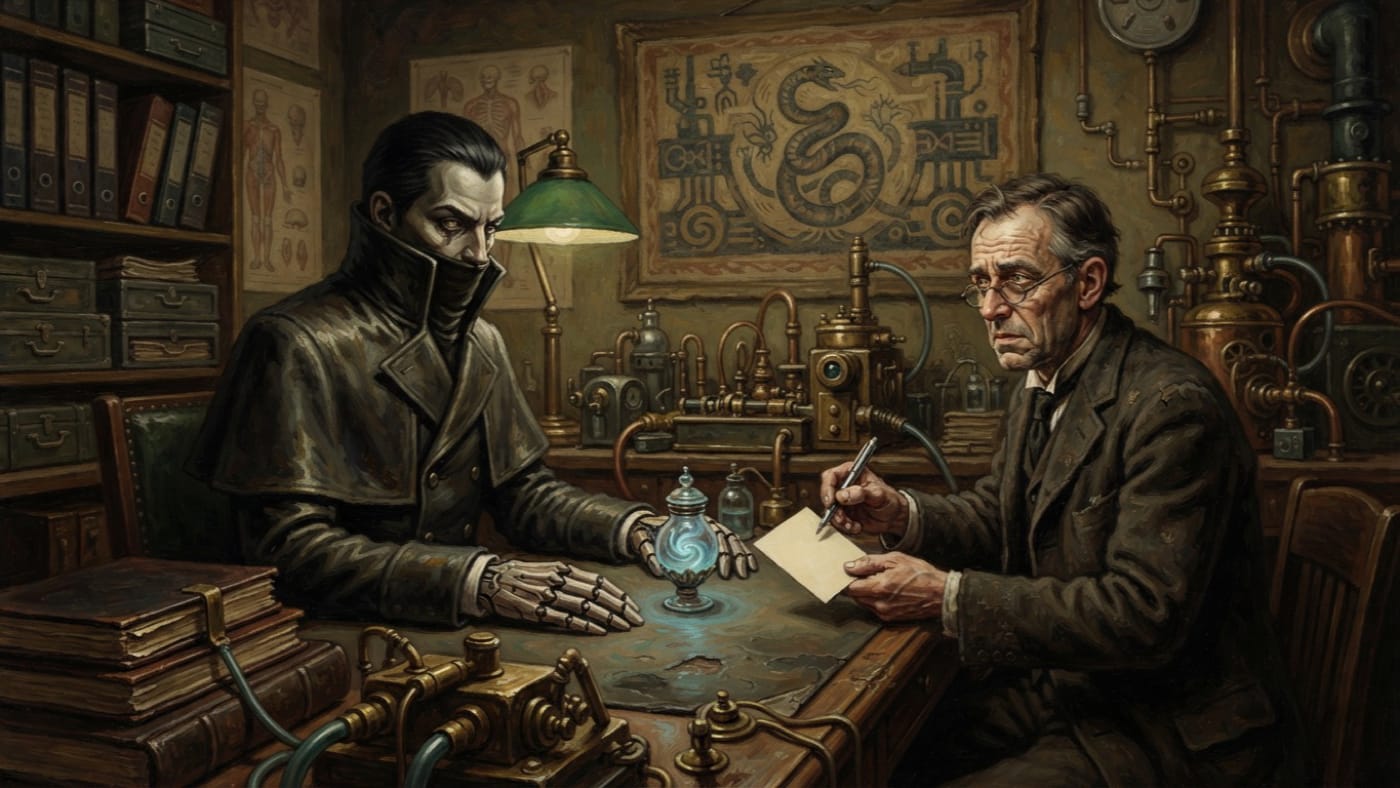
The Collectors are demons of Velmora, the Covetous Serpent and Sin-General of Greed among the Seven. They are true demons. They are not her soldiers and not her congregants. The Bureau's classified bestiary lists them beside the Assessors, the Coinbound, the Ledger-Keepers and the Guarantors, and one requirement sets them apart from that company: each Collector is bound to acquire a specific thing. It has no general appetite for treasure of the kind a quartermaster has for flour. It wants one item, held by one person, and it comes to the table for that item alone.
I record this first because the word causes trouble. In the Synod's market towns a collector is a man with a cudgel and a list of arrears. The Ten Thousand Keys rank their human servants as Debtors, Creditors, Assessors, Ledger-Keepers and Inheritors, and Collector is not among those five. Morwen's congregations give the title to a human rank in an entirely different trade. The entity in this entry carries no cudgel, belongs to no cult ladder, and gathers no faces. It makes an offer.
Testimony gives Collectors the general look of Velmora's household: metal-sheened skin, eyes like cut stones that seem to appraise, hands that reach. Those features describe her demons as a class. They are not a diagnostic list, and a Collector that came to the table looking like any of them would have negotiated poorly.
The danger lies in the Collector's manners. It is reasonable, and it does not raise its voice. It has come about one small matter.
#On What Is Acquired
Velmora's dedicated file gives four examples of what a Collector may need: blue eyes, firstborn children, the feeling of a summer afternoon, and regret. These are recorded demands. They are not four breeds, and no clerk should open four folders.
The first two are bodily and familial, and the Bureau holds no account of how such a thing passes from seller to buyer. I will not invent a procedure to fill that silence. On the second I will set down the position of the Bureau of Doctrine, which I share: a parent may sign whatever a parent pleases, but the signature cannot carry the will of a child who never signed. What a parent's agreement does to a household in Velmora's held country, where chains are ordinary furniture, is a matter for the Bureau of War. It is not a question of theology.
The parent entry on Velmora develops the intangible cases, and they are worse. A widow is asked for one summer afternoon, a particular afternoon that she remembers and nobody else does. A magistrate is asked for the feeling of certainty he has not had since his first appointment. A frontier surgeon is asked for the trust they extend to strangers who arrive after dark. These are illustrations. They name no one and carry no dates, and I have no case file to attach to them.
The specificity is the method. A Collector has no use for summer in general. It needs the hour in which the widow's husband was still alive and the light lay across the table in a certain way. It needs this surgeon's trust and no other surgeon's. The thing is worth nothing to anyone else, which is why the seller agrees to part with it.
The loss is discovered later, at the moment of use. The widow reaches for the afternoon and finds the shelf bare. The magistrate sits down to pass sentence and cannot feel the floor under the verdict. At the third knock after midnight the surgeon stands at the door with a lamp, and the door stays shut, and the man on the step bleeds out on the step.
Regret I leave to the reader's own arithmetic. Compute what a man becomes when he can no longer regret anything.
#On the Fair Exchange
Velmora's file says the trades seem fair. The parent entry says the Collector trades fairly. The Bureau of Records would like one answer. I give it two, because both are true.
The exchange is fair in the sense a notary recognises. Terms are proposed, and they are proportionate to what the seller believes they are giving up. The seller accepts. The Collector delivers what it promised, all of it, on time, and takes nothing it did not agree to take. Velmora's demons as a class honour their agreements exactly as written. A clerk who searches the transaction for the forged coin, the hidden blade or the clause in small type will find a clean ledger, close it, and go home pleased.
The exchange only seems fair because the seller priced the item before learning what it was for. The Collector does not lie about the merchandise. It lets the seller set its value by present convenience, and present convenience misjudges what has not yet been needed. The widow was not using the afternoon that week. The magistrate thought certainty a vice of young judges.
The Bureau's sources say the Collector trades. They do not say in what coin, and I decline to supply one. The consideration is not necessarily gold. It is not necessarily Coinbound, whatever the garrison tavern believes. It is whatever was agreed.
Doctrine reads all of this as Velmora's theology in miniature: the reduction of a person's interior furniture to stock, love and loyalty and memory each given a price, and the price allowed to stand in for the thing. I report Doctrine's reading. The Creator has not sent the Bureau a ruling on whether it is the whole truth, and I will not forge one.
The seller chose. They could have refused at the table, and the Collector would have bowed and gone. The general rule of Velmora's file holds here as everywhere: no demon can override a human will in Synod lands, and no pact is truly enforceable. That rule protects the next choice. It does not return the afternoon.
Earlier editions of the Codex classified Velmora's primary sorcery as "cursed coinage."
The Bureau of Doctrine's classification of Velmora's sorcery is Contract Theurgy. This correction concerns her general classification. It appears here because a reader who brings the old term into this entry will watch the Collector's hand for a coin and miss the request. No source requires a signed parchment for a Collector's bargain either. Watch the request.
#On Their Place in the Ledger
Clerks who like a tidy file draw Velmora's instruments as a procession. The Assessor prices the man, the Collector buys the piece, the Ledger-Keeper writes it down, the Guarantor stands behind the clause, and the Coinbound pile up wherever the money settles. It makes a handsome diagram, and nothing supports it. The sources assign each class its function: the Assessors determine value, the Collectors acquire their particular targets, the Ledger-Keepers record, the Guarantors attend to fulfilment, and the Coinbound are wealth given a body. No source gives an order of operations, a chain of report or an office. Until the Great Deceiver files an organisational chart with the Bureau of Records, the Bureau will not draw one for him.
Location is easier. The Gilded Chasm and its commercial territories, the Counting Kingdoms where time and memory change hands, the Assessment Halls and the Binding Markets, are country in which a Collector's kind of trade is ordinary business. I do not assign a Collector a stall there. The file gives none.
Synod territory is different. A physical demon must travel into the Synod's lands like any other traveller, in disguise or smuggled in by a cult, and true demons are rare on this side of the Line. Most of what the Synod calls demonic activity is the work of compromised men and women. The moneylender in a Wallachian border town who offers easy terms is almost always a member of the Keys, or simply a moneylender. Reserve the capital letter for when it is earned.
Opposite Bastion-Sibiu, where Velmora mines the gold under the Transylvanian Alps and buys loyalties along three supply corridors, the pressure is real and constant. The sources do not name a Collector as the hand behind any particular bribed convoy, and neither will I.
#On the Countermeasures
No ward against Collectors is recorded, and no cure. What the Synod has are its general defences against Velmora, each of which helps only in part.
The Bureau of Records keeps contract readers, specialists who go through agreements for unusual phrasing, buried clauses and terms that do not mean what they appear to mean. They are good at it, and a good number go mad from what they read between the lines. Their method assumes a written document with something wrong in it. A Collector's terms may be written. They may be spoken across a table. They may contain nothing wrong at all.
The Debt Tribunals can annul a debt shown to have demonic origin. Proving that is nearly impossible, most petitions are dismissed, and debts that are annulled have a habit of reasserting themselves by other routes. In any case a tribunal cancels obligations. It does not restore a widow's afternoon.
The Bureau of Doctrine teaches that a proper tithe inoculates the soul, and the Bureau of Tithes promotes this with an enthusiasm I will not comment on. Whether it works is unclear. I have raised my own tithe twice.
The Value Fasts take away a citizen's property for a fixed period on the theory that detachment weakens Velmora's hooks. In practice they produce a stretch of concentrated desperation, which her agents exploit. The Mark of Poverty goes further and renounces ownership entirely. Its adherents may be right about ownership. They are wrong if they think it protects them from the Collector, which has never wanted their purse. A destitute man still has his eyes, his children and his memory of summer.
My counsel carries no seal. Before you sell anything, ask what it is for. Ask what you would reach for on the worst night of your life, and keep that. If the buyer is reasonable, patient and in need of one small thing, refuse. A refusal is always possible. It mends nothing already sold. It keeps what you still have.
#The Ratification
The Bureau sets no price on the reader's possessions, and the entry asks none. Since the Sundering the Covetous Serpent has profited from war, from famine in Kargath's wake, and from every quartermaster with a weak hand. The Collector works on a smaller scale. It needs one thing, it asks nicely, and it pays.
Before you close this folio, name the quality in yourself you would sell first because you do not use it. That is the one you will want back.