
#On the Bell-Frames
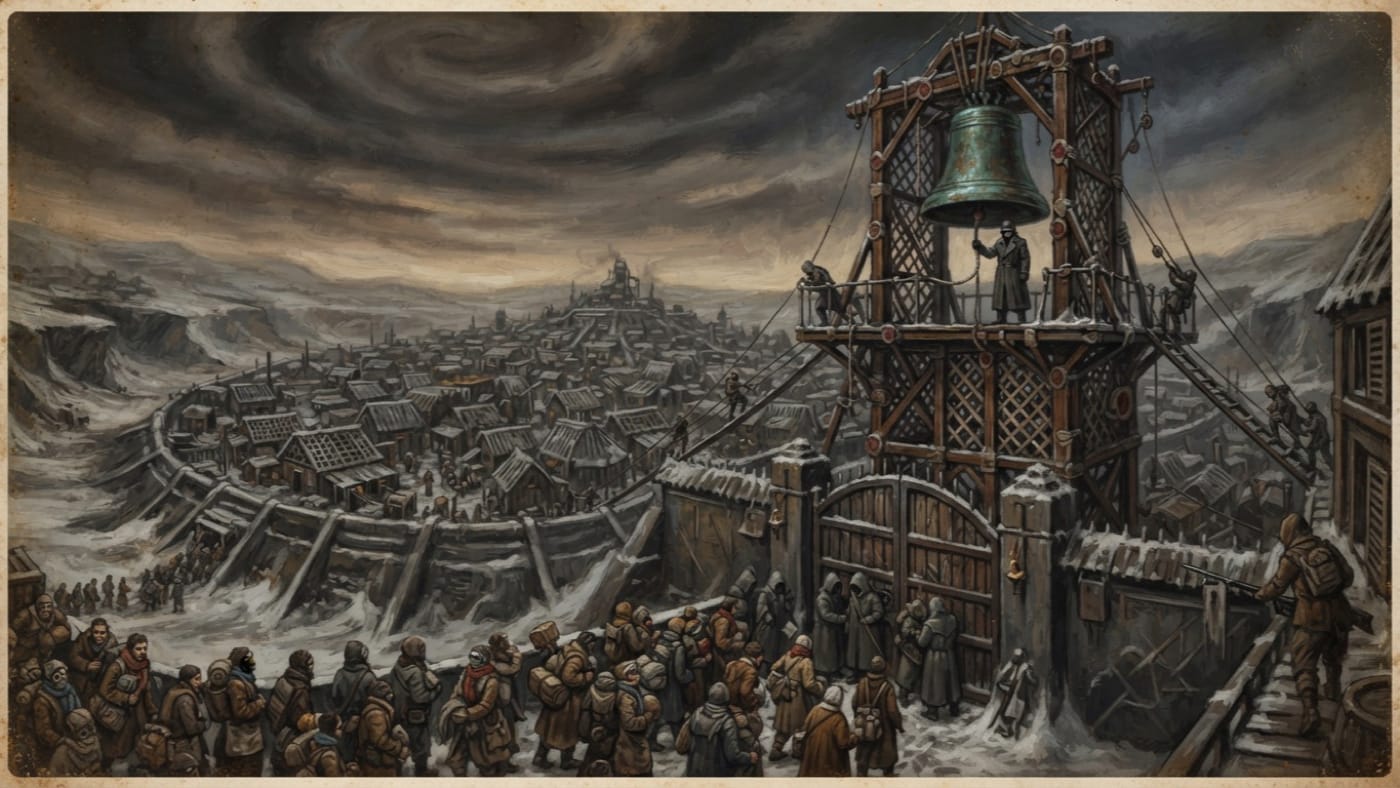
The closure bell of Black-Snow Lor hangs in a rib-frame lookout above the berms. Its rope is grey with wax, stiff with ash and colder than any glove that closes on it. Below the lookout lies the town. There are low bone-lattice roofs and soot-brick vent stacks. The outer storm berms form one ring, and the Breath Cordon forms a tighter ring around the safehouses. Then there is the Filter Gate, the only protected way in once the drift begins. Beyond the gate lie ash flats, trench-cut gullies and the old bonefields. For as long as a storm lasts, everything below that rope belongs to whoever holds it.
The hand on the rope belongs to Storm Warden Ilex Marr.
The apparatus is older than the Warden who now commands it. Lor was founded in A.S. 71 as Storm-Shelter Node 14-C, to keep convoys moving along the Sagittal Line. The frontier administration of that time posted lookouts on rib-frames and paid them in filter cloth to tell ordinary weather from the other kind. By the warren's account, the lookouts got bells because shouting does not carry through ash. The bells got relays because no single frame sees every approach. The relays got runners, closure diagrams, bell-line signals and a corps of Wardens wearing bell pins. Through the slow build-up that produces most frontier law, the whole arrangement also got the power to stop the town's business with one stroke. No file I have been permitted to open contains a commissioning charter for the present network. Lor does not appear to miss one.
The frames are Bone-Guild work: bone-lime footings, rust-iron fittings, marrow-glued reed lattice and wax at every seam. Lor counts the bell-riggers who keep them knotted among its essential labour, and the warren's saying about them is short: one missed knot and a district dies. The vents under the Breath Market will sell you counterfeit breath stamps, illicit filters and storm-safe rentals. They cannot sell you a real tower bell key. Sabotaging a tower bell is one of the few crimes Lor will not forgive. I approve. A town must hold something sacred, and in Lor it may as well be the rope.
#On the Three Bells
Closure in Lor comes as three signals, each tighter than the one before.
At first bell, the towers warn. The relays carry the signal across the warrens, and bell-line runners take it where sound fails. Residents who still keep the storm bell kneel perform it, which is brief. Then they stand and begin calculating, which is not.
At second bell, Lor prepares. Shutters drop across the lattice with a clatter that carries further than the bell. Market stalls are struck and dragged under, and vent-runners sprint. Families holding permits make for the safehouses, and families without permits make for the families who hold them. The Breath Office begins its reckoning of capacity, which means it begins deciding which of its own figures to believe. Second bell is the hour of bargaining. Everyone who strikes a bargain then knows that third bell is coming.
At third bell, Lor closes. The Filter Gate locks and the Breath Cordon seals. Those inside begin the silent breathing drills and the ash fast, which forbids speech while the drift runs, because local catechism holds that the storm counts a cursing mouth's breaths first. Those outside are outside.
The bell is an order, not a mechanism. Marr's third stroke seals nothing by itself. The gatekeepers have to throw the locks, and the shutter-fitters have to have finished fitting. The Guild's wax has to have cured, and the filter cloth has to be clean enough to pass air at all. A flawless closure rung over rotten wax shelters no one. A roof loaded with ash, a clogged screen, a crowded room or a chest already wet with lung-rot will kill on schedule, whatever the timing of the bell.
Opening a safehouse during a storm is forbidden. Lor ranks it with bell sabotage among its red lines. Marr has nonetheless ordered safehouses reopened for children. I record the prohibition and the exception side by side and decline to reconcile them.
#On the Price of an Interval
Three powers divide the interval between first bell and third. Marr owns its end. Breath Comptroller Juno Varr controls the rations and clean-room access that decide who may spend that interval indoors. Rib-Mother Sael holds the craft that makes indoors mean anything. Her Guild maintains the frames, lattice, shutters, screens and ribbed rooms, and it knows which of them will hold. That knowledge is worth more than either of the other two will admit in a meeting.
Because the interval is finite, it is sold. Clean minutes, Lor's storm-window tokens, change hands in the vents and in the Breath Market like coin. The warren will tell you that time until closure is the one currency nobody can inflate, which shows how little the warren knows about the Breath Office. A clean minute buys no guaranteed place. Neither does a shelter permit, a breath stamp, a requisition from the Line quartermaster, a priority list from the Frontier Chapterhouse or a bribe in lamp oil and spare cloth. Each of these improves the odds before third bell, and each loses its value sharply afterward. Varr's office has been accused of selling the same air twice. The accusation remains unproven. I note it because everyone in Lor does.
Marr's discretion overrides all of it. The Warden has held the gate past second bell for a late convoy carrying filter cloth. Marr has accepted the quartermaster's priority names and then ignored half of them, and has refused shelter to soldiers. Clerks have tried to extract a rule from these acts and have failed. Such a rule would only help the people who already own the most clean minutes.
#On the Closure of Late A.S. 199
The documented case is short.
During an off-cycle storm in late A.S. 199, Marr rang closure eight minutes before the Breath Office had posted its official warning. When the Filter Gate locked, twenty-seven civilians, two ash-sled crews and one convoy chaplain were still outside the Cordon. The chaplain was later found fused to his reliquary case. The file does not say what became of the others, so I will not tell you either.
The Breath Office protested. Its memorandum cited lost clean-minute revenue and unauthorized panic. The first complaint was honest. The second admits that the Office believes panic should be licensed. Marr replied on a single page: the storm had arrived nine minutes after first bell, and the Office's notice would have buried three hundred.
Both figures in that reply are Marr's. The nine minutes is a Warden's reckoning of the weather. The three hundred is a claim about people who did not die, and no ledger in the Church can audit a crowd that was never buried. I enter it as Marr asserted it.
A Chapterhouse digest summarising Breath Office memorandum 199-B reported that the Bureau had found Marr's closure unwarranted.
Corrected. Memorandum 199-B called the closure "procedurally excessive and socially destabilizing." That was a protest, not a finding. The Bureau's amended judgment after casualty review holds that the closure was procedurally excessive and correct. Digest clerks who cannot tell a protest from a verdict will be reassigned to the vents, where the difference is taught quickly.
Both halves of that judgment stand. Excess and correctness are entered in separate columns, and the Bureau of Doctrine has never been embarrassed by a ledger that balances on only one side. What joins the two columns is the gate. The people outside it stayed outside because the bell was right. The chaplain's reliquary case is now the most persuasive relic in Lor, though nobody venerates it.
The opposite failure has its own name. Lor remembers the Nine-Bell Night, which no record I trust has dated. By local account, the towers rang late that night and a whole district suffocated sealed in. A Warden who closes early kills the people outside. A Warden who closes late kills the people inside. The town gave the late closing a name. The early one got a memorandum number.
#On the Present Watch
Since A.S. 199 the storms have arrived off-cycle. The Wardens' sealed ledger of storm cycles failed three times between A.S. 199 and A.S. 201. The black snow, which falls from clear skies when it pleases, has gathered in patterns at window seams and vent-screens since A.S. 143 and the Year of Ash Rain. It now clogs filters at a speed the Breath Office calls unprecedented and the Guild calls invoiceable. When the forecast fails, the bell is the only instrument still reporting for duty.
Heavy use is wearing the apparatus down. Every closure consumes oil, cloth and wax. Every season of wrong-timed storms loads the roofs, frays the knots and strains seals that the Guild must renew at Guild prices. Marr has requested bell-riggers, lamp oil, filter cloth and authority. The first three have not arrived. The Bureau of War has considered replacing the Warden several times, and has stopped each time at the question of who would ring next. The Bureau of Purity keeps its interest in the Warden's mask and has, for now, postponed it until some quieter season.
The closure bells were built for storms the town could predict. Lor now keeps them against storms it cannot. The frames have fewer riggers than they need and the rooms have less cloth, and the Warden at the rope showed in late A.S. 199 that the bell will ring on the Warden's reckoning, whatever the Office has posted.