
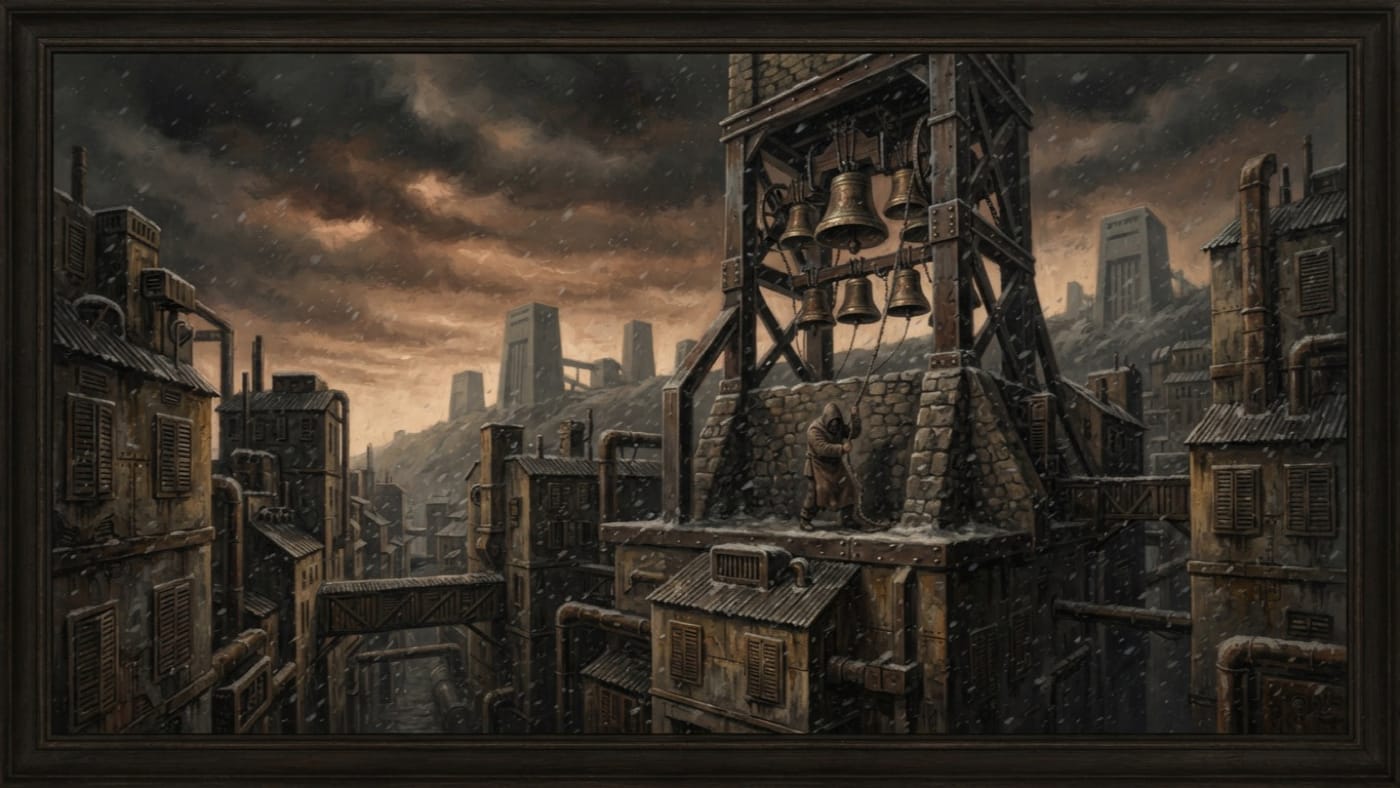
#On the Night Lor Remembers
This survey is entered in A.S. 201 / 1911 CE. It covers a catastrophe and the use Lor still makes of it. The catastrophe has no year. I have looked for one in every paper this Bureau holds on the town and found none. The anniversary-keepers of the Ash-Chapel cannot supply one either, though they are happy to accept donations toward the search.
The town calls it the Nine-Bell Night. The towers rang late, and a whole district was sealed in and suffocated. The history kept in the warren's own record gives the event in that order. The abstracts filed on Filter Gate, on Lor and on the closure bells repeat it in nearly the same words. Four accounts agree, and agreement establishes that it happened. They do not record the hour, the name of the district, the number of the dead or the name of the Warden who held the rope. I omit those things, and I will not borrow them from some better-documented disaster.
Lor stands on a windward ridge at the Carpathian edge of the Sagittal Line. It was built as a storm-shelter node to keep convoys moving through weather that kills. Black snow falls there, clogs filters and loads roofs. A town in that position survives by closing at the right moment and then trusting the rooms it closes. On the Nine-Bell Night it closed, and the rooms did not keep their people alive.
The Chapterhouse would like a widow at a shutter for this entry. I have no widow on file. Anyone who wants one may visit the Warrens and pay for the version they prefer.
#On the Interval Before Sealing
The procedure surveyed this year has three stages. First bell warns, and the relays carry the warning across the warrens. At second bell the town prepares: shutters come down across the lattice, the market stalls are struck, and everyone with a claim on shelter goes to make it good. Third bell orders Filter Gate locked and the Breath Cordon sealed. These are stages of one signal. I record no separate instruments, and I do not claim the procedure ran this way, unchanged, on the night in question. Nobody has preserved the sequence that was rung then.
Two boundaries matter. Filter Gate admits a person to Lor. The Cordon around the safehouses keeps a separate ledger of who may shelter behind it. A stamped permit gets you through the gate and no further. The district that died on the Nine-Bell Night was behind the seal, which means its people had made it to the place the town promises will keep them breathing.
The bell is only an order, and other people carry it out. Gatekeepers throw the locks and householders drop the bars. Seams need wax that has cured. Screens need filter cloth clean enough to pass air. Vents need to stay open to the routes the Vent-House maps. A sealed room is a room cut off from the storm, and it remains fit to live in only while the air it draws stays clean. Clogged screens, overcrowding and ash-loaded roofs are the ordinary dangers that the Lor surveys list. They are not findings about this district.
A late bell shortens the whole of second bell. Everything the town does in that interval has to be done in less time. The local account puts the late towers and the suffocation in one sentence and does not say how one led to the other. I have no grounds to supply the link, so I leave it out.
#On the Workmanship and the Inquiry
The Bone-Guild of Rib and Reed makes and maintains the things a sealed room depends on: masks, shutters, lattice, vent-screens, safehouse seals, marrow glue and the frames that carry the bells. Its motto is posted in Maskers' Row and scratched inside shutter frames. No Guild lattice, no Guild guarantee. It reads as a warranty when trade is good and as an alibi when it is not.
Nine-Bell Night appears in the Guild's papers in exactly one place, a correction. Instructional pamphlets issued in A.S. 132 had described the Guild as an informal association of mask-makers. After the Nine-Bell Night inquiry, that description was withdrawn. The record establishes that by then storm shutters, tower vents, safehouse seals and Breath Market screens were already Guild work under an enforceable charter. The Guild's corrective account adds a sentence of its own: informality ended when a whole district discovered that its shutters had been fitted by amateurs.
That sentence belongs to the Guild, and I enter it as theirs. The inquiry's verdict has not reached me, and neither have its transcript, its findings on cause or any names of the accused. What the correction does establish is jurisdiction. A Guild that held the charter for a district's shutters held responsibility for that district's shutters, whoever had swung the hammer. Amateurs working inside a monopoly are the monopoly's problem before they are anyone else's.
The correction proves that much. It does not prove that every death that night came through an amateur's seam, and the Guild does not claim it does. A late bell, a crowded room, a clogged screen and a bad shutter could each kill a district, and no surviving paper says which of them did, or whether more than one did together.
A.S. 132 instructional pamphlets described the Bone-Guild of Rib and Reed as an "informal association of mask-makers."
Corrected after the Nine-Bell Night inquiry. Storm shutters, tower vents, safehouse seals and Breath Market screens were already maintained under enforceable charter. The correction fixes the Guild's responsibility. It does not publish the inquiry's finding on cause, and the remark about amateur shutters remains the Guild's own.
Today those duties are divided among three present officeholders. Storm Warden Ilex Marr commands closure and the Storm Warden Corps. Breath Comptroller Juno Varr and the Breath Office hold the ration accounts and access to the clean rooms. Rib-Mother Sael governs the Guild and its seams. No document places any of the three at the Nine-Bell Night, among its investigators or among its causes. They inherited the offices and the memory of it.
#On the Other Closure
The second case belongs to late A.S. 199 / 1909 CE, and I keep it apart from the first.
An off-cycle storm came in. Marr rang closure before the Breath Office had posted its official warning. When the Cordon sealed, civilians, ash-sled crews and a convoy chaplain were still outside it. The chaplain was found fused to his reliquary case. The Office filed a protest over lost clean-minute revenue and unauthorized panic. After casualty review, the amended judgment found the closure procedurally excessive and correct, and both findings remain on file.
The two cases differ in where the danger lay. In A.S. 199 people died because they were shut out before they reached the Cordon. On the Nine-Bell Night the people who died had reached it. An early bell protects the rooms only if they are fit to hold anyone. Marr's closure was judged correct in its season, but that judgment does not make early closure a cure. A bell rung early over rotten wax would have produced the Nine-Bell Night's dead and A.S. 199's dead at once.
#On the Present Account
The night matters this year because the conditions it punished are present again. The Wardens' sealed ledger of storm cycles failed three times between A.S. 199 and A.S. 201. Storms now arrive off-cycle, and black snow clogs filters faster than the launderers at Filter Gate can turn the cloth. Marr has requested filter cloth, lamp oil and bell-riggers. The Bureau of War approved the request in principle and has delivered none of the three. A bell with too few riggers and a room with too little cloth are the two failures Lor fears most, and this year it has both.
The Guild's quarrel is about the second. Varr's office has issued shelter-upgrade permits to non-Guild contractors under emergency authority. Sael answers with posters about cloth allotments, but the real dispute is over who has the right to inspect a seal. The Guild has threatened a work stoppage, and as of this survey it has not begun. If the Guild stopped work, nobody would repair the masks, reseal the shutters, wash the screens or tension the bell-frames. Lor has already recorded what happens to a district that is sealed into rooms that cannot keep it alive.
Every party to that argument is asking who may certify a room, and the town has already lost a district inside rooms that someone certified. Sael can point to the correction to argue that the Guild must hold jurisdiction. Varr can point to the same correction to argue that the Guild held jurisdiction once and the district died regardless. The inquiry might have settled that argument, but its verdict has not reached me.
I record the night as Lor keeps it: the towers rang late, the district was sealed in, and the district suffocated. No date, district or toll survives in any paper I hold, and I have added none. The dead are owed an accurate record more than a full one.