
#On the Black Classification
Classification Black is the plainest restriction the public lexicon admits to knowing. It sits in common speech beside Amber and Crimson, and Strasbourg clerks say it aloud in corridors without dropping their voices. Its whole doctrine fits on a thumbnail: a document classified Black may not be read.
The document stays. It keeps its shelf, its weight, its accession line and its place in the dust order. It may be carried, counted, wrapped, inventoried, insured against fire and moved to a damper room when a richer department wants the dry one. A clerk may do anything to it that a clerk may do to paper, except the one thing paper is for.
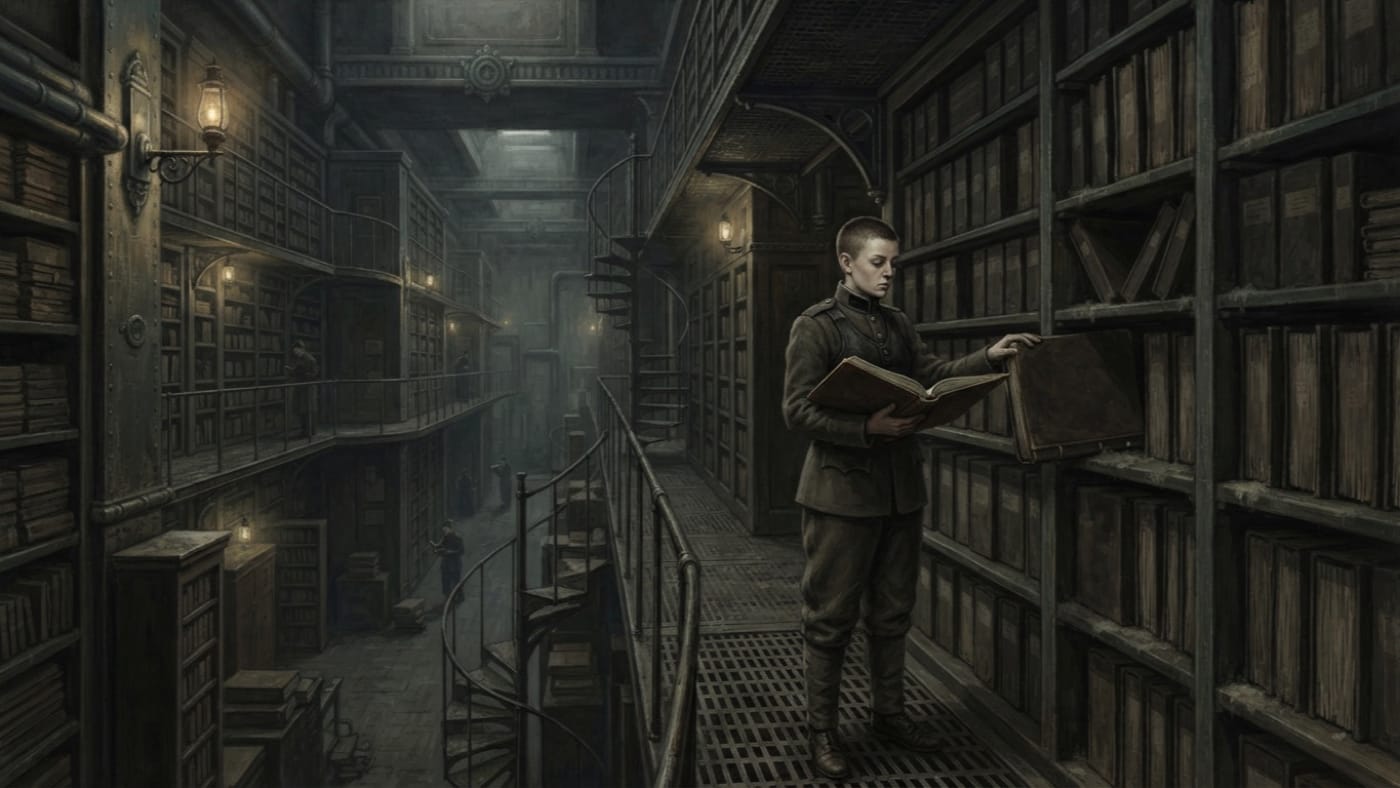
Take the ordinary archivist on an ordinary morning. The register lists a folio, and the folio is on the shelf where the register says it is. The archivist may confirm its existence, its condition and its binding. The archivist may write in a fair hand that the folio was found present and entire. The archivist may not open it, and every year of training has prepared them to accept this as the natural state of knowledge. The folio is kept. Its contents are kept from everyone. Some theologians call this a contradiction. I call it a job.
Black asks for no ceremony. No prayer is said over the file and no Custodian stands by when it is shelved. Nobody records the clerk's pulse. The restriction works through custom and fear, and through the general understanding that in this Dominion curiosity is a confession waiting for its notary.
#On the Offices That Keep It
Every Bureau that handles paper has its own reason for keeping some of it shut. The Bureau of Records preserves. It keeps what exists, in the condition in which it exists, because a destroyed record cannot be corrected later and the Synod lives by later correction. The Bureau of Purity prosecutes. It keeps what it may one day need against someone, and the someone need not be told. The Bureau of Silence licenses the libraries and archives and redacts dangerous language with ink thick enough to bleed through the leaf. The Bureau of Shadows denies that it keeps anything, and it does so with great precision.
Each of these purposes can be served by a file nobody may read. Records keeps the document whole. Purity keeps its evidence out of the defendant's hands. Silence keeps the dangerous phrase on its licensed shelf. Each gains something by having the folio present and unopened.
The public lexicon gives the grade a name. It does not say whose hand applies it, and no source available to this survey assigns Black to one Bureau alone. People who ask which Bureau owns Black are usually asking for a transfer. People who answer are usually guessing.
The habit itself is older than any of the offices that claim it. Files were withheld in this Dominion long before Records was remade in A.S. 78, before Purity's Index took its later shape around A.S. 80, and before the Synod was formally constituted at Strasbourg in A.S. 90. The interim council and its growing offices kept papers and locked some of them away. Hiding a document needs nothing but a cupboard and a reason, and the Church never lacked either.
The published survey of Seal Obsidian places the A.S. 82 "ancillary offices for the maintenance of doctrinal security" in the margins of "the early Synod's charters."
Corrected. The A.S. 82 language belongs to the instruments of the emerging authority that came before the Synod. The Synod itself was formally constituted at the Concordat of Strasbourg in A.S. 90. The ancillary offices bred in the right margins. The margins belonged to someone else.
#On Black and Obsidian
The comparison between the two is unavoidable. Every clerk who learns one name hears the other whispered behind it, and the whisperers are usually wrong.
Black restricts access. It controls who may read a file, and on the present evidence the answer is nobody. The file stays on the register, on the shelf and within the ordinary geography of the archive. Anyone who asks whether it exists can be told that it does.
Seal Obsidian works differently. Obsidian keeps knowledge because the Dominion needs it for operations, and it enforces deniability around that knowledge so thoroughly that the classification is said not to exist. Obsidian material is held in vaults missing from the floor plans and on shelves counted by their missing numbers. It is attended by the Custodians, who collect contradictions, documents and people, and who prefer absence to anything messier. The visible signs belong to Obsidian alone: the grave-dust wax, the countersign that stays blank until the reader says their own name aloud, and the ribbon of black glass-fiber fine enough to cut. A Black file needs none of these things.
I once told a junior clerk that Black prevents a document from being read and that Obsidian permits a document to read back. I stand by the formula and have since had it embroidered for my study, where it frightens visitors pleasantly. It describes a difference of nature, and degree has nothing to do with it. A Black document is a locked box. An Obsidian document is a locked box with something inside that knows the key has been turned.
Ambitious clerks talk as though a Black folio ripens into Obsidian with enough age, damp or episcopal neglect. No rule of promotion appears in the public account. Black files do not climb. When a matter turns Obsidian it is because the Bureau of Shadows has taken an interest, and when Shadows takes an interest the old classification stops mattering much to anyone, the file least of all.
The real difference lies in what each does to the person who asks. Asking after a Black file earns a refusal, usually in triplicate. Asking after an Obsidian file earns a visit.
#On the Other Uses of Black
The Dominion's chanceries are fond of colours and short of imagination, so black is used everywhere. The coincidence leads young officials into embarrassing mistakes.
A name struck in black ink from a parish roll is not a document under Classification Black. That name has been put through some other procedure, perhaps administrative dissolution, which removes persons from the rolls and has no concern for whether paper is read. A black wax seal shows the colour of the wax and says nothing about the grade of the folio under it. The gray vellum and grave-dust wax of the Night Papers belong to the deniable warrants of Shadows, with their own materials and their own dawn. They are a separate instrument. A black wash on a frontier map marks ground that the cartographers and the fortifications office have their own reasons for shading. The Night of Black Decrees in A.S. 58 gave the colour to an evening of accessions, and no archive grade was made that night.
Several departments also keep private colour tables for hazards and the categories of their own trade. A Bureau's private table is binding on that Bureau and on nobody else. If a clerk reads the colour on one office's table and applies it by another office's law, the clerk will soon find out how many offices there are.
#On the Present Application
In A.S. 201 Classification Black remains in use and the public lexicon still names it. Clerks across Strasbourg go on shelving folios they will never open, beside folios they are permitted to open and never do. The Forbidden Stacks keep their licensed horrors under the eye of Silence. Those horrors may be read by the properly licensed, and that alone puts them outside this grade. The Bureau of Records keeps counting its shelves and Purity keeps its evidence shut. Somewhere beneath both of them, Shadows keeps the vaults that are missing from the plans.
None of the archives this survey was permitted to consult records when Black was founded, who first applied it, what rank may impose it, or how it is lifted. The rubric itself appears to be filed under its own classification. I find this fitting and refuse to find it funny in public.
The grade will outlast this survey and its author, and most of the clerks now standing in front of Black folios with their hands folded. The documents will outlast all of us. They are well kept, at least.