
#On Its Nature
Every garrison on the Sagittal Line depends on a small article of faith that nobody examines: a voice belongs to the throat it appears to come from. The sentry calls the challenge, the patrol answers, and the gate opens. An officer gives an order in the dark and the line obeys because it knows the man. A soldier hears himself think and assumes, without filing any petition on the matter, that the thought is his.
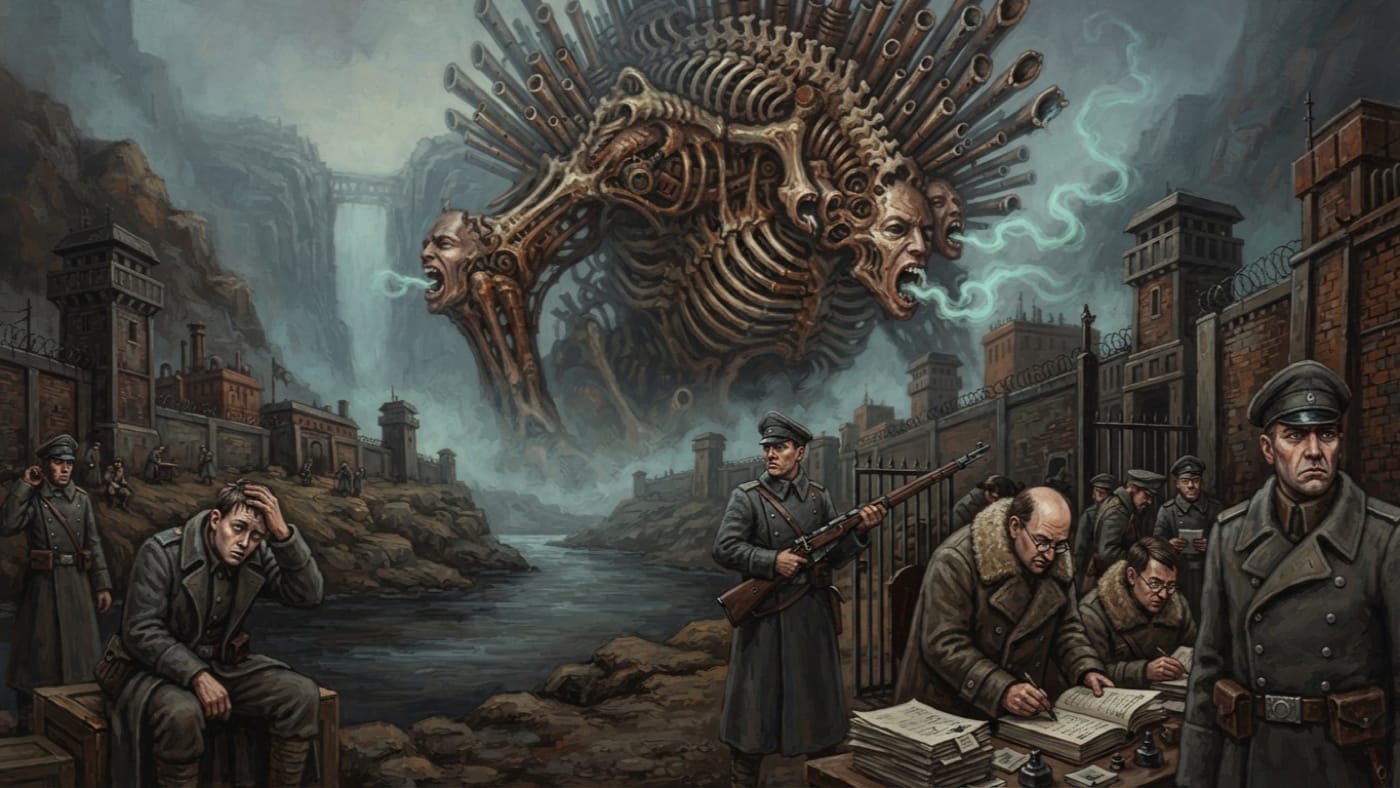
The Choral Maw is the engine that Morwen, the Weeping Host, Sin-General of Envy, keeps against that article of faith. It is her war machine. The parent entry, The Seven Sin-Generals, lists it among her armies, and I will thank the Bureau's junior readers not to promote it to an eighth general merely because it is large. Every source I have been permitted to consult describes it as a vast organ of bone and sinew that wails in stolen voices until those who hear it can no longer distinguish their own thoughts from the echo.
In Morwen's domain, envy has outgrown the neighbour's ox and wants the neighbour. The Maw is that appetite given pipes.
#On the Bone Organ
The archives agree on its materials and its scale, and on very little else. It has bone for a body and sinew where a Church organ would have leather and wire. Throats stand where the pipes should be, and there are many of them. The Lore archive numbers them at a thousand, all wailing together in a single collective cry. The sources call it colossal, titanic and vast, and say that it looms over the Hollow Vale and groans there. Those are the words of men who saw it from a distance they considered insufficient.
I record a thousand because the sources record a thousand. I do not certify it. No surveyor has walked its length with a chain and a tally-stick. The Bureau of Records has declined, with some heat, to fund the attempt.
The silences in the record outnumber the throats. Nobody knows who built it, or whether it was built at all rather than grown or gathered. Nobody knows what feeds it. Nobody knows whether it moves, is moved, or simply waits for the war to come within hearing. No operator is attested: no organist at a console, no bellows-crew, no choirmaster of the damned. I will not supply one to satisfy the Bureau of Doctrine's taste for a villain with hands. The sources also do not say whether the Choral Maw is a single object or a name the Line has given to more than one. The definite article is a clerk's habit and should not be read as a census.
Demons do corrupt the works of men. Morwen's territory reportedly holds machines turned from honest manufacture to the counterfeiting of persons. It does not follow that the Maw was once the organ of some lost eastern cathedral. Anyone who prints that it was will answer to me before answering to Purity.
#On the Stolen Voices
The Line knows loudness well. Kargath's Mawwheel is loud, and so are Maldrake's forges, and a loud thing can be endured with wax, prayer and the sergeant's fist. The reports of the Maw dwell instead on recognition. The listener hears in the wail something unmistakably his own: a cadence, a turn of phrase, the voice he uses inside his skull when he recites his catechism. Then he loses any means of deciding where it came from.
A man who hears his own voice outside himself begins to doubt the one inside. If the echo says what he was about to think, which of them thought it first? The Lore archive speaks of mortals driven to madness "by the sound of their own selves undone." I take that phrase in the poetic spirit in which it was written. Beside it I set what the record will actually bear: confusion, the collapse of judgment, and men who stop trusting the most private instrument they own.
Morwen's wider host offers parallels, and I set them down as parallels only. The archive records a bishop at the Hollow Vale whose voice was stolen mid-sermon and went on preaching without him, speaking blasphemies in his own tone. It records soldiers at the Palace of Echoes who found themselves praying to a copy of their own prayer and could not say which version was theirs. Neither account names the Maw, and neither is to be read as its work. Both describe the patron's method. Neither describes the engine's mechanism.
The military consequence needs no theologian. An army is a structure of voices trusted on recognition. The countersign, the order shouted through smoke, the chaplain's absolution and the confession that clears a man for the line all depend on someone deciding, quickly, that a voice is what it claims to be. The Maw need issue no false order. It is enough that every true order should sound as though it might be one. Hesitation is the cheapest casualty in war and the most expensive.
"...until madness drowns all will to resist."
Strike this phrase, which comes from the troop-lists of the Lore archive. Doctrine holds as fixed that no demon may possess a human body, compel a human act, or remove a person's capacity to choose otherwise. The Maw can ruin a man's ability to tell his thought from its echo, and it can make his resistance disordered, late and useless. It cannot take the choice from him. Whatever he does within its hearing, he does himself.
#On Its Place Among the Host
The Maw looms over the Hollow Vale, Morwen's domain of hollow trees and mirror-lakes that will not return a man's true face. Her seat is the Palace of Echoes. The archive places the Maw over the Vale. It does not install the engine inside the Palace, and neither do I.
The Maw must be kept distinct from her infantry of theft. Mimic-Knights strike with the stolen strength of those they kill. Shade-Doppelgangers wear stolen faces and walk among regiments. The Stolen Saints counterfeit blessings. Closest in kind are the Wail-Casters, who shriek in the voices of mothers, fathers and children to break resolve with grief. A Wail-Caster borrows the voice of someone the soldier loves, while the Maw, by every account, borrows his own. No source says whether the Casters feed it, serve it, or merely share its patron's taste.
Morwen's dedicated file also describes resonance machines that broadcast identity distortion until people cannot say which memories were theirs. The likeness is obvious, but no source identifies the Maw as one of these machines, and I decline to do so myself.
Her front lies along the Danube approaches, opposite Bastion-Irongate at the Iron Gates gorge, where the river runs between the Romanian and Serbian cliffs. The Bureau of War records that she attacks the gorge because she envies its beauty. No field return in my hands places the Maw at any named Irongate position. I note only that a fortress whose garrison calls it the Gasket Choir, and which licenses voices the way other cities license carts, faces a general who steals them. The Bureau of War does not consider this funny.
#On the Defenses
The Synod has answered Morwen with paper, as it answers everything. The paper does some good, though not much.
Recognition codes and challenge-response rituals rest on the theory that a copy cannot know what the original knew. In practice the good copies know everything, so the rituals catch only the bad ones. The Ledgers of Self record a man's appearance, habits, history and secrets so that a questioned identity can be checked against the entry. But ledgers can be altered, and no office has yet settled who decides which entry is the true one. The Confession of Identity requires a soldier to recite his history and his particular sins, on the theory that only he would know them. Confessors have been known to accept a false confession because it was more fluent than the true one. Mirror restrictions cover or dull reflective surfaces near Morwen's front, and the men who live under them begin to forget their own faces.
Each of these tests whether a person is who he claims to be. None was designed for the case the Maw presents, in which the person himself is no longer certain. A ledger can confirm that a soldier's answer matches the record, but it cannot confirm that the soldier still believes the answer is his. A man who no longer trusts the voice giving the answer can still answer a challenge perfectly.
No source available to me establishes a defense specific to the Maw. Correspondents of varying sobriety have offered me wax, deafness, counter-hymns, artillery aimed at a chosen throat, and vigorous silence. None of these is attested. I list them so that nobody can later claim the Bureau failed to consider them. I endorse none of them so that nobody can later claim the Bureau recommended them.
#Present Assessment
This entry reflects the survey of A.S. 201. The Choral Maw stands in the record as Morwen's war engine: a bone organ of many throats that steals voices and disorders the listener's possession of his own thought. Its origin is undated. Morwen came after the Sundering of A.S. 45, as all of the Seven did. No record says when her engine first groaned over the Vale, and I will not lend it a birthday. No victory against it is recorded, and no destruction or capture either. The sources do not extend to its patron's war machines the Sin-Generals' supposed invulnerability. They extend nothing to them, which is worse.
The Maw is a weapon of the Great Deceiver's envious hand, and it remains in service. If any reader, finishing this entry, finds that the last sentence sounds rather like something he was about to think, he should go to his confessor and his ledger, and, failing both, to the nearest officer of Purity.