
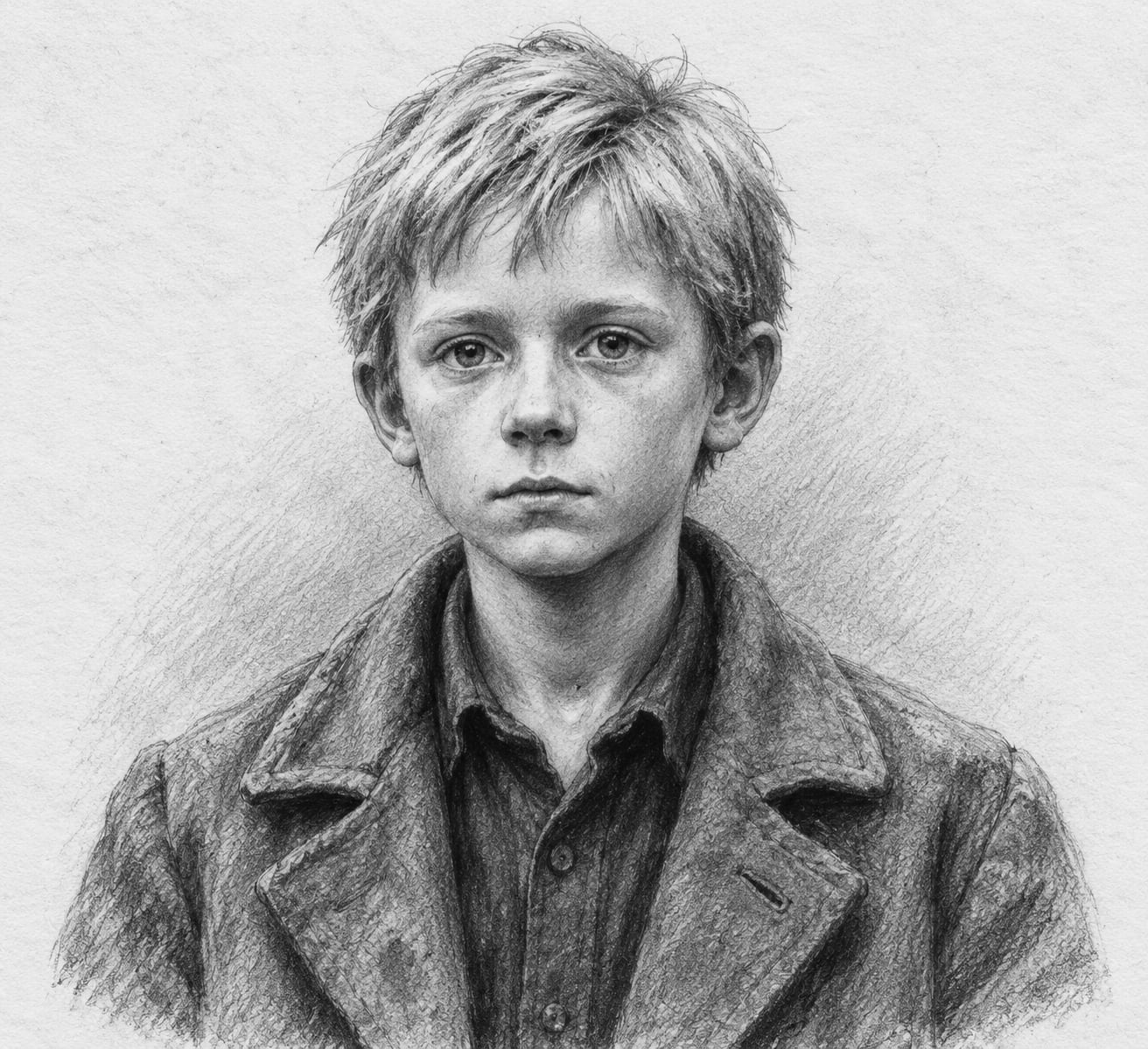
#On the Condemned Name
First on the heretics' list, and therefore first on the Bureau's.
The Child of Innocence stands at the head of the roster that heretics recite when they believe the walls are thin. He is the first of the so-called Virtue Generals: a pale boy, said never to age, who speaks truths that unravel loyalty. That is the whole heretical formula as the Synod's compendium preserves it. I add nothing I cannot attribute, and I subtract nothing, because a condemned name must be held exactly before it can be struck.
His place at the head of the list reflects the order in which the heretics recite the names. It gives him no command over the six who follow and no seniority in any choir above us. Heretics number their saints the way drunkards number their grievances, in the order they remember them.
Official doctrine stands. The Virtue Generals do not exist. Standing Order 44-D condemns the doctrine of celestial champions as a counterfeit channel of hope, one routed around the licensed offices of the Synod. I have defended that order in committee and in print. My defences were admired. In the matter of this particular boy, they also had to describe in considerable detail a person they declared absent.
#On the Boy in the Reports
What is said of him, in order of credibility.
The common description is narrow and stubborn. He is pale. He is a boy. His face reportedly does not advance through the years as faces are required to. His speech leaves listeners less bound than it found them. These four points recur. Everything else drifts.
The existing tract on the Virtue Generals bears my office's seal. It reports that heretical sources place his apparent age at nine or ten and describe his speech as rare and delivered in short declarative sentences. I keep these as the tract's claims. I do not promote them. An apparent age is a witness's estimate, and a cadence is a witness's memory of a cadence. Neither is a birth record, and the Child has none. There is no parish, no font and no family entered in any register that Records will admit to holding.
The agelessness is a claim about duration. Duration requires a witness who has stood at two points in time and recognised the same face at both. No such witness has been produced. What exists are reports from separate years describing a similar boy, along with a heretical assumption that similarity means identity. The Bureau would not accept that reasoning on a land deed. I decline to accept it on a miracle.
The speech is the real matter. The tract records that his words have made soldiers lay down their weapons and clerks lay down their quills. None of his words are on file. I have looked. The transcripts record the effect and leave out the cause, as though every examiner who took them had agreed, without consultation, that the sentences themselves were not to be written down.
#On the Rhine Accounts
Where he is said to have walked, and what is said to have followed.
The heretical roster places his last sighting near the Rhine and records that villages burned after he passed. The compendium's entry leaves his identity unverified. Put plainly, the Bureau holds a description, a river and ash. It has no one in custody.
The river matters. The Rhine is the heartland's wet ledger. It carries barges of grain and paper, rope-ferries, bridge courts, tariff chapels, pilgrimage roads, relic transit and archive traffic between the Strasbourg dependencies and Mainz and Cologne. Across the Rhineland, the Synod's administration moves by water as much as by road. Such a corridor runs on loyalty in its most tedious form: the ferryman who keeps the schedule, the toll-clerk who records the cargo honestly, the copyist who reproduces the decree without improving it. Disturb those men and the disturbance does not stay in its village. It travels downstream in the manifests.
No source I accept ties the Child to any town, bank or ferry. I name the great river towns only so the reader can take bearings. None of them is a sighting.
The tract groups the reports more tightly. It counts four sightings near the Rhine between A.S. 140 and A.S. 188. Each was followed by what the Bureau of Purity calls "a crisis of fidelity," and one was followed by fire. The Bureau attributes that fire to mass hysteria. The tract says the surviving villagers hold to a different explanation, but it does not record what that explanation is. Neither do I, because I do not have it.
The two accounts differ in scale. The roster speaks of villages burning, plural. The tract speaks of one fire among four reports. I keep both, each under its own attribution. Combining them into a total would mean doing arithmetic on rumour, and Records does not accept rumour as a figure in any sum.
"The Child of Innocence ruins villages by telling truth." This office, The Warrior of Justice, On the Condemned Name.
Narrowed. The sources support an association between three things: reported speech, a reported collapse of loyalty, and burning that followed his reported passage. They do not establish who set the fires, or whether his words set anything. The sentence was mine. It was elegant. It named a cause that no deposition supplies.
#On the Offence of Truth
Why a boy with no army troubles three Bureaus.
The Synod governs by sentence as much as by sword. The Bureau of Doctrine defines which words may be spoken. It maintains the Index Claritatis, the rolling register of permitted terms. The Bureau of Purity prosecutes whatever falls outside that register and keeps the Index Damnatus, where condemned doctrines are entered by category. Records preserves the authorized account, so that what was officially said remains what officially happened. In the field, the White-Mantled Inquisitors walk the print-quarters and pilgrim roads in starched mantles that show every speck of soot, listening for words that have drifted from their approved meanings.
I describe this machinery only in general terms. No file shows any of these officers handling a report of the Child. The machinery matters because of what the Child is alleged to do: defeat all of it with a sentence anyone could understand.
The Synod asks its clerks for accuracy, but only within the approved account. Loyalty, in the Ledger's practice, is the habit of continuing to stamp while knowing what the stamp leaves out. Every officer of the Ledger carries a private store of things he has agreed not to say, and that store is the mortar of the institution. A truth spoken aloud and plainly, by a child who wants nothing from the listener, cancels the agreement. The clerk who hears it cannot unhear it. According to the tract, he puts down his quill, and the Bureau loses him without a single heretical argument having been made.
Innocence is the aggravating circumstance. A heretic can be refuted, because a heretic wants something. A boy who seeks no office, tithe, following or recantation gives the examiner nothing to take hold of. Obedience is our measure of virtue. By that measure, a truthful child who dissolves obedience is a hazard of the first order, whatever his nature, and Doctrine is consistent when it says so.
Doctrine's interpretation is that the figure, if any figure exists, is a mask worn by the Great Deceiver: false light offered to the gullible. That is an institutional reading. It is the reading I am paid to hold. It proves nothing about his allegiance. Neither does the heretics' claim that the Creator sent him. Both parties have a portrait. Neither has the sitter.
#On the Unresolved File
What this office does not know, entered as carefully as what it does.
His identity is unproved. His agelessness is unproved and rests only on the resemblance between reports from separate years. His nature is unproved, whether celestial, infernal or merely human and pale. Doctrine's verdict on that question is a verdict of policy. The link between his passage and the burning is unproved in both directions: no deposition shows him lighting anything, and none clears him.
The Warrior of Justice shares his roster and his condemnation, and nothing more that I can show. No report places the two of them together. None places the Child beside the Crone of Patience, whose followers say she outlasts the very things the Warrior is said to interrupt. The Warrior's association with the Judges belongs to the Warrior alone. The Child carries no instrument and pronounces no verdict. He is said only to speak.
His status as of this survey is unconfirmed. He has no shrine, no approved image and no feast day. No hymn may name him and no chaplain may quote him. That prohibition is easier to enforce than most, since nobody has his words.