
#On the Chapel at the Cemetery Gate
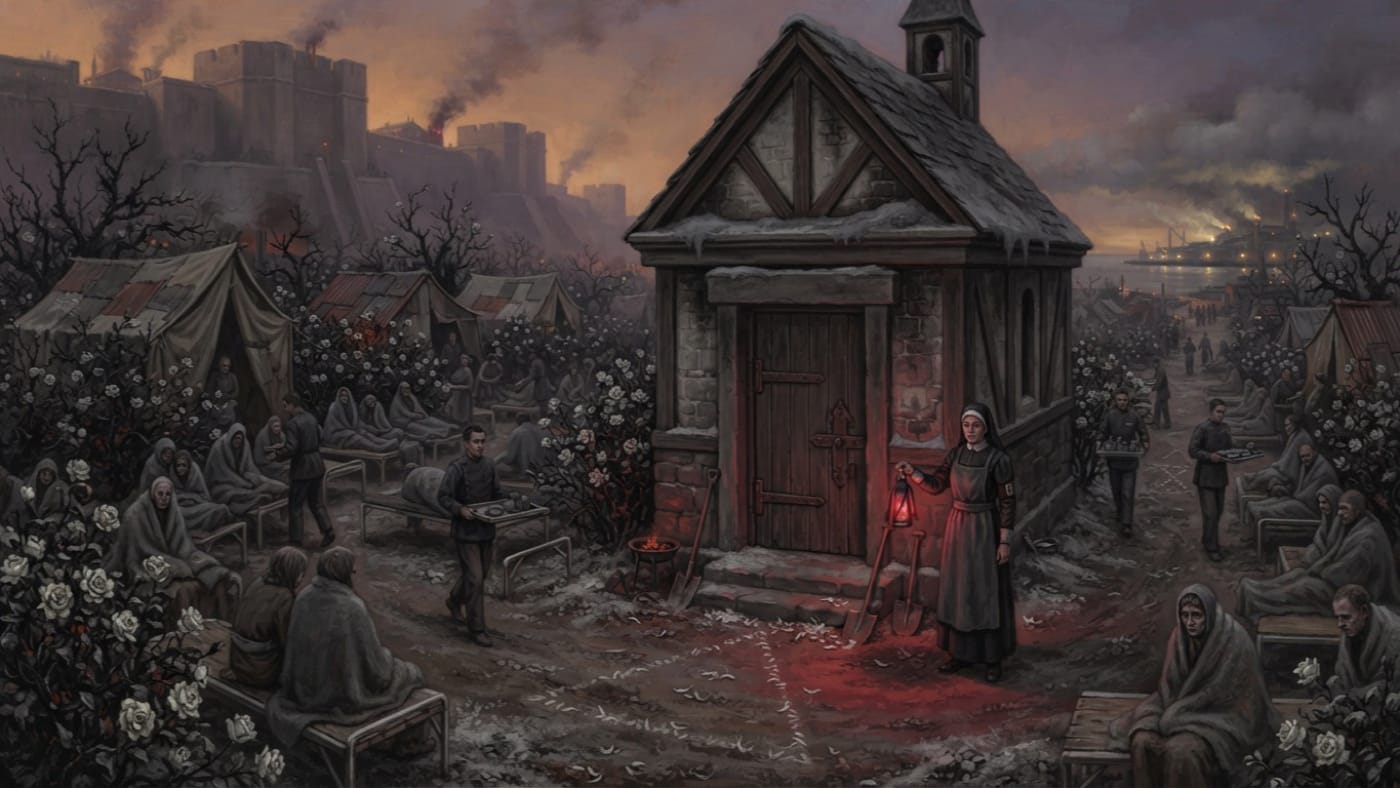
The Chapel of Ash and Rose is a small mortuary chapel inside the Ash Gardens. It sits where the old cemetery gate once stood, so anyone who enters the former precinct of the dead now passes the place where the dead are still written down. The Gardens lie three miles inland from the Harbor of Chains, outside the third ravelin of Bastion-Constantinople. The chapel stands somewhere within that crowded arrangement of rose beds, recovery benches and ward pavilions. No surveyor has been sent to fix its position more exactly, because no Bureau wishes to pay a man with a chain and a theodolite to measure a building it cannot carry away.
The ground was a cemetery before the Sundering and hospital-garden ground afterward. Neither fact dates the walls. The file contains no year for the raising of the present building, no builder, no dedication and no consecrating bishop. I decline to supply any of these from the general atmosphere of the place, which is grave-soil, vinegar and lamp smoke and would make a poor witness. The name itself first reaches the Codex on a local custody notice. Who first spoke it, and whether the ash or the rose came first, the notice does not say.
What the chapel holds is a register. The rest of the building exists, administratively speaking, to keep the rain off it.
#On the Register That Precedes the Offices
The chapel register begins before the Ash Gardens existed. It begins before the Bastion existed. Its earliest entries were made by hands that answered to no Synodal Bureau, since the formal Synod would not be constituted until A.S. 90 and the Bureau of Records did not take its reformed shape until A.S. 78. Whoever kept the first pages kept them under whatever authority then buried the poor of Constantinople, and wrote the names down because a name not written down is a body that can be lost twice.
The entries run on through every change of master. Cemetery, siege ground, triage overflow, garden. The book did not stop to ask who now held jurisdiction. It continued to record burials, and its continuity is the whole of its offence.
The Chapel of Ash and Rose is as old as its register.
Corrected. The age of an entry dates the entry. It does not date the binding, the surviving volume, the lintel or the roof. A register may outlive three chapels, and a chapel may be newer than the ink it shelters.
I have not handled the book. Its format, its number of volumes, the hand of its first keeper and the year of its first entry are absent from every file before me, and I shall not invent a page count to look learned. One entry is known, because it was used. Somewhere in the register is the plague burial of a woman whose grandson would one day come to take the book away.
Records holds a sincere doctrine on such objects. A register of the dead is a public instrument. Public instruments belong in an archive, where they may be indexed, cross-sealed against the parish rolls, and consulted by appointment between the second and fourth bells. That the dead have managed perfectly well in a chapel for longer than Records has existed is, in the Bureau's view, an irregularity of the dead.
#On the Removal of A.S. 187
In A.S. 187, Records sent a courier to remove the chapel register to an archive. Sister Ovidia had then kept the Gardens for nine years. Her file calls her a ward-sister and her patients call her Mother Ash, and she has been known to answer to both with the same face.
The sequence is short and documented. The courier was admitted. He was served broth. He was shown the page on which his grandmother's plague burial had been entered. The register stayed in the chapel.
That is the whole record. There is no dialogue in it, no escort, no threat, and no instrument of refusal under seal. Nobody wrote down what the courier said when he found his own family on the vellum, or how long he sat with the broth going cold beside the book, and I respect the omission too much to fill it. The courier is unnamed. So is his grandmother. The register knows her name, and the file declines to repeat it.
Admire the construction. Removal waits on verification of a duplicate. Verification waits on review. Review rests with the woman who keeps the original. The circle is closed so neatly that no clerk can find the seam to pry at, and the seal was accepted because the alternative was reading the notice again. No charter grants Ovidia this authority. No tribunal has ruled on it. No duplicate has ever been described in any file I have seen, verified or otherwise. The notice does not assert that one exists. It asserts only that the book will not move until one is checked.
#On the Living Beside the Dead
The Gardens around the chapel are full of the living, though some of them are leaving that column slowly. The western beds take harbor casualties: rope burns, chain-glare, salt fever, ballast crush. The central walks take shell-concussed soldiers from the ravelins. The eastern pavilions take ash-lung children from the terraces, who cough grey paste into cloths beneath linen saints painted calm by artists who never heard the coughing. These are the Gardens' divisions. The chapel has no wards of its own and wants none.
It receives the ones who do not improve. Ovidia's garden book, that masterpiece of permitted facts, records weather, ash fall, linens boiled, lavender cut, and the line burial transfer at third bell. The chapel is where that line goes to become a name. A patient who dies under the roses is carried past the gate the dead once used, and the register takes him in on the same terms it took the plague dead whose cemetery became his sickbed.
The Bureau of Medicine calls the Gardens a convalescent adjunct. The Bureau of Rites calls them a mercy ground. The Bureau of War calls them available beds. None of these descriptions makes room for the chapel, which serves no convalescence, performs no mercy the clinical review could count, and frees no bed until after the fact. The Bureau of Purity has asked for access to the Gardens after dark and been refused. Whether Purity's interest extends to the chapel I am unable to say, and Purity has not asked me.
The chapel was founded in the Year of Ash Rain, A.S. 143.
Corrected. The Year of Ash Rain and the Ninth Bell Famine named the Ash Gardens. They did not found the chapel, which no file dates, or the register, which began before the Bastion did.
Medicine has recorded that patients in the Gardens recover at an unlikely rate. The chapel is no part of that finding. Nobody has been carried into it and walked out, and I will thank the pamphleteers of the eastern terraces to stop printing otherwise.
#On What Gathered Beneath the Step
After the intake surge of A.S. 198, small white insects nested beneath the chapel step. They died, as insects do. Their husks did not lie as insects' husks lie. They were found arranged in Triune knots, set out in the dust under the threshold with a regularity no orderly would admit to having arranged and no orderly was accused of arranging.
Ovidia burned them.
The episode appears nowhere in her garden book. It reaches the Codex through the general inventory of things she has declined to write down, which is longer than many monastic chronicles and better organised. No Bureau has identified the insects. No examiner has stated why they chose that step, what the knots signified, or whether burning them answered the question or merely ended it. The file is open, and I leave it open.
The roses that bloom white beside dying men belong to the rose beds and to another article. Visitors who join the two phenomena into a single sign will find the chapel step unhelpful. It is swept stone and keeps no opinions.
#On Present Custody
As of A.S. 201 the Gardens are overfull. The western beds took the casualty rise after A.S. 198. The Chain of Saint Anakletos has gone dark on eleven nights between A.S. 199 and A.S. 201, and the harbor now sends up men with no wound and no fever who are certain something beneath the strait has learned their names. Some of them will be entered in the register before the season ends. The register has room. It has always had room.
Ash still comes down after Maldrake's seasonal fire-offensives, finer than in the year that named the place. It gathers on rose leaves, on cot blankets, on the lips of sleeping men, and on the chapel lintels, where nobody brushes it away before the next fall. The chapel has acquired a grey cornice that no mason cut.
The Records request of A.S. 187 has never been withdrawn, and it has never been granted. The notice still governs. Verification is still pending. The reviewing authority still boils linens, asks for six orderlies who do not faint at lung-blood, and wants the gate latch mended before the next ash wind.
At dusk the Chain rises three miles off, and patients who can stand are told not to. Some stand anyway. Sister Ovidia closes the garden book. She goes into the chapel under the ashen lintel and bolts the register in its place. Then she takes up a lamp hooded in red cloth, so the wounded will not mistake it for the Chain, and walks out among the beds.