
#On the Name
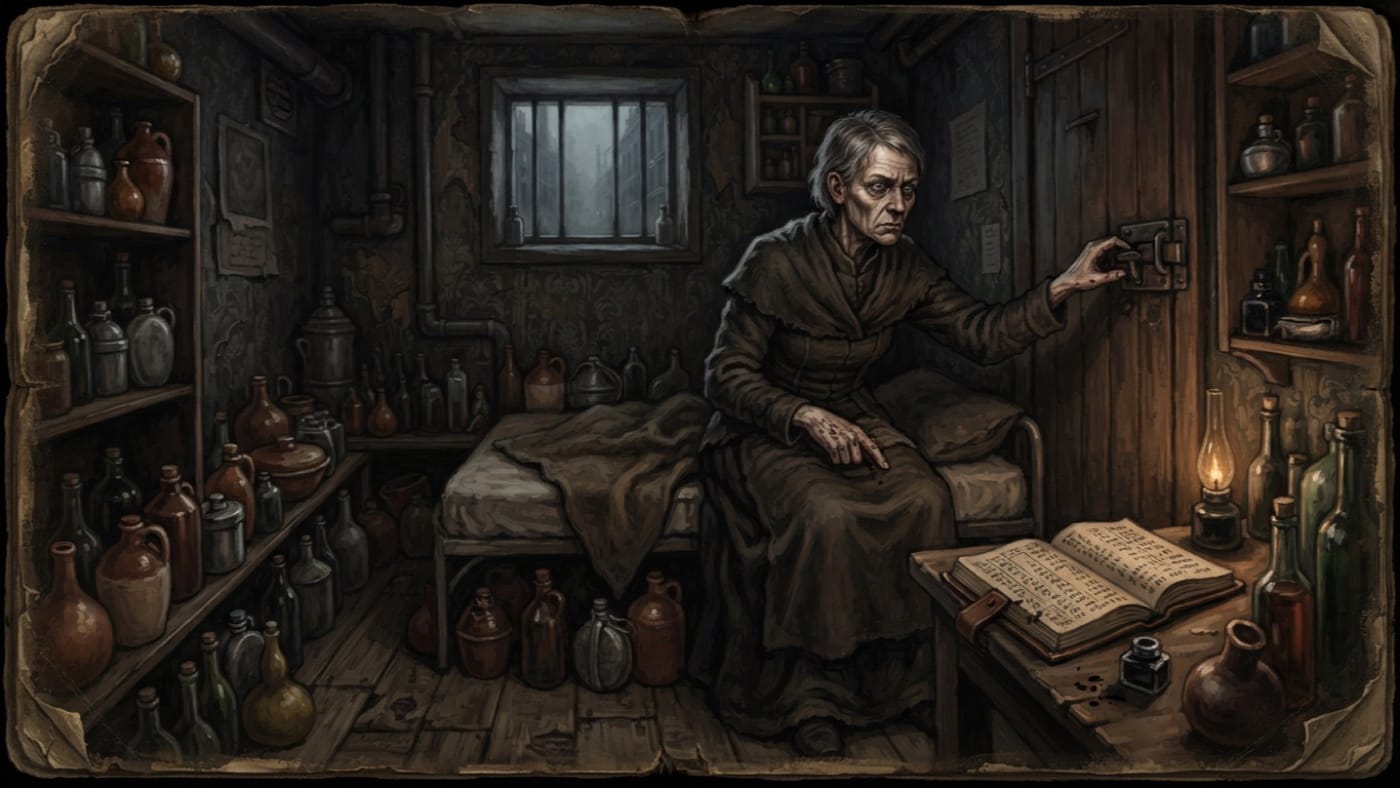
A veteran of the chain, three seasons off the road and living in rented rooms in a city no column has ever entered, gets up in the night to test a lock already tested. Nobody is on the other side of the door. The nearest chain is in a depot forty leagues off. The veteran tests the lock again, because the hand that tested it the first time cannot be trusted. Each test is a number, and a number must reconcile before anyone sleeps.
The Handlers call this chain-sickness. The Bureau of Mercy has no name for it. Its physicians keep no entry under that heading. Their lexicon runs from the agues to the wasting fevers and through every complaint a ward can bandage, and it has no place for a grown man who counts his own breathing. A complaint without a name cannot be charted. A complaint that cannot be charted cannot be rationed, and Mercy does nothing it cannot ration.
#On the Work That Remains
Chain-sickness is made of duties that outlive their column, and every one of them was necessary once. On the road the master keys are tied to the Handler's wrist at night and kissed at morning inspection. Losing them ends a career. Having them stolen brings the Bureau of Purity. On the road the headcount must agree with the tally slate at every shrine, and the Route-Stamper cares only that the figures match. On the road every cup poured from the mercy gourd is entered against a tag number, and the gourd never holds enough for the column it serves. The Handler decides who drinks, and decides it every day.
The Road-Mercy Scandal of A.S. 136 put that decision under a formula, last revised in A.S. 141. The Bellway Harmonisation of A.S. 148 put the march under bell-windows that the Bureau of Bells can hear from a valley away. Neither reform invented the affliction. Each turned the screw. After 136 every mercy had to be counted, and after 148 every hour had to be kept. A Handler caught between the count and the hour learns to keep both while asleep, and later cannot stop keeping them awake.
"...the Bureau of Pilgrimage's delivery statistics collapsed so thoroughly..." (Codex entry On the Pilgrim-Chain Handlers, concerning the unchained Jubilees of A.S. 94–108.)
The Bureau of Pilgrimage was formally established in A.S. 123. It kept no statistics in A.S. 108 because it did not exist in A.S. 108. The chain was introduced in A.S. 109 and the Handlers were licensed in A.S. 112, both under a pilgrimage administration older than the Bureau's charter. This entry does not name the office that issued those first licences, because the record before me does not name it. The dates stand. The attribution does not.
#On the Signs
Four habits mark the sufferer.
The first is the key. A Handler on duty checks locks to survive, and an auditor who found one who did not would be right to ask why. The sickness begins where the column ends. The chains go back to the depot and the master set goes back to its rack under seal, but the hand keeps testing: twelve, fifteen, twenty times a day, by the published account, on latches, cupboard hasps, and the clasp of a purse with nothing in it. Those figures are observations. Nobody has fixed the number of tests at which diligence becomes disease, and I decline to be the first. The difference lies in what the hand answers to. On duty it answers to a chain. In the rented room it answers to nothing that is there.
The second is the count: footsteps, breaths, heartbeats, the strokes of a broom, the stairs between bed and privy. The profession's own lore records Handlers counting footsteps in their sleep, legs keeping cadence under the blanket while the mouth murmurs totals to a shrine-clerk who is not present. A mind that has spent years turning a column of bodies into figures on wax does not easily let go of the figures. They were the only part of the road it was allowed to hold.
The third is the hymn. On the road, hymns are sung on order, by throats that have had no water since the last shrine, and the Handler hears the order inside the singing. Years later, when a parish choir reaches the same melody, the veteran flinches. The shoulders rise and a hand goes to the belt where keys once hung. What returns is the memory of compulsion. The Handlers report no voice speaking out of the hymn, and I will not supply one.
The fourth is water. Veterans cannot pass a well without filling a vessel. They sleep with a gourd beside the pillow. They go white when a child spills a cup, as though a mercy unit had just been entered against the wrong tag. The water is seldom drunk. It is kept, as the gourd was kept, against a decision that may have to be made before morning.
The end of it, in the Handlers' own idiom, is that you stop hearing voices and hear only links. Bell-sickness, which turns screams into rhythm and troubles bell-crews as well as chains, shares some of these tells. It is a separate entry and a separate complaint. The Handlers keep the two names apart, and so shall I.
#On the Bureau's Recognition
A Handler is judged on delivery rate, count accuracy, compliance with the mercy quota, incident reports, and keeping to the bell-hours. All five are recorded, and all five are audited. A Handler who satisfies all five is excellent. An excellent column arrives intact, quiet and on time, and its deaths occur only where deaths are allowed.
The Handler appears nowhere on that list.
The obvious petition would go to Mercy, which practises care the way the Synod prefers it: with a ledger at the bedside. The bowl is entered, the bandage is entered, the cot is entered, and the patient's name is entered beside all three and passed to the Bureau of Records in due season. The ward-siblings know counting compulsions, because their own trade breeds them. They know hoarding, because a sister who has rationed broth through a famine keeps crusts in her sleeve for years afterward. What they lack is a line on the form for a Handler's hands. Mercy does not treat what it cannot enter.
So the sufferer stays where the institution has filed them, under the heading of success. The numbers were perfect and the ink is dry. That the hand which kept those numbers now cannot leave a latch alone is a private matter, and the Church is most respectful of private matters that cost it nothing.
#On Maren Kessler
Maren Kessler is the case I can attest to, as far as attestation goes. It does not go far.
In the Jubilee of A.S. 188 I walked behind Column 7-North on the Strasbourg–Przemyśl corridor, attached to the Bureau of Doctrine's Audit Secretariat. Kessler, Handler Third Class, was in command. Four hundred and twelve souls left the departure yard. Three hundred and seventy-nine were counted at the first checkpoint. Three hundred and seventy-nine were counted at every checkpoint after that, and the column was filed at a delivery rate of one hundred per centum.
The ledger reconciled. A reconciled ledger proves that two numbers agree, and it proves nothing about the thirty-three between them. This Codex can say that they were not counted after the first shrine. It cannot say what became of each of them, and I will not dress the gap in individual fates I did not witness. Kessler told me where the ones who could not walk went. The slate did not say which ones they were.
Kessler was excellent. In another entry I compared her competence to a surgeon's, inseparable from a measured cruelty, and nothing here withdraws the comparison. She commanded eight Jubilee columns, and every one arrived ledger-perfect. Whatever the sickness took from her, it did not take her hand off the cadence while there was cadence to keep.
In the Jubilee of A.S. 193 a pilgrim in her column died reciting a psalm. Kessler could not tell from the sound alone whether the recitation was prayer or accusation. She has not entered a church since.
She retired in A.S. 196 to a village outside Mainz. She keeps forty-seven water vessels in her house and counts them every morning. Her neighbours take this for devotion.
#On Leaving the Road
The exits are few, and none of them is a cure. Handlers drink. They count. They sit and stare at a wall until the wall has been counted too. Some ask for transfer to gate-work, where the only chains are on the doors and the only screaming comes from outside. The profession's lore records this as its one regular exit and calls it rare.
Suffering does not buy innocence. A Handler who flinches at a hymn still forced the hymn. A Handler who hoards water still poured it by formula to the ones who could walk and left the rest to the ditch. The sickness does not settle that account. It only keeps the account open in a rented room, a latch at a time.
The Handlers say the true believers among them, the Rite Purists who take the chain for a sacrament and the suffering for divine arithmetic, never catch chain-sickness and always sleep soundly. I once wrote this down as fact. I set it down here as testimony. No physician has examined a Purist for the complaint, since no physician recognises a complaint to examine for. Whether the Purists are spared or are simply better with the slate, the Codex cannot say.