
#On the Crossing
Where the city walked from its counting-houses to its castle, until it was told to stop.
The Chain Bridge joined Buda to Pest. Every schoolchild in Budapest could once recite that sentence, and the Bureau of Doctrine would prefer it recited less. It describes the structure's entire civic purpose. On the western bank stood the hills, the royal quarter, the castle walls and the offices that issue orders. On the eastern bank lay the flat commercial grid of Pest, with its markets and warehouses, its rail termini, and its three hundred thousand workers and the families they fed. The Danube ran between them, brown and wide. Over the Danube hung iron chains on masonry piers, and they carried carts, clerks, mourners and fishwives for the same toll.
The Hungarians call it the Széchenyi Lánchíd. They called it that before the Synod reached the river, and they still call it that in the coffee houses, at funerals and in the registration queue. The Bureau of Doctrine has issued memoranda on standardising nomenclature. The Hungarians have issued nothing. They carry on as before.
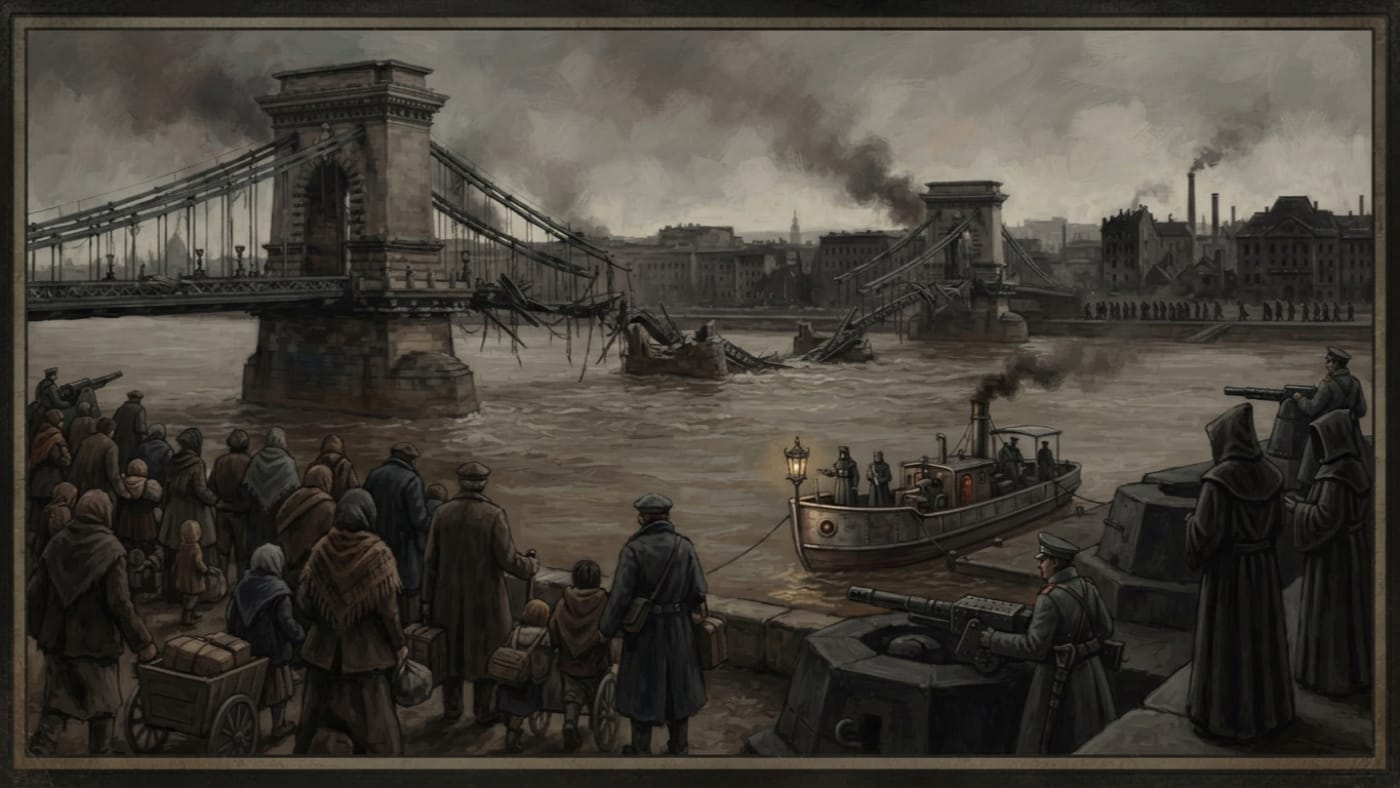
Today the crossing is a row of broken piers standing in the current. The Danube divides the bank the Synod holds from the bank it has declared Vacated. The western shore is a staging ground for the Central Corridor. The eastern shore is watched. The piers stand between the two and belong to neither, which makes them the most honest jurisdiction in the city.
#On the Last Span
Where the order of events is the only mercy the file contains.
The order matters, so I give it in order.
In A.S. 117 the perfume fog came up from Belgrade and lay over both banks for eleven days. It was Velkara's work, a Lust-surge of the Mirror and Perfume Arts, and the scent lingered for months. The Bureau of Purity spent three years testing the air and sealed whatever it found. The bridge carried traffic in both directions that year, and no office yet had a reason to stop it. Rumour has since tied the fog to what later happened in Pest. The rumour has never been confirmed, and I record it only so that the reader knows the fog came first.
Between A.S. 118 and A.S. 122 the Bureau of War took down every bridge in Budapest. Its reasoning survives in the account and is simple. Holding both banks against Velmora's forward agents, with Morwen's pressure seeping up from the south, would cost more than the eastern districts were worth. The local accounts file the episode under the Great Retreat. The broader histories closed that retreat half a century earlier, so I use the name the clerks on the quay would recognise: the Budapest withdrawal, the severing of the eastern bank.
In A.S. 120 Pest's evacuation was declared complete.
From A.S. 118 to A.S. 125 the Mothers of Plenty processed evacuees on the western bank.
The careful reader will see that the last two entries disagree. The same reader will also see that the Chain Bridge was still standing two years after the bank it served had been officially emptied, and that people were still walking across it.
It was the last bridge in the city to fall.
#On the Six Hours
Where iron is credited with what the arithmetic declines to explain.
The demolition charges were set on the fourteenth of September, A.S. 122. The published account gives no hour. It names no officer and gives no weight of charge. What it does give is an interval: after detonation, the Chain Bridge stayed up for six hours.
The Bureau of Engineering attributes those six hours to "superior nineteenth-century ironwork." Note the compliment. Engineering seldom praises anyone, least of all engineers who are dead and cannot be promoted. When an office reaches back a generation to hand credit to strangers, the credit would usually have landed somewhere inconvenient if left alone.
The difficulty comes from the same sums that produced the compliment. Eight hundred refugees were crossing. By Engineering's own calculation, their weight should have hastened the collapse. A span that had already been blown, and that was carrying more than it had carried an hour earlier, should have gone into the river sooner. This one went later. The office that did the arithmetic has never withdrawn it.
The garrison draws its own conclusion and credits the delay to the eight hundred. I set the two accounts side by side and leave them there. I have no technical solution, and I refuse to manufacture a miracle. The Church authenticates miracles through proper channels, with depositions, a tribunal and fees, and I know of no petition ever lodged for the Chain Bridge. The Creator may have taken an interest in that stretch of river. So may the Great Deceiver, whose interest in it was hardly small. So may eight hundred frightened people who did not wish to go into the Danube. The file assigns the six hours to iron because iron cannot be questioned, cannot be canonised, and cannot be listed as transferred.
Six hours is long enough to cross the Danube at Budapest a great many times. The file does not say how many times anyone did.
#On the Eight Hundred
Where a count of the crossing is mistaken by everyone except the Ledger for a count of the dead.
Eight hundred refugees were crossing at the moment the demolition account identifies. That is the whole of the number's pedigree. It counts people in transit. It is not a roll of the drowned or a roll of the saved, and I will not allow either reading in this entry. The account does not give their names. It does not say which way they were walking or how many were still on the span when it fell.
The bridge is registered as destroyed. The people are carried as transferred, destination: pending. The Budapest account credits that entry to the garrison. The Pest account credits it to the Bureau of Records. I cannot reconcile the two and will not invent a form that does. For present purposes the entry belongs to whoever will sign for it, and no one has come forward.
"Transferred" is a verb with two ends. A Mercy clerk who wrote deceased would have needed bodies, or at least a river willing to testify. A Mothers' registrar who wrote received would have needed eight hundred names with crossing writs attached. The garrison wrote transferred because a transfer needs only a departure.
The figure stands beside the larger silence of Pest. Between sixty and ninety thousand residents of the eastern bank remain unaccounted for, and the Mothers' registers have never reconciled them. Their names sit in the Great Ledger under status: administrative review. Nobody has established that the eight hundred belong within that figure. Any clerk who subtracts one number from the other to tidy a column will answer to me.
Corridor manuals describe the eastern bank as "successfully cleared prior to bridge severance."
The eastern bank was declared cleared, in A.S. 120. The last span was severed in A.S. 122 with eight hundred people on it. A cleared bank has no further need of a bridge.
#On the Present Condition
Where the piers remain, and the patrol keeps their count.
What remains is masonry. Broken piers stand in the brown water below the castle hill, and the current parts around them and closes again downstream. A little iron still clings to them, rusted to the colour of the river. Beyond them, four hundred metres off, Pest keeps its sharp roofline, its three surviving spires and its dark windows. On windless mornings the reflection fills in the gap where the span hung, and the crossing appears whole for as long as nobody throws a stone.
Gun emplacements line the western shore. Between dusk and dawn, flat-bottomed patrol boats sweep the reach with reliquary lamps at the bow. Their crews rotate every forty-five days under Quartermaster-General Hofer's authority, because longer postings produce reports. Every sweep passes the piers. A Litany-Engineer sits in the stern and listens to stone and iron as the boat goes by. I have not been shown what the piers say.
The Bureau of Shadows' assessment of A.S. 199 found coordinated movement in Pest and Velmora's assets in three commercial buildings. It revised the unaccounted population upward and kept the classification of Vacated. The assessment says nothing about the bridge. It is the reason the stumps of a crossing nobody can use still lie inside a field of fire.
Western residents are advised under Pastoral Directive 88-E to face west. The piers are the last thing such a resident sees before turning.