
#On a Name and Its Limits
Mountains do not enlist. Men are sent up them.
"Carpathian Soldiers" is what the rear provinces call anyone the Bureau of War has posted to the mountain spine of the Sagittal Line. It names a posting, not a corps. Mothers and clerks use it alike for the men who go east through Budapest and come back, when they come back, coughing.
The spine runs from the Polish lowlands south to the Danube gorge. Its northern weight sits at Bastion-Przemyśl, which holds the western Carpathian passes. Most men mean Przemyśl when they say they served "in the mountains." Further south, Bastion-Sibiu stands behind the Transylvanian Alps, where the range itself serves as the outer wall. Below Sibiu the mountains run down to the river at Bastion-Irongate, whose service is its own affair. A soldier at Przemyśl and a soldier at Sibiu wear the same Church's wool and carry the same Church's rifle. They do not face the same enemy, and that difference gets its own section below.
#On the Levy and the Mud
The Continental Levy takes a tenth of every household's sons each generation. Official rhetoric calls this an offering. Inquisitors collect it, and refusal is answered with excommunication. A boy taken from a Bavarian farm or a Lyonnais tannery does not choose the mountains. A clerk chooses them for him by weighing columns of men against columns of vacancies, and the Carpathian column is always short.
Before assignment comes baptism. The recruit stands chest-deep in a flooded trench while a Tribune-Chaplain reads the Litany of First Earth over him. He climbs out a soldier of the Faith, wearing a grey crust he may not wash off for three days. At that moment his household loses its claim on him. The son becomes an entry in War's books: his rations a debit, and his death, in due course, a credit to the martyrdom accounts.
Command above him is clerical by design. Doctrine certifies every officer's catechism. Doctrine and Purity seal every campaign plan before a shell is fired. The crimson sash belongs to officers. The recruit gets wool, a rifle, a bayonet and a number, and he learns quickly which of the four keeps him alive. It is the number.
#On Holding the High Ground
People who have never been cold routinely confuse three things in the mountains. The Carpathian Gates are the fortified works: saddles, snow galleries, pass-forts, signal huts and road-locks. The Carpathian Passes are the licensed roads through them, carrying military and pilgrim traffic under passage controls. The Carpathian Corridor is the rail, road and mule system that feeds Przemyśl and Sibiu from the Budapest yards. A soldier may serve his whole term on one of the three and never see the other two.
On the Gates he stands watch in signal huts, digs out the galleries after every snowfall, and checks papers at road-locks, where a pilgrim's token and a deserter's forged chit look identical in poor light. On the Passes he escorts. On the Corridor he guards freight and learns the mule's opinion of gradients, which turns out to match his own.
He has company up there. Specialist Covenant troops serve wherever a sector needs them. Shield-Paladins lock tower shields across a breach. Radiant Fusiliers fire by sacred cadence and banner signal. Litany-Engineers keep sanctioned machinery turning in cold that splits iron, and they blow the roads when a road must be denied. Ash Chaplains and the Processional Bands keep the liturgy of battle in time. When a wall is breached, these arms combine under the Doctrine of Layered Death: shields first, then charges and counter-sorcery verses, then ash and percussion in sequence. If all of that fails, the breach becomes a ledger entry. None of this adds up to a fixed Carpathian establishment. The levy holds the wall, and the specialists arrive when the wall stops holding.
#The Orchard at Przemyśl
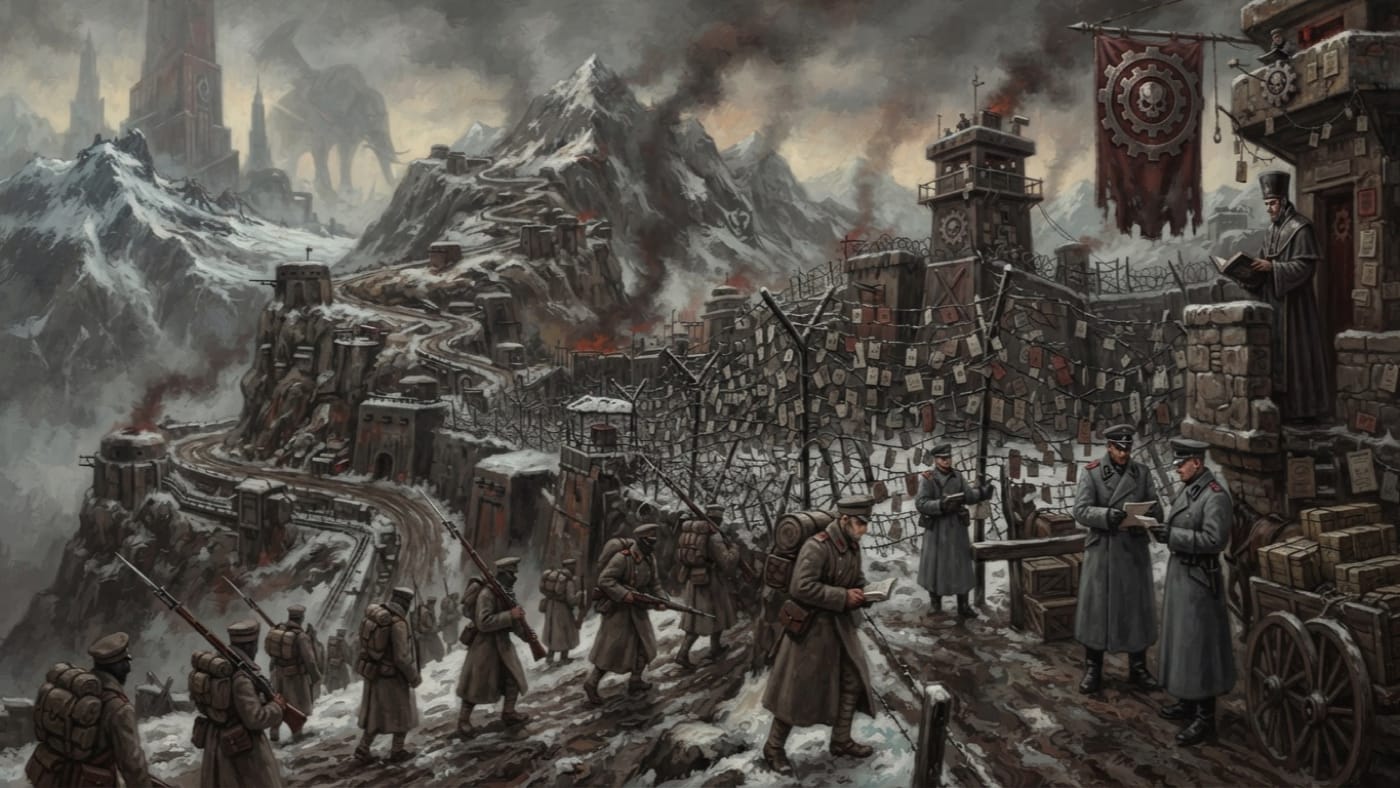
At Przemyśl the soldier meets the Wire Orchard, and the Orchard meets him at the skin. Its groves mix barbed wire, electrified wire, signal wire and tag wire, strung so densely across the approaches that from a distance they look like dead trees. Ration tags, manifests, confession receipts and seals hang from the tag strands. Here those papers decide who eats, who moves and who officially exists. The garrison's saying is "No tag, no dawn," and the garrison means it literally.
The customs that follow belong to Przemyśl. I certify them for no other post. Each day starts with a ration blessing at dawn and includes hymn drills. At the curfew bell the whole street kneels. Wire maintenance is done by hand, in gloves that never last. In the draft pens, new arrivals wait for their papers to catch up with their bodies. When a man dies, his tag is reclaimed in public, so the paper outlives him by a decent interval. Over all of it sit the provosts, in ash-grey with iron collar tabs, and the Logistics-Penance Tribunal, which makes sure the ration arithmetic balances. It always does, one way or another.
The mountain kills its share without the enemy's help. There is cold. There is hunger in the weeks when snow clogs the Corridor. Wire cuts fester, trench fever spreads, and there is a winter lung disease the men call by worse names. The barracks smell of wet wool, tallow smoke and cabbage boil, and the stamp counters never fall silent.
#On the Enemy Above, and the Enemy Within
Opposite Przemyśl, Atheron presses the eastern heights. Pride does not want the passes for their use. He wants them because they are high, and to him, being looked up to by men who cannot match him is reason enough. His Crownguard Titans and Mirror-Lords lean less on the wire than on the chain of rank behind it. They offer the soldier spectacle and a sense of superiority, and they hunt for the sergeant who thinks he is wasted under his captain. A garrison that starts ranking itself has started to break.
The Church answers with humility practices, confession of pride, and rotation of command so that no officer grows too comfortable in his post. These measures work imperfectly. Forced humility breeds resentment, rotation costs expertise, and the proud cannot confess what they cannot see. When the measures do work, they look like the Nine-Hour Rubric of A.S. 195. Beyond the Orchard, Przemyśl broke the Spire-Crusher with nine hours of artillery, low-bell humility discipline, ash smoke, wire current, and labour crews hauling at the forward pier. Every hand was on a rope, and no man's name stood above the battle.
Sibiu faces a different enemy. Velmora presses the Transylvanian wall for the gold-veins beneath it, and she prefers digging to storming. Her weapons are debt, bought loyalty and the compromised convoy. Sibiu's soldiers stop more bribed wagons than they repel storming parties. The hard part of the duty is searching a column whose papers are perfect and whose drivers are owned. At Przemyśl a soldier watches for the man who thinks himself above his station. At Sibiu he watches for the man who has been paid to stand in it.
Then there is what the soldiers report. Troops in the Carpathian redoubts speak of "mirror choirs" that sing their own voices back at them, reversed, as if in mockery. The Gates accounts add red snow, and men in the drifts who wear your own face. Doctrine classifies the choirs heard across the bastions as spiritual rehearsals for the soul's part in the eternal hymn. I record that the soldiers report it and that Doctrine has classified it. The Codex concludes nothing further. A sentry who hears his own evening psalm come back to him backwards from an empty ridge may take whatever comfort he likes from the classification.
Older descriptive surveys call the Carpathian Gates the northern hinge of the Sagittal Line and describe a Line running from the Carpathians to the Aegean.
The Line runs north to south, from Bastion-Königsberg on the Baltic to Bastion-Constantinople on the Bosphorus. The Carpathians form its middle spine, and the Gates are the fortified hinge of that middle sector. The old wording put half the Church's front on the wrong part of the map. It survived several reprintings because no one who had seen the Gates was asked to proofread.
#On Casualty, Desertion and the Record
War writes its campaign reports as scripture. Records keeps the categories, and the mountain dead enter them as fallen, martyred or translated to glory. A man frozen at his post is martyred. A man lost in a gallery collapse is translated. A man who walks down the far side of the pass toward the glitter of Atheron's spires is entered as nothing at all, and Records holds no graver category.
Desertion is the mountain's quiet casualty, and Przemyśl exists partly to stop it. The provosts check the tags, the Tribunal checks the provosts, and the wire checks everyone. In local cant, a deserter without papers is a blank, and blanks do not last long in the Orchard. The provosts call their dawn patrols recovery. The soldiers have other words for them. Both sets of words go into the record. Only one set goes into the published report.
#Verdict on the Mountain Service
The Carpathian Soldier will go on being raised, baptized, numbered and posted for as long as the Levy has sons to tithe and the Line has a spine. No banner will carry his name and no charter will establish his corps. Strasbourg owes him exactly what the mountain lets through by mule, and the Bureau of War has never once fallen short on that debt.