
#On the Northern Guild Corridor
"Procedure song keeps you alive." — public instruction of the Cantor Corps
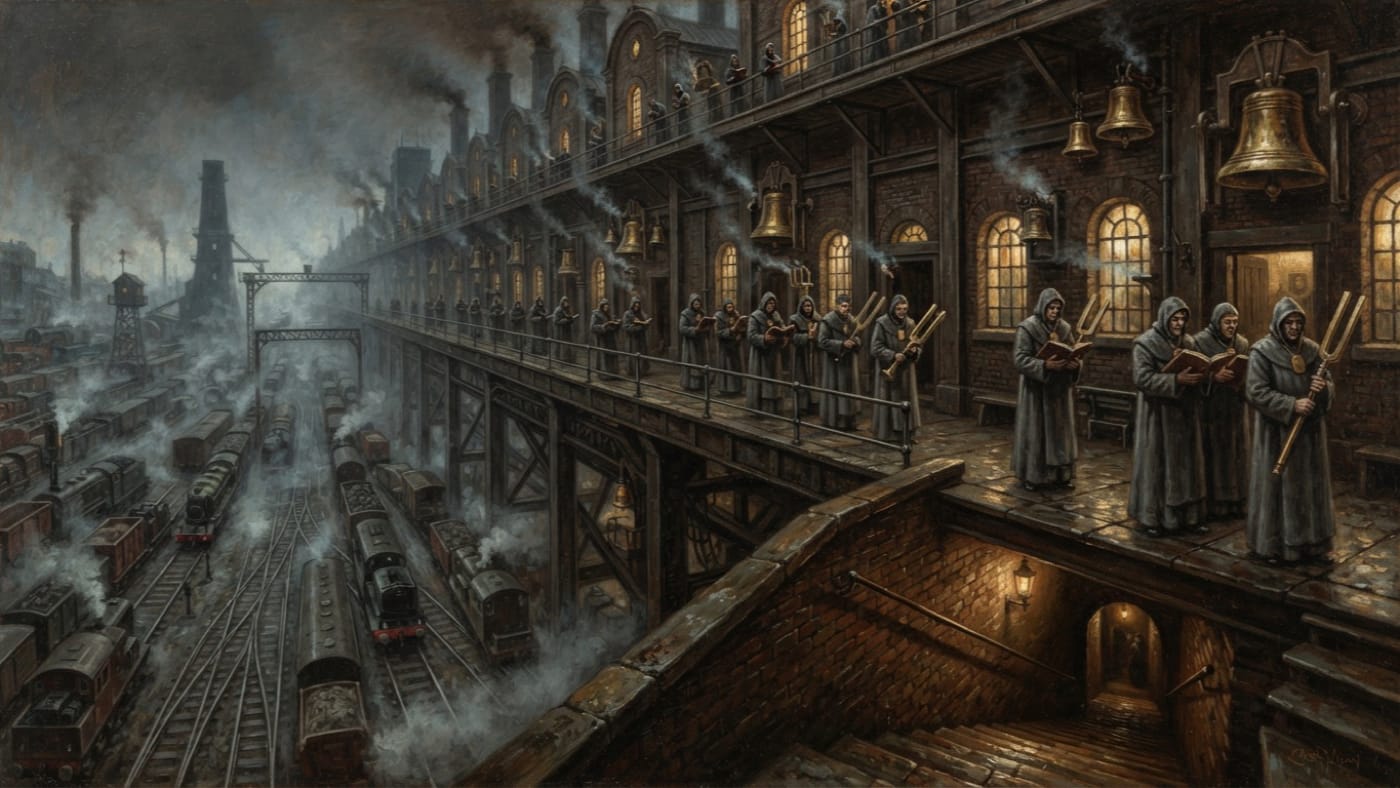
Cantor Walk runs along the northern perimeter of the Palatine Switchyard of Lorn. It is a corridor of guild halls with its back to the slag hills and its face to the rail sea. The bell-line routing cantors keep their instruments here, along with their hymn codes and their low opinion of everyone else. The air smells of incense and machine oil. Wax smoke hangs in the doorways, and the brass is polished so often that it shows the polisher's fatigue.
Anyone who comes expecting a choir school will be disappointed. The Walk is a maintenance district for the voice of the yard. In law, every throw of every switch in Lorn starts as a sound licensed on this street, and the iron below only obeys it. The switchman's arm moves the point, but the cantor's throat is what makes the movement lawful. Take away the throat and the arm becomes a vandal with good timing.
I walked the full length of it twice. The Bureau of Bells gave me an escort for the first walk and a second escort to watch the first. Nobody counted the halls aloud while I was there, so I record no number. The Walk has never given one to the Ledger, and I do not invent figures for institutions that decline to supply their own.
#On the Measures Made Compulsory
None of the registers I was allowed to read gives the Walk a founding year. The city is easier to date. The Bureau of War requisitioned the market town at the junction in A.S. 104 and turned its chapel into a dispatch office before the week was out. By A.S. 110 the First Continental Levy had swollen Lorn into the continent's iron throat. In A.S. 112 a night crew sent a munitions train onto a siding that no manifest admitted existed. The siding ended at a slag wall, and all forty-one men died.
The Bureau of Records filed the disaster as a terrain reclassification error. Bell Marshal Gerren Stahl, the first to hold the title, filed a theology instead: no switch thrown, no signal given and no dispatch ordered without a voiced measure from a certified cantor. If procedure is sung, falsifying it leaves audible evidence. The Yard agreed, and the cantors arrived within a season.
The archive does not record where they lodged that first season, or when the first hall went up on the northern perimeter. The Bell Codex, ratified in A.S. 115, governs the measures sung today. It came after the cantors and gives the street no birthday. I decline to lend it one.
What actually killed the forty-one is still a matter of competing paperwork. Records filed an error and Stahl filed a doctrine. Later analysts filed something else again, and their reports were sealed. I come to them below.
#On Licensed Throats
The Walk belongs to the Cantor Corps of the Bell Marshal. The towers belong to it as well, though the towers are cold and nobody burns incense in them. Bell Marshal Sister-Calder commands one hundred and twelve certified cantors across all of Lorn. That figure is a roster for the whole corps, not a count of who sleeps on this street. Her cantors wear the ash stole and the brass throat tag. The tag is stamped and the stole is unmarked, and a careful eye learns which of the two a forger finds easier to copy.
Instruments are tuned in these halls, and the hymn codes are held under guild custody. The dispatch litany is drilled here until it can be sung half-asleep, as the night shifts require. A Lorn departure needs the full platform crew to sing the route code, the cargo blessing and the procedural invocation in four-part harmony, loud enough for the nearest tower caller to log it. The Walk trains those voices, certifies them and, when they fail, shames them in public. The corps has three tools: certification, ritual and humiliation. It uses all three every day.
The Walk is also where purity checks are kept. I watched one candidate sing a measure three times in front of a seated examiner. The examiner said nothing. The candidate wept on the fourth attempt and passed, and I could not tell whether the weeping counted toward the result.
Sister-Calder keeps a leather-bound register she calls the Missed Measures. It lists cantor failures and their consequences, and its entries go back to A.S. 148. She reads from it at disciplinary hearings and at meals. The book is older than her temper, though only slightly.
The cantors' authority ends where other offices begin. Yard Palatine Odrin Kessel controls priority and throughput. A cantor can sing a flawless measure for a train Kessel has given no window, and the train will wait at the Needle with its blessing going stale. Prefect Halden Wry controls manifests and documentary identity, so a cargo the Walk has blessed in harmony can still be refused by the Manifest Basilica in ink. Together the three make up Palatine Yard Command, which has three hands on one throat and no agreement about which hand squeezes.
Below all of them are the men who actually throw the switches. The Switchmen's Union, known as the Thrown Hand, says its members know the yard, carry the risk and lose the fingers, while the cantors only sing. The cantors answer that labour can be replaced and the voice is doctrine. Each side is correct about the other. The Yard Palatine keeps it that way.
#On the Books That Travel Unsung
The street that licenses every lawful sound in Lorn also prints unlawful ones. Illegal hymnbooks are printed in Cantor Walk. That fact appears in the Yard's own descriptions of the district, next to the purity checks, with no visible embarrassment. I was not shown the press, and nobody named the printer. When asked, the corps said nobody prints anything. It said so in harmony.
The books leave by going underneath the street. The Hush Tunnel Runners carry illegal hymnbooks printed on the Walk, together with forged bell-cards and the brass throat tags worn by cantor impostors. Their smell-guides know a long brick passage beneath the Walk, identified by rat heat: the warm, crowded air of a corridor where something living is always ahead of you. The tunnel and the street are two separate places, and their only shared feature is the ceiling. One registry uses the name Cantor Underwalk. I cannot certify that it refers to the same brick passage, so I do not.
Sister-Calder treats silent movement as an offence against sung procedure. On the Walk, everything moves to a measure. In the brick passage below, nothing moves to one. Her cantors say every unsung passage pushes the yard further out of true. The Runners answer with a proverb: A clean stamp won't stop a bad throw. They have painted it under Cantor Walk seven times. The seventh version included the Bell Marshal's birth name, and she ordered that section of wall cut out and burned.
That name has not reached my desk. If it ever does, it will not reach this page. The Bureau of Shadows keeps a list of men who learned that name, and I prefer to stay off it.
#On Correct Songs and Wrong Routes
The Walk promises that correct song means safe movement. The Hymn-Phase Slip contradicts that promise from the yard floor. A cantor sings the dispatch measure correctly, the tower caller repeats it correctly, the switch throws clean and the signal clears. Then the train arrives at a siding the manifests call empty. Other reports describe switches found in settings nobody set, echoes that repeat a measure late, manifests that smear as if wet, and night crews who say the yard briefly became unfamiliar, as though someone who had seen it only once had rebuilt it from memory.
The Slip is strongest at Tower Nine and the Tri-Span Bridge. The Walk does not produce it. The Walk receives the blame for it, and that is a different burden that is filed in the same drawer. The Bureau of Bells classifies the Slip as a Category Two localized acoustic-mechanical disturbance. Three Bureau analysts, in reports the Bureau of Doctrine has sealed, attribute the Silent Derailment of A.S. 112 to a Slip large enough to move a siding. They name the sealed clock tower in Tower Nine's foundation as the probable source of the resonance. That is their interpretation. No one has dug to check it.
Since A.S. 199, relic-payroll crates logged through the Needle have arrived empty with their seals intact. Kessel produces audits proving the crates were empty. Wry produces stamps proving they moved. Sister-Calder produces tonal records proving every measure was sung without fault. The crates themselves produce nothing.
The Cantor Corps teaches, and this dispatch formerly repeated, that procedure song keeps you alive.
Corrected. Procedure song keeps a record. Forty-one men died on a siding the manifests denied, and every measure sung over the Payroll Spur since A.S. 199 has been flawless. The Corps' instruction is preserved on the halls of the Walk, where it still functions as a hymn.
#On the Present Condition
In the survey year A.S. 201, the Walk goes on as it always has. Instruments are tuned at dawn under bell fog. Candidates weep through their purity checks. Stoles are brushed and throat tags polished. The brick throat underneath stays warm.
Pressure arrives from every direction except below. The Thrown Hand is preparing a slowdown and wants to know how long a sung measure lasts when no arm moves the point. Sister-Calder is preparing a purge, and the Missed Measures has blank pages left. Inquisitor-Regent Veyl Hark is reviewing Tower Nine's bell codes in Strasbourg and is expected in Lorn. Nobody on the Walk has yet set her arrival to music.