
#On Pressure and Obedience
The Canticle of Stable Pressure is a working prayer. It belongs to the field-hymnal repertoire of the Litany-Engineers: mechanical cant, carried in the same satchel as the feeler gauges and spoken over machinery whose needles have opinions. The title tells you its office. A pump labours, a seal weeps, a housing starts to sweat under the lamp, and the engineer reads the gauge, corrects what needs correcting, and then applies the cant. The order is fixed by training and enforced by audit. Calibration comes first and the sanctioned voice second. Verification and the ledger close the work.
The Ledger does not record who composed it. I have looked. No author's name, no year of first authorization and no minute of whichever assembly of greasy hymnodists first agreed its intervals survives in any folio I may open, and I may open a great many. By the time anyone thought the Canticle worth naming in a deposition, it was already in the books. Most useful prayers arrive that way. Saints get biographies. Tools get inventories.
The Bureau of Doctrine teaches that steel has a temper and temper obeys the Word. The motor sheds teach something narrower and harder to preach: certain rhythms, held at certain marks against certain engines, keep the wrong notes out of a machine. Doctrine calls the Canticle obedience. The pump crews call it maintenance. Both parties sign the same log, and a shared signature is the only reconciliation the Church has ever asked of anyone.
#On the Working Page
A field hymnal is an ugly book, and that is how you know it is used. Cathedral prayerbooks keep their gilt because nobody's life depends on them before breakfast. An engineer's hymnal comes back from the trench-line oil-stained and water-warped, its corners worn round by gloved thumbs, its spine cracked at whichever pages the work demands most often. It lives beside the torque wrench and the timing light. A man reaches for it the way he reaches for a spanner, without looking, in the dark, with the pump knocking.
The margins carry arithmetic. The profession's books are known for it: pressure readings scrawled beside a stanza, breath-counts tallied against measures, corrections for wet clay and cold mornings, chalk-dust ground into the gutter of the page. Doctrine prefers to call these devotional annotations. They are field calculations made by men who found that the sanctioned text and the gauge did not always agree, and who chose to write down the difference rather than die of it.
I can't certify what any particular copy of the Canticle carried in its margins. The depositions name the cant. They don't describe a page of it, and I won't make one up to please a reader who wants a relic. It is enough that the Canticle sat in these books, among these figures, in this weather.
#On the Tender Canticle
In A.S. 178 the Synod held a provisional engineering position west of old Odessa, deep in the Charnel Lands, cut through clay, salt and black reed-root. Litany-Engineers were stationed there to keep the pumps, trench lamps, drainage screws, hymn-gaskets and field bells working. The full account belongs to the Weeping Trenches of Odessa, and I will not copy it out here. This tract concerns one cant and what was reported to have happened to it.
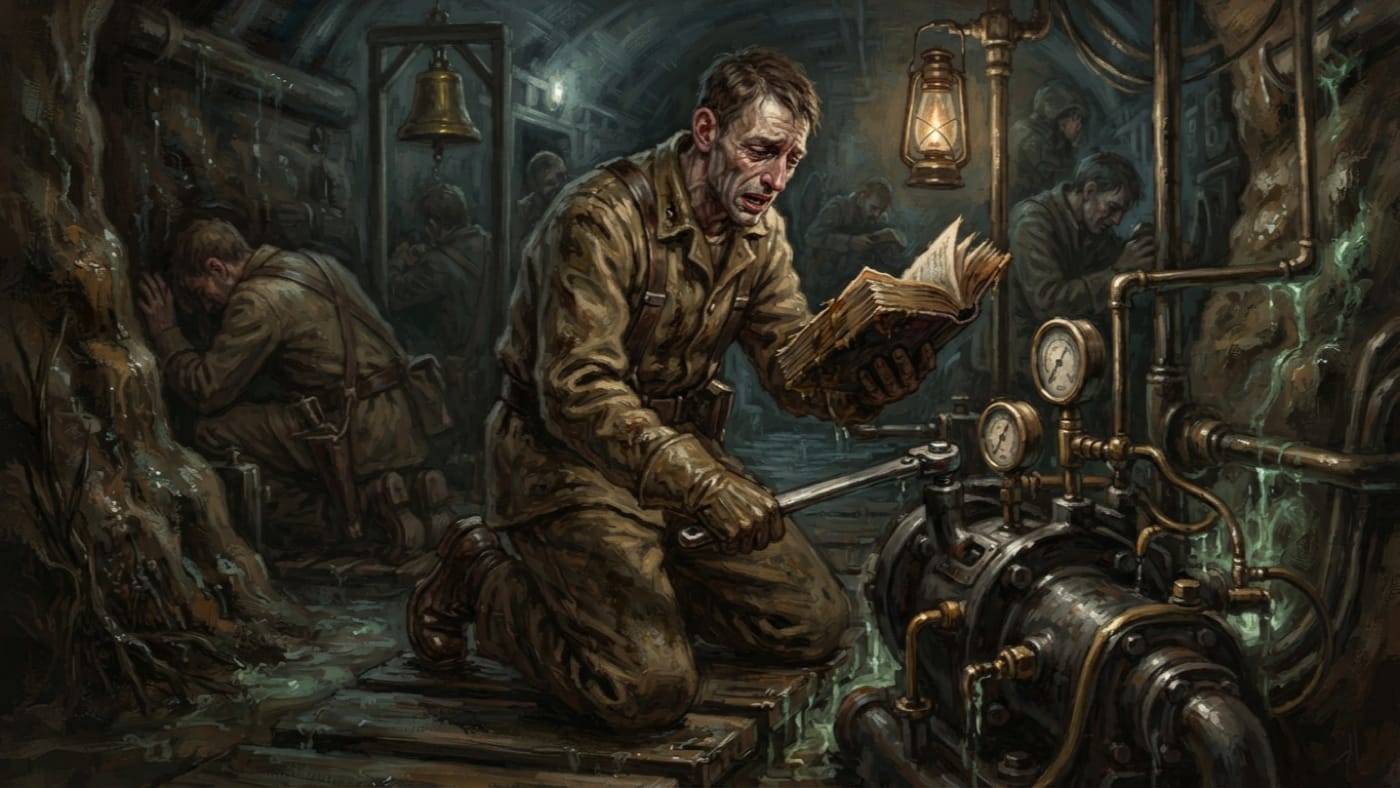
The Pale Chanters were heard before they were seen. Their sound came in through the trench walls and ran along the pump housings and drainage screws, under the boards where tired men slept. The engineers had been trained to answer foreign harmonics with sanctioned ones, so they reached for their hymnals out of habit. The training was sound. The Enemy had read it too.
According to the depositions, the books had gone wrong. The Psalms of Ignition bent toward lullaby, and the closing hymns read like apologies. The Canticle of Stable Pressure turned tender.
Think about what that means for a pressure cant. It exists to hold a needle at its mark. It speaks to metal the way a sergeant speaks to a recruit, and its whole usefulness is that it doesn't give way. The witnesses say that at Odessa it gave way. They describe a working prayer that had begun to sound like something murmured over a sick child at night. Whether the ink moved, or the eyes reading it changed, or both, the record doesn't settle. I leave the question with the Bureaus that are paid to be wrong about it.
Whole companies fell into a sobbing exhaustion. Some men tore pages from their hymnals and stuffed the paper into their mouths. Relief arrived at dawn under bell-cover, and forty-six survivors were examined at first light. Their tongues had been gnawed to ruin by their own teeth.
Pump Engine Three was still running.
Two men had repaired the west drainage screw during the incursion, tightening bolts while they wept hard enough to blind themselves. Their hands kept to the work after their voices had failed. The depositions don't say which page any man was holding when he began to chew, or whether he was singing the Canticle, the ignition psalms or nothing at all. I won't supply the page. Nor will I credit the running pump to the Canticle, though there is a clerk somewhere longing to do exactly that.
Aldric Venn later cited Odessa in a memorandum, since withdrawn, arguing that the cadence in the trench walls followed Covenant field hymns too closely for comfort. I record the argument as his. His subsequent transfer settled where he would work. It did not settle his arithmetic.
The first Bureau of War dispatch described the Odessa incident as "mass panic among auxiliary personnel."
Withdrawn. The personnel were Litany-Engineers on combat rating. The panic was induced from outside. The men classed as panicking had kept a pump running and repaired a drainage screw while it went on.
#On the Reinforced Margins
The response came in pieces, as Synodal responses do, with each Bureau mending the part of the wound it was willing to admit.
The Bureau of Bells ordered reliquary wax issued to forward engineering units. The Odessa survivors kept writing, on slates, that they could still hear the walls through the wax. Bells are a countermeasure, and countermeasures fail. The Bureau of Bells files those failures under maintenance. The Bureau of Engineering revised its trench-wall dampening, added hush-powder to certain clay mixes and asked, in a very small hand, whether pump housings ought to be treated as acoustic conductors. Doctrine answered by asking whether Engineering had considered repentance.
Then Engineering turned to the books.
An addendum of A.S. 179 ordered forward hymnals of mechanical cant printed on heavy rag stock with reinforced margins. The order is dated that year, and the revised hymnals went out to the forward companies only after it, at whatever pace the presses and quartermasters allowed. According to the public procurement language, the purpose was durability in wet conditions. The internal purpose was that a man who tore and chewed his book in extremity should be able to do it without destroying the whole page of cant.
The addendum, as recorded, deals with paper and margins. It says nothing about the words. No replacement text for the Canticle appears in it, no cure for the walls and no promise about tongues. Engineering changed the book so that it could survive being eaten, and left the prayer as it stood.
#On the Damaged Books
The relief column's hymnals were kept. The Bureau holds them in a drawer, with the bitten pages catalogued by stanza and some still marked by teeth. One leaf carries a whole pressure calculation in saliva-darkened graphite, written around a missing Psalm of Closure. Some will want that leaf to belong to the Canticle, because the figures concern pressure and sentiment likes a tidy relic. It doesn't. The catalogue says Closure, and I am not in the business of improving catalogues for the sake of a better story.
The Bureau of Records filed the injured under "voluntary disarmament of the tongue." Each word in the phrase can be defended. The teeth were the men's own, which makes it voluntary. A Litany-Engineer without a tongue has lost half his issued kit, which makes it disarmament. Records names the organ and leaves the cause unnamed. Doctrine declared the same men martyrs. Both entries were sealed, and neither Bureau found the other's entry inconvenient.
The survivors who went back to maintenance work could still read a gauge, set a valve and torque a bolt to its mark. They could not apply the cant. The ledger close requires numbers, a cant code and a witness signature, and that left a column in every maintenance log that they could no longer fill in their own voice.
Pump Engine Three was logged serviceable. There is a column for that.