
#On the Recorded Canticle
The Canticle of Restraint comes into the Ledger through one occasion and one locked room. A shrine-barge was on station near Pressburg on the Danube when the order of the Cadence Reforms came aboard. Its gun crew rejected the order. The choir conductor on duty, Sister Margit of the Fourth Hymnal, then sang the Canticle for eleven hours. That is the whole of the occasion. It is preserved in the Reform account, and the Codex repeats it as a reported account, with its seams showing.
The file says nothing more about the song itself. Composer, words, notation, mode, stanza count, the office that licensed it and the year it was first sung all lie beyond the record. Singing the Canticle does not make Margit its author, and the Ledger declines to promote her into one. The name "Fourth Hymnal" comes attached to hers. The account does not say whether it names an order, a choir unit or a numbered book, and I shall not invent the answer for it.
The file carries A.S. 95 because the Reforms carry it. The order arrived and the mutiny followed. No month or day survives in the account, and the number dates the quarrel, not the hymn.
What remains is use, and use is what concerns this office. A song is only a sheet of ruled vellum until somebody sings it at the wrong men in the right room.
#On the Powder Sanctum
Every shrine-barge keeps its powder in a sanctum, and every keg in it is counted twice, because the First Floating Cathedral Burn taught the river what unlogged powder does to a shrine-barge. Kegs, shot stores, slates and wax all sit in that one compartment, which is both the platform's purse and its pyre. Whoever holds it holds the guns' next hour.
The Pressburg gunners understood this perfectly. They meant to seize the shot stores and force the old drill back onto the deck: fire by sight-line, by temper, by the captain's say, and send the choir back to decorating embarkations. The account first has them entering the sanctum and then places them outside Margit's locked door. It does not say how the threshold changed hands between those two sentences or how the door was fastened. The Ledger records both sentences and rules on neither.
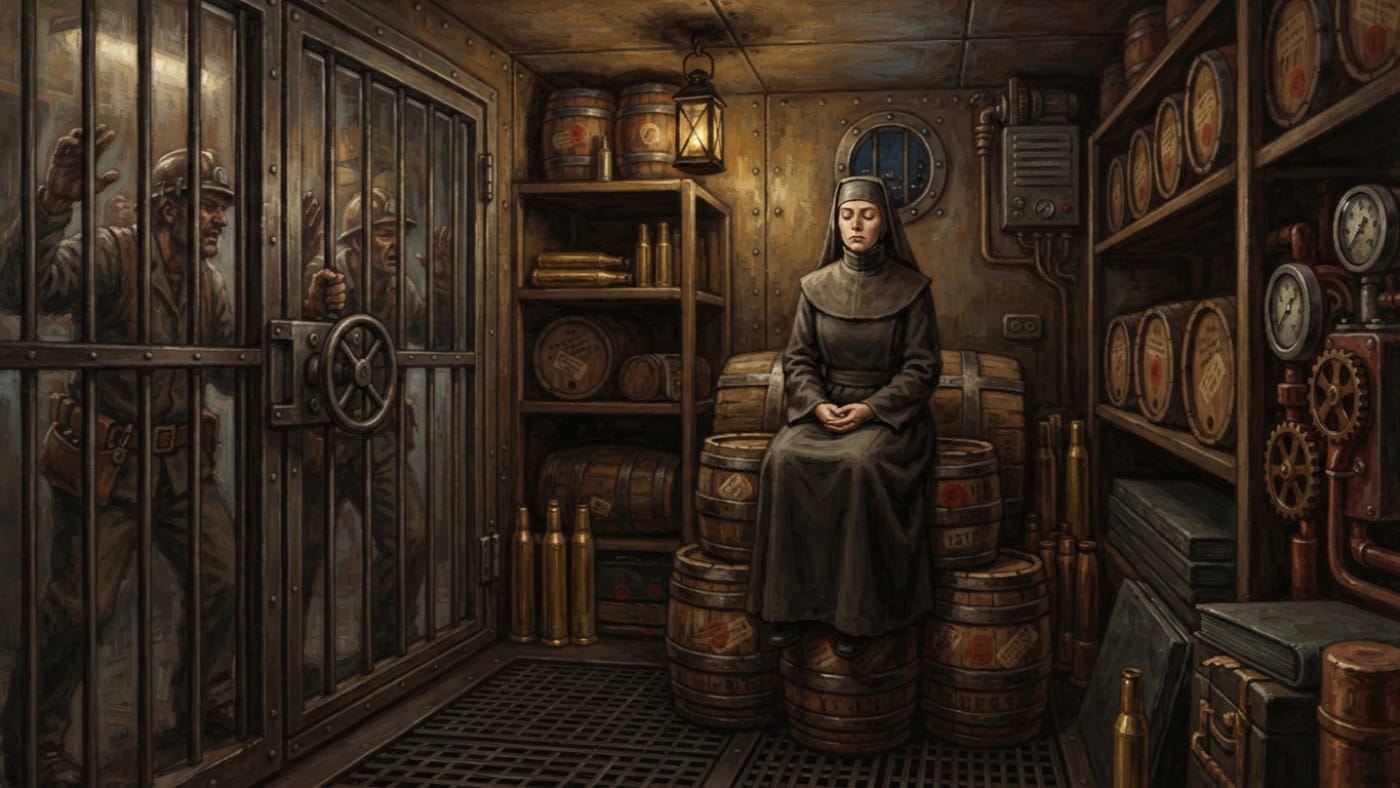
What it does record is this. Margit locked herself inside with the powder kegs. She sat on them. She sang the Canticle of Restraint for eleven hours. The report notes that she had water, a stool and an "uncooperative calm." It seats her on the kegs and gives her a stool in the same breath. I leave the furniture question to the auditors, who have time.
Outside, the mutineers shouted, argued, threatened, prayed and cursed, which is the full liturgy of men who have mislaid their plan. The account records no threat from Margit against the magazine, no bargain and no sermon through the keyhole. None was needed. A gun crew may storm a choir stall without consequence. Storming a sealed magazine with a singing conductor seated on its contents is another calculation, and the gunners, whatever their limits as theologians, could count kegs.
They surrendered. The report puts the surrender down to acoustic exhaustion. I accept the phrase. It manages to be clinical and insulting at once.
#On the Measure
Why should a gun crew care who keeps time? Because before the Reforms recoil kept it for them, and recoil is a poor clerk. Batteries fired against the choir beat, deck plates split and mortars shook loose into the hold. After enough of these desynchronisations the Synod concluded that a shrine-platform must have one measure or none. The Bureau of Engineering supplied the recoil tables, Orison supplied the singers, and the war administration supplied the resentment.
The settled drill of the Shrine-Deck Crew has six steps:
- Sanctify the ward line.
- Tune the cadence to the metronome bell.
- Load by measure.
- Fire on the sanctioned toll.
- Log the shot at once.
- Purge the residue.
Powder and shot are tied to hymn-bars. A volley lands on a toll or it does not land. During an active sequence the Cadence Caller held the timing. The Battery Steward commanded the gun crews, but only within the measure. The Ordnance Deacon held the authorizing seal. The gunner, the proudest man on deck, found himself fourth in a chain whose first link was a small brass bell.
Seen from that ladder, the Pressburg seizure was a dispute over loading, nothing grander. Shot that gunners take from the sanctum on their own word is shot loaded outside the measure, and a volley without a measure is just the old disorder again. Seize the stores and you seize the clock.
The account gives Margit's place in this ladder plainly: conductor. It gives her no other rank, and neither does the Codex.
Nothing in the file makes the Canticle of Restraint a loading hymn, a firing hymn or part of the platform's ordinary battery repertoire. No gun was being served in that sanctum and no toll was struck. Whatever the Canticle was written for, its recorded work at Pressburg was the opposite of a volley: a measure kept for eleven hours in a room where nothing was allowed to discharge. Its title is the only commentary it left, and that is enough.
#On Commendation and Initiative
Having lost on the deck, the mutineers appealed to paper. Their formal grievance cited "unreasonable vocal endurance." It was denied. I have read many grievances in my years at the Ledger, and few confess their author's defeat so candidly in the first clause.
The account reports what followed. The gun captains were reassigned. Two went to static wall batteries, where the stone does not move and nobody sings. One spent eight years in Mercy convoy service. These details belong to the Reform account alone. The occupational record does not repeat them, and the Codex gives them on that account's authority.
Sister Margit received a commendation sealed under Orison. She also received a private warning for excessive initiative. Both are entered, and neither cancels the other.
The commendation paid for the eleven hours. The warning priced the precedent. A conductor who holds a magazine against a gun crew in defence of Synodal order is useful. A conductor who has discovered that she can hold a magazine raises a question the Church would rather nobody asked aloud. The Bureau took the victory, wrote the Reforms harder around it and filed a quiet note against the woman who had won it.
A pious later account holds that Bureau of Oaths negotiators resolved the Pressburg Mutiny by sworn compromise.
The Reform account is explicit: no Oaths delegation was present, and no compromise occurred. The gun crew surrendered to a locked door and a conductor who did not stop singing. Credit is withdrawn from the negotiators. They may keep the oath they never administered.
#On the Inheritance
After Pressburg the Reforms hardened, and the hierarchy they fixed became working law on every shrine-deck. The Pilgrim's Ladder Commission of A.S. 110 took choir-timed barrage onto rails and into crowds. The Processional Arsenal made the arrangement so ordinary that crews curse it without remembering what it replaced. The Reform file names Margit as the precedent, and on paper that is all she inherits.
The Canticle inherits even less. No record before the Ledger shows that it was later made compulsory, given a feast, written into drill or sung again on any platform. Its absence from later files proves nothing about what became of it, and the Codex will not compose an ending for it.
Crew devotion found its icon later, in Saint Orla the Brass-Throated, who was canonised for singing through a deck fire to keep the timing. Careless pilgrims must not merge the two women. Orla sang so the guns would fire on the toll. Margit sang in a room where nothing was to be fired at all.