
#On the Nature of the Instrument
"Every flock requires a shepherd. Every shepherd requires a man behind him whose name he does not know."
The Canonical Audit is the instrument of the Seal of Discipline. Of the Seven Seals of Faith, Discipline is the one that looks at the clergy. Doctrine looks at the faith and Purity looks at the faithful. Discipline looks at the cassock, the sacristy and the priest's own side of the confessional screen. The constitutional record gives its domain as scandal, concealment, and the orderly disposal of inconvenient confessions. The Audit is how that domain acts. It is an investigation, and it is conducted in sealed chambers. Those two facts are the whole public statute, and I have read the public statute more often than its authors did.
The Seal works inside the framework settled at the Concordat of Strasbourg in A.S. 90. That was when the Bureaucratic Synod took its formal shape and the domains of absolute authority were divided among the Hierarchs. The Ledger does not say when the first Audit was convened, who convened it, or which unfortunate it examined. I have looked. The Ledger stays silent on the point with a consistency I would admire in any of my clerks.
#On Those Who Answer to It
The Seal's jurisdiction runs from the lowest parish Street-Vicar up to the Archons of the provincial tribunals. Between those two ranks stands the whole clerical body of the Church. That includes the confessor who hears too much and repeats it, and the procurator whose tithe-roll will not balance. It includes the tribunal clerk who loses a writ in exchange for a cask of Moselle. It includes the Archon who decides that a provincial sentence need never trouble Strasbourg at all. The laity fall outside it. A cobbler who blasphemes belongs to the Bureau of Purity, and the Bureau of Purity is welcome to him.
The constitutional arithmetic is explicit. The Bureau of Doctrine defines truth. Purity enforces it. Discipline punishes those who enforce it incorrectly. A clergyman can therefore be examined from three directions at once. Doctrine asks what he taught, Purity asks what he tolerated, and Discipline asks how he did either. Being exposed to the third gives him no shelter from the first two. The Seals overlap by design. The architects meant a priest to stand exactly where that overlap leaves him.
So a man who holds a writ, a seal, a pulpit or a confessional key has made himself answerable twice: to the Creator, and to an investigation whose investigators he cannot name. The Creator, at least, is listed in the catechism.
#On the Sealed Chamber
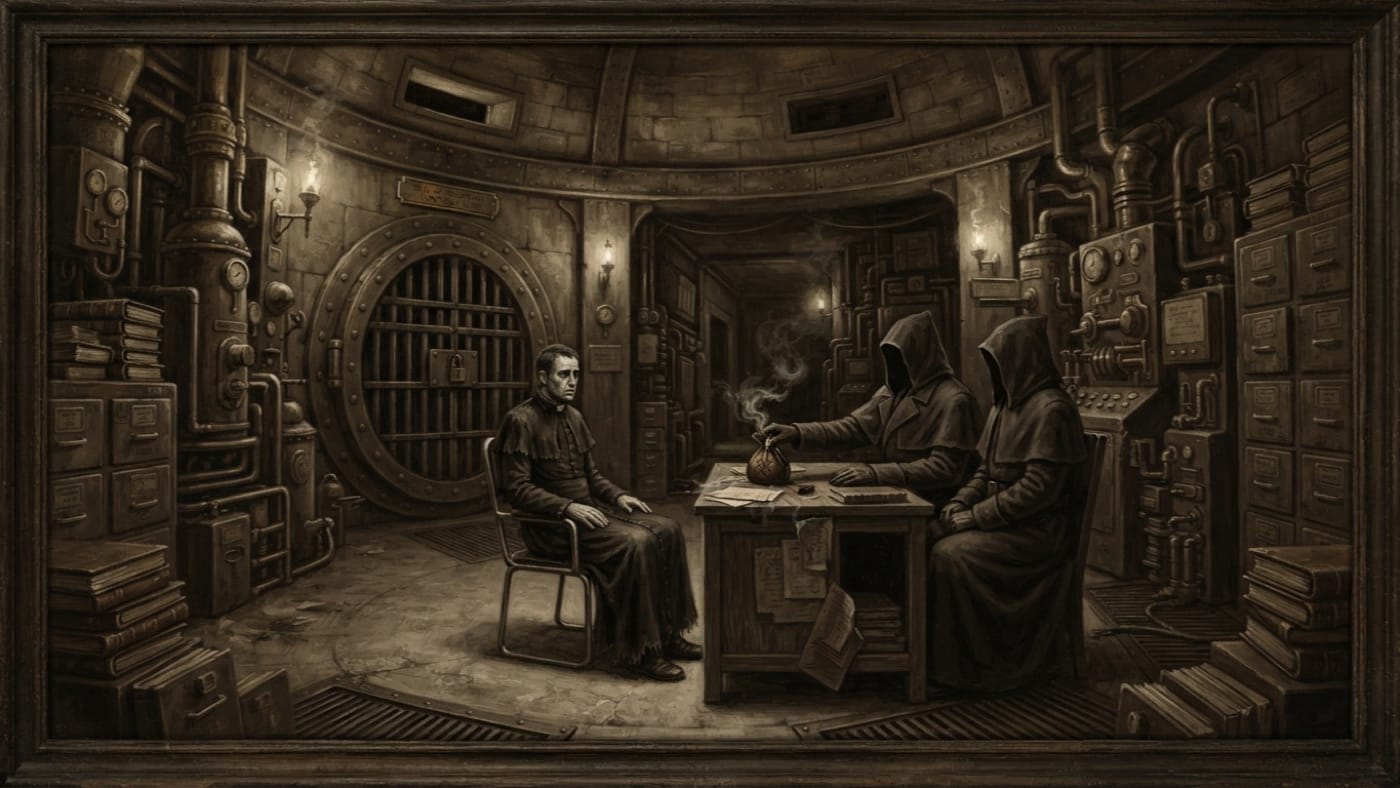
The Audit is conducted in sealed chambers. I am not authorised to say where they are, which is a polite way of admitting that I do not know. The Basilica of the Ledgered Saints has vaults beneath its vaults, and the precincts of Strasbourg Cathedral hold more locked choir-stalls than choirs. Any of them would serve. No one has shown me which.
The investigators' names are withheld even from the Bureau of Records.
I give that sentence a line of its own so the reader can sit with it, as I have had to. The Bureau of Records holds the baptismal entry of every infant christened under the Church's rite. It holds the tithe history of every parish that has ever paid one. It holds confessional summaries of persons who believed their confessions went unrecorded. It holds my own file, which I have asked to see twice and been shown once. It does not hold the names of the men who conduct the Canonical Audit. A Synod that records everything has created one office whose occupants it has agreed to forget.
Beyond that the statute says nothing. It does not say how many investigators there are, or whether they serve for life or for a single inquiry. It does not say whether they are ordained, or whether the Hierarch of Discipline knows their names or has merely been assured that someone does. Every clerk in the Basilica has answers by the third glass. I decline to enter tavern arithmetic into a codex that bears my seal.
The difficulty is professional before it is theological. An investigator without a name cannot himself be audited. The clergyman he examines cannot know whether his examiner was his rival, his confessor, or the curate who borrowed his good boots and never gave them back. And the Ledger exists so that every act of the Church has a hand to answer for it. Here it is left with a column of acts and an empty column for the hands. Discipline watches the clergy, and by statute the record of who watches Discipline is blank.
#On the Pouch
The findings of a Canonical Audit are delivered in wax-sealed pouches. The pouches destroy themselves when opened. The Bureau of Engineering designed the mechanism. The Bureau of Engineering does not discuss the mechanism.
Those four sentences are all the constitutional record says. I have written to Engineering on the subject three times, on the proper forms with the proper countersignatures. I received three acknowledgements of receipt. Each thanked me for my interest in the Bureau's work, and none mentioned a pouch. Engineering is the only Bureau in the capital whose silence arrives on letterhead.
The record says the pouch destroys itself. It says nothing about what becomes of the finding inside. A hasty reader will assume the finding dies with its container. A careful reader will notice that the statute speaks only of the pouch, and that a pouch which destroyed its contents before anyone read them would be a very expensive way of sending nothing. The record also leaves open how long the recipient has: a minute, a breath, or as long as he likes. It does not say whether a fair copy lies in some sealed chamber, or whether whoever breaks the wax should first step back. Engineering has not said. I will not say it for them.
It does not say who receives the pouch, either. The Hierarch of Discipline is the obvious candidate. The obvious candidate is not named.
Consider the instrument as a clerk must. A finding of the Seal against a clergyman carries the full constitutional weight of an absolute domain. It travels to its reader in a container built to stop existing at the moment it is used. The verdict arrives, and the vessel that carried it does not survive the arrival. I have spent my whole career insisting that a document without provenance is a rumour with a seal on it. The Seal of Discipline has apparently reached the same conclusion, and decided that a rumour with a seal on it is exactly what it needs.
#On the Third Hierarch, Who Is Not an Example
"The moths have not been questioned."
The Third Hierarch of the Seal of Discipline is the first great absence in that Seal's succession. The Bureau of Records insists that his file was destroyed by moths in the sub-vaults during the damp winter of A.S. 112. His portrait in the Hall of Succession keeps its frame and its nameplate. The canvas has been painted over in ecclesiastical black. Three investigators were assigned to the matter. All three were later reassigned to duties the Bureau describes as "contemplative."
I place the episode here because every honest reader will connect it with the Audit, and no document I can find makes that connection.
The three investigators assigned to the matter of the Third Hierarch made up the first Canonical Audit of record, and their findings were delivered in the customary pouch.
The Warden struck this before sealing. The record calls them investigators assigned to the matter. It does not call them Auditors, does not put them in a sealed chamber, and does not mention a pouch. An inquiry touching a Hierarch of Discipline does not thereby become a Canonical Audit, however much the shape of the thing invites the comparison. The Warden regrets accepting the invitation.
What remains can be stated plainly. Records attributes the destruction of the file to moths, and I record that Records attributes it to moths. Moths are a real nuisance in the sub-vaults; they have cost me a binding of bell folios. As a rule, moths do not paint canvases black. Somebody decided the face should not be seen, and somebody else decided the frame should stay on the wall. The record does not say whether those were the same somebody.
The three investigators' contemplative duties are not specified. No verdict was published and no culprit named. The record states no cause for the Third Hierarch's absence, and I have been given none to enter. The Hall of Succession keeps the frame polished.
#On the Present Application
The Audit continues. I know this because the Seal of Discipline continues, and a Seal without its instrument would be a stamp without ink. Street-Vicars still preach under its jurisdiction, and Archons still pass sentence under it. Somewhere in a sealed chamber, investigators whose names Records does not hold are examining a clergyman who does not know he is being examined. Or no one is examining him today. He cannot tell which, and neither can the Ledger.
The Street-Vicar reading this entry should not try to work out which. The Warden has tried. The Warden now keeps his own accounts with particular care, and returned the boots.