
#On the Severance
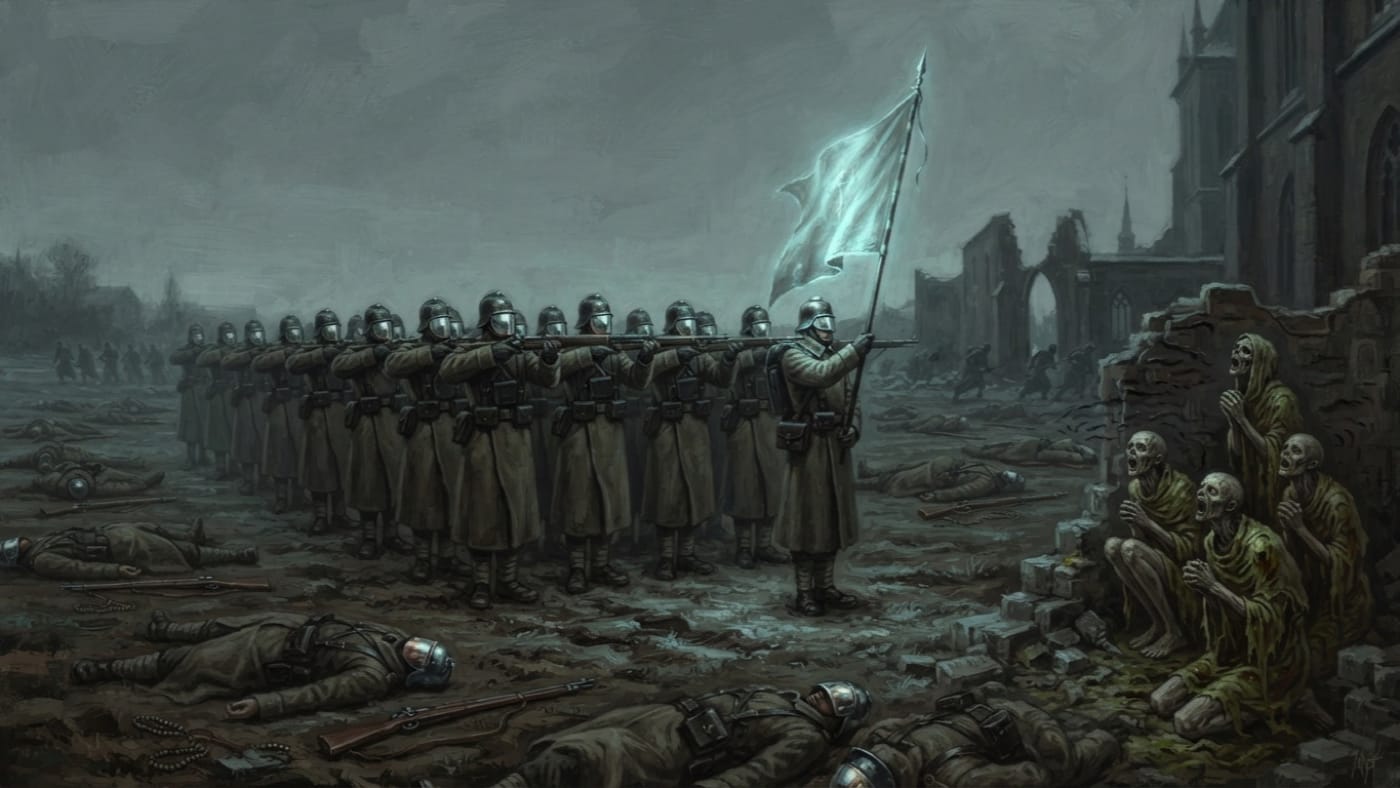
Cadence severance is the Bureau of Bells' name for a failure that ought to be impossible in a disciplined line. The order is given and the order is heard. The soldier takes it in as cleanly as a sealed writ passed across a desk, and every visible part of his drill holds: rifle shouldered, black glove at the trigger guard, breath regulated, eyes on the banner. Then the act that the order was written to produce never comes.
Keep the phenomenon apart from its cheaper cousins. A deaf man never received the order. A coward received it and declined. A mutineer received it and argued. An unconscious man has no drill left to keep. The severed Fusilier is none of these, and every Bureau that tried to file him under one of them has had to withdraw the folio. He keeps his posture, his aim, his fear and his obedience. He does not fire.
What has been cut is the passage between command and act. That corridor is so narrow that no catechism before Prague troubled to name it, since nobody supposed the enemy could walk into it. Bells named it afterward. I do not propose to explain it. Explanation is the business of offices that have a budget for being wrong.
#On Banner and Counter-Hymn
A line of Radiant Fusiliers does not watch the enemy. It watches the banner. The consecrated cloth presides over the ranks, and the mirrored plates on every helmet throw its light back into the eyes beneath, so a man sees holy cloth doubled and trebled until it crowds out everything else. In ordinary use the banner flares and the first volley answers. It dims and the second follows. When it blazes white, the third volley belongs to the Creed entire. To fire out of order is heresy. To fire alone is damnation. Generals have been executed for anticipating the cadence by a breath, and I have never heard a Fusilier complain of it.
The system works because the man inside it need not decide anything. The banner decides. The cue enters, the drill receives it and the finger follows, and the volley lands with the authority of a sealed decree whose clerk never had to read it. This economy of will is the Fusiliers' glory, and it is also the exact seam the counter-hymn found.
The Pale Chanters are the Shadow Court's choir, if one is generous with nouns. They are emaciated things in bile-soaked rags, with ruined throats and ulcerated tongues, and their voices are bone-scrape more than song. Soldiers who have stood within reach of them describe sudden hollowness rather than terror: the rifle is still there, and the wish to lift it has gone. Instruments of Purity's Iron Choir have recorded the vibration in helmets, in trench walls and in marrow. The Bureau of Doctrine holds that the Chanters' voices are sorcery. Engines & Furnaces answers that the chants align with certain subterranean acoustics. A redacted line in Records suggests they may be our own songs returned to us crooked.
#On the Prague Evidence
The principal evidence comes from Prague, in A.S. 167 (1877 CE). The full account of that night belongs to the Night of Silent Steel, and readers with stronger stomachs and more leisure may go there. This tract takes from the event only what the definition requires.
A Radiant Fusilier regiment stood in three ranks on the eastern seminary field. Seven Pale Chanters occupied the ruined seminary across the ground. The parent account says they sang an inversion of the Kyrie Eleison. Doctrine's approved phrasing prefers "a counter-hymn bearing superficial resemblance to the mercy prayer," and I reproduce both because I am paid to. The banner rose and the command to fire was given, and no opening volley followed. The enemy advanced into the gap where the volley should have been.
Forty-three men died without discharging a round. Forty-three rifles were recovered still loaded, and forty-three cartridge rosaries were recovered intact, every bead accounted for. That figure counts the dead and what was taken from them. It is not the strength of the regiment, and anyone who quotes it as such will find my correction waiting in his file. Eleven bayonets were blooded in the close fighting that followed. The record does not say whose hands held them, and I will not supply the names. Those bayonets matter here for a narrower reason: they show that the severance at Prague did not freeze the hand forever. Something passed from command to act once the steel was close enough to need no cue.
The Lore Book's shorthand says the men "simply forgot to fire." As a summary for the laity it will do. Survivor deposition 17-B, taken from a Fusilier whom the file leaves unnamed, is more exact:
"I remembered the command perfectly. I remembered the rifle. I remembered my finger. I could not remember what firing was for."
Note what the witness still had. The command, the weapon and the finger were all present, and only the purpose was gone. Another surviving deposition records a man who heard his childhood chaplain instead of the enemy. That is one man's testimony about his own ears. It is not a diagnosis of the regiment, and this office does not stretch a single witness across forty-three graves.
#On the Recorded Cause
The public papers call Prague a command miscommunication. The phrase is elegant, and it is false in the way that the best Bureau phrases are false: every word is defensible and the sentence is a lie. The command did not miscommunicate. It arrived. The A.S. 168 review says as much in internal language, placing the failure in the passage between obedience and act, past the point where any trumpet, officer or wet cartridge could be blamed for it.
The Bureau of War tried the material explanations first, as offices do when the immaterial one would cost them a doctrine.
Cadence severance at Prague is attributable to trumpet delay, wet powder, and smoke interference on the seminary field.
All three were withdrawn. The trumpets sounded on time, the recovered powder was dry, and every surviving man had seen the banner rise. The loaded rifles that War offered as proof of a powder fault are the best proof against one.
The severance should also be kept off neighbouring shelves. Prayer-jam is the Engines term for what happened at Vienna, where Chanters sang through the sanctified peals and bent the bell-tones until the defence rang false. There the signal itself was corrupted. At Prague the banner rose clean and the command was spoken plainly, and the failure began only after both had been received. Silence Domes, for their part, smother sound and meaning together. The Prague field was not silent. The steel was. All three conditions attack coordinated action, and no Bureau has shown they share one cause. Until one does, I keep them in separate drawers and lock all three.
#On Correction and Continued Use
The A.S. 169 revisions (1879 CE) are the part of the matter that produces paperwork. The Bureau of War introduced hostile-song interruption drills, in which recruits load and fire while hired choirs hum wrong intervals behind canvas screens. The Bureau of Bells added a banner-tone anchor, a sanctioned sound tied to the rising cloth, so that the cue arrives through the ear as well as the eye. The Bureau of Doctrine forbade the soldiers' phrase "the day the Creed went silent." That ban has guaranteed the phrase a long life in every barracks that received the memorandum.
Look closely at what the addendum asks. For a century and more the cadence tables taught that a volley out of order is heresy and that a man must wait on the cloth whatever his own heart says. Now the same tables tell him to fire when the cue reaches him empty, and to let the finger act where understanding has gone. One may call this a contradiction, or one may call it the original doctrine with the sentiment scraped off, since the Fusilier was never asked to understand the banner, only to answer it. The tables do not say which reading governs, and no office has settled when a man's emptiness counts as a cue and when it counts as a breach of cadence. I leave the matter as the seals left it.
None of these measures has been certified as a cure. Bells are the catechism's answer to the Chanters, and Vienna showed that bells can be bent. An interruption drill trains the hand in a hall with screens, under conditions the Bureau chose. The banner-tone anchor adds a second cue, and a second cue can be severed as easily as the first. What A.S. 169 produced was training. It did not explain what happens inside a man when command arrives and finds no purchase. Doctrine holds that it is the Great Deceiver's work set to music, while Engines holds it is a matter of resonance, and the Creator has not yet filed an opinion with either office.