
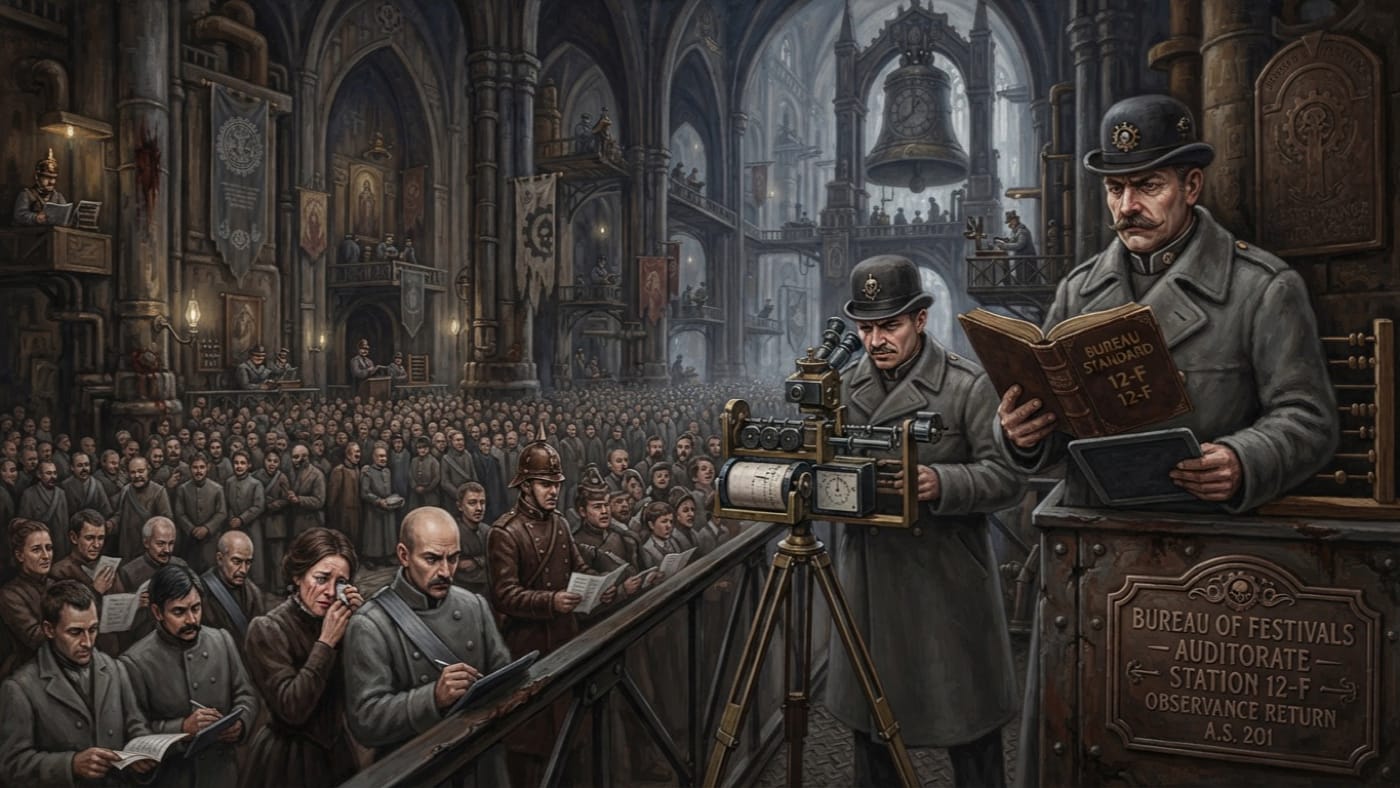
#On the Authority of the Standard
"Feeling is private. Its evidence is public property."
Bureau Standard 12-F carries the full title On the Measurement of Public Sentiment Through Observable Behavioural Indicators. It belongs to the Bureau of Festivals the way a cane belongs to a schoolmaster. Every Attendance Auditor keeps a copy beside his slate and counting frame. With it, a festival becomes a return: something that happened becomes something that is owed.
Joy was rationed long before anyone audited it. In the provisional years after the Sundering, the Church governed by council and improvisation, with no Concordat behind it. In A.S. 52 a priest in the ruins of Cologne declared a feast because a barricade had held. By A.S. 58, festival governance had a place in the Charter of Prescribed Observance. By A.S. 72 the Bureau had a seal and a budget. Once morale had a budget it needed a measure, as surely as a late bell brings a fine.
The archives I am permitted to open do not say when the Standard was first issued, by whose hand, or over whose seal. I record it as I find it. It was in use in A.S. 201 at every sanctioned observance I attended. A.S. 201 is the year of my survey and not the year of the Standard's birth. Any clerk who copies it into a provenance column will be corrected in red.
#On the Observable Indicators
"The face is a form. Fill it in."
The Standard assigns numerical values to smiling, cheering, weeping, kneeling, singing and thirty-seven further behaviours. That makes forty-two by arithmetic. The full schedule is withheld below Auditor grade, and I will not rebuild it from tavern rumour. A Codex that invented the forty-third behaviour would deserve to be scored for it.
The Auditors' own field account preserves some detail on the five named entries. A smile that shows teeth is scored apart from one that does not. Two knees outrank one, unless the kneeler is visibly lame. In that case a supplementary table applies, and the Auditor must decide from across a square whether the leg is lying. Weeping is proper at grief observances and suspect at a victory salvo. At a harvest rite it goes into a column headed Unexplained. Singing is judged on volume, on pitch and on the second verse. Anyone can mouth the first verse, so the second sorts the faithful from the merely present.
Observe the mechanism. The Auditor never records that a woman is grateful. He records that her lips parted, that her knees met the stone, and that she knew the words about the harvest of the righteous. The Standard then does what Doctrine has always done with evidence and treats the outside of a person as a sworn statement about the inside. Teeth become testimony. A bent knee becomes a deposition. The Bureau calls this inference. I call it theology with a counting frame, and I have put my seal to worse.
At the close of a festival the scores are added together, and the total places it in one of three classes. Spiritually Productive is the target. Insufficient in Zeal requires remedial action. Excessive in Spontaneous Emotion requires notice to the Bureau of Purity.
#On the Paired Return
"Two slates, one figure, no appeal."
A festival has three officers, and only one of them is paid to stand still. The Chorus-Master shapes the performance. The Pageant Captain moves the bodies that carry it. The Auditor records how it is received. The Chorus-Master's work becomes the Auditor's evidence. When the baton lifts for the communal kneel, the kneel either comes or it does not, and the slate records which. So the Chorus-Master writes the very behaviour by which his district will be judged, and by which he will be judged if it fails.
According to the corps' field account, Auditors work in pairs. The senior takes the head-count and the absences. The junior takes the behaviours. These are separate quantities, because a full square can be a dead one. An absence from one of the mandatory observances goes beside a name in the Great Ledger and stays there. At the dispersal bell the two men compare slates in the nearest doorway. Where their figures disagree, the lower enthusiasm score is entered. I have not found that rule as a numbered clause of the Standard. It is the practice of the men who carry it, and practice outranks clause in every office I have known.
The reconciled figure goes to the district office, where deviations are reported against the Joy Compliance Index. From there it goes to Strasbourg, and from Strasbourg to whichever office can use it. Tavern returns go to the Censorium of Taverns under their public heading, devotional levity allocation, which has replaced the older phrase since A.S. 199. The figure starts on a slate and ends on a desk where someone owns tongs.
Several entries in this Codex have directed readers seeking the Festival Attendance Auditor to the Sky-Sermon Attendance Auditor.
Corrected. The Sky-Sermon officers belong to the Bureau of Orison and Song and count windows during broadcast sermons. They do not carry Standard 12-F, and its scores are not theirs. The Festival office is filed under Attendance Auditor. The two corps share a title and a contempt for each other. They share nothing else.
#On the Four Points and Their Consequences
"Rejoice exactly."
Four points separate Insufficient in Zeal from Excessive in Spontaneous Emotion. The published accounts do not give the thresholds on either side, and I will not invent them. The width alone is enough to frighten a reasonable man. A district can be found sullen at one feast and seditious at the next by the same Auditor, with the same chalk.
Chorus-Masters work inside that margin as gunners work inside a powder allowance. The Pure Conductors aim at the lower edge. They cut early and accept the remedial finding, because they prefer a cue hymn to a Purity file. The Mercy Maestros spend the margin. They hold a hand half a beat longer and let a widow's extra sob pass under the drum, and they trust that four points is wide enough to grieve in. Both schools are trained at the Festival Conservatory of Strasbourg. Both learn exactly where the edges sit.
Remedies for insufficiency are described in the field account: a cue hymn, a relic float rerouted past the dull district, a communal kneel, or a morale review entered against the parish. At the mandatory feasts, insufficient enthusiasm also goes to Purity, classified as Passive Ingratitude, Category One. So both edges of the margin can end at the same door. Excess reaches that door by right. The Standard classifies and never sentences. What Purity does with a correct classification is Purity's business, and Purity has never once asked the Bureau of Festivals whether the classification was meant as advice.
#On the Errors of Measurement
"The slate was right. The slate is always right. Observe what that buys."
In A.S. 153, during the Feast of the Cracked Bell, the taverns and guildhalls of Seville went over their mirth quota with one coordinated hour of singing past curfew. The songs were lawful. The excess lay in duration and volume. The Attendance Auditors logged it as spontaneous morale surplus and recommended cutting the next month's quota by two percent. That was a proportionate finding, made by men doing their arithmetic honestly. Purity rejected it. The Lictors were sent and tongues were taken, and the Laugh Riots ended. Two years later the Subjugation of Seville cut thirty feasts from the Iberian calendar. Later writers measure the Seville recommendation against Standard 12-F. The record does not preserve which edition, if any, those Auditors carried. The comparison is retrospective, and so is the lesson.
The lesson is that real feeling, scored honestly, was overruled. Reims supplies the opposite case. For three consecutive years, one parish achieved perfect affective compliance at the Feast of Doctrinal Submission by painting mild gratitude onto its faces with diluted berry dye. The Auditors approved the scores. Then rain ran the smiles into purple tears, and Purity discovered the fraud in A.S. 176. Festivals argued privately that the parish had met the measurable standard. Doctrine suppressed the argument, because it was correct.
Put the two cases side by side. Seville felt something, and the Standard measured it and was ignored. Reims felt nothing, and the Standard measured that too and was believed. The Standard did not fail in either city. It did exactly what its title promises, and its title promises only behaviour.
#On the Present Application
"Count until the bell."
The calendar for A.S. 201 holds three hundred and eighty-seven approved observances. Forty-one of them are mandatory. The Standard goes to every one of them in a grey sash, under some Auditor's arm.
Last autumn I attended the Festival of Departed Flames. The names were read and the torches lit. A woman wept for her son, killed at Bastion-Irongate. The Auditor beside me entered her tears as Category Three Emotional Display, Duration: Forty-Seven Seconds, Classification: Within Parameters. I read the entry over his shoulder. It recorded where she stood, how long she wept and whether the weeping suited the feast. Among its forty-two behaviours I could find nothing that would show whether she had wanted to come, or whether she would have wept the same in her own kitchen with the shutters closed. The Bureau has no column for the kitchen. It has never needed one. Her return was correct.