
#On the Allocation of Mirth
A mirth quota is the allowance of public merriment that the Bureau of Festivals grants to a ward, a licensed house or a supervised occasion. It sets how loud and for how long. It names the bell at which laughter may begin and the bell by which it must end. It measures applause, licenses song, and forbids the striking of tables, cups or heels in common time. That last provision carries the theology. One laugh in a cellar troubles nobody in Strasbourg, but forty laughs landing on the same beat trouble the entire administrative capital.
Since the terminology correction of A.S. 199, public instruments have said devotional levity allocation. This entry keeps the older term because the internal registers keep it, because the Seville files were written in it, and because the people subject to the measure have never been persuaded to call it anything else.
The principle beneath both names is plainer than either. An exhausted people must be let off the chain for an hour or it will stop pulling. A people that discovers it can feel one thing together, at one moment, without a conductor, has learned the first drill of mutiny. The quota stands between these two facts. It licenses fellowship and confiscates the surplus.
Its birth certificate is missing. Augustinus's Charter of Prescribed Observance in A.S. 58, the Censorium apparatus documented from A.S. 60 and the Bureau's seal in A.S. 72 are stages in the emerging Church's management of feasting, and the formal Synod would not be constituted until A.S. 90. The quota follows these instruments the way a fee follows a licence. Nobody recorded the day it was invented. Everybody records the day it is exceeded.
#On the Measure and Its Keepers
The number is sealed. Clause 5 of Festival Form 19-M refers the applicant to the ward's current allocation and declines to state it. The publican is shown the visible restrictions: no laughter past the Ninth Peal, songs cleared in advance, the permitted bell intervals posted by the door. He is never shown the total those restrictions protect, so the boundary is learned at the moment of its violation, much as children learn stove-iron. Lore of the Censorium records that laughter quotas are recalibrated after every fast. A house that has finally learned its limit through fines must then begin learning it again. This is called stewardship.
Four instruments surround the allowance, and careless clerks confuse them. The quota is the ration. Form 19-M, Application for Civic Mirth Above Licensed Volume, is the petition by which a guild or parish begs for more. The List of Laughters is the register of what was actually heard. The Prescribed Ovation Index sets the applause owed to a particular performance. Bureau Standard 12-F scores observable festival behaviour and is, for the last time, a separate document.
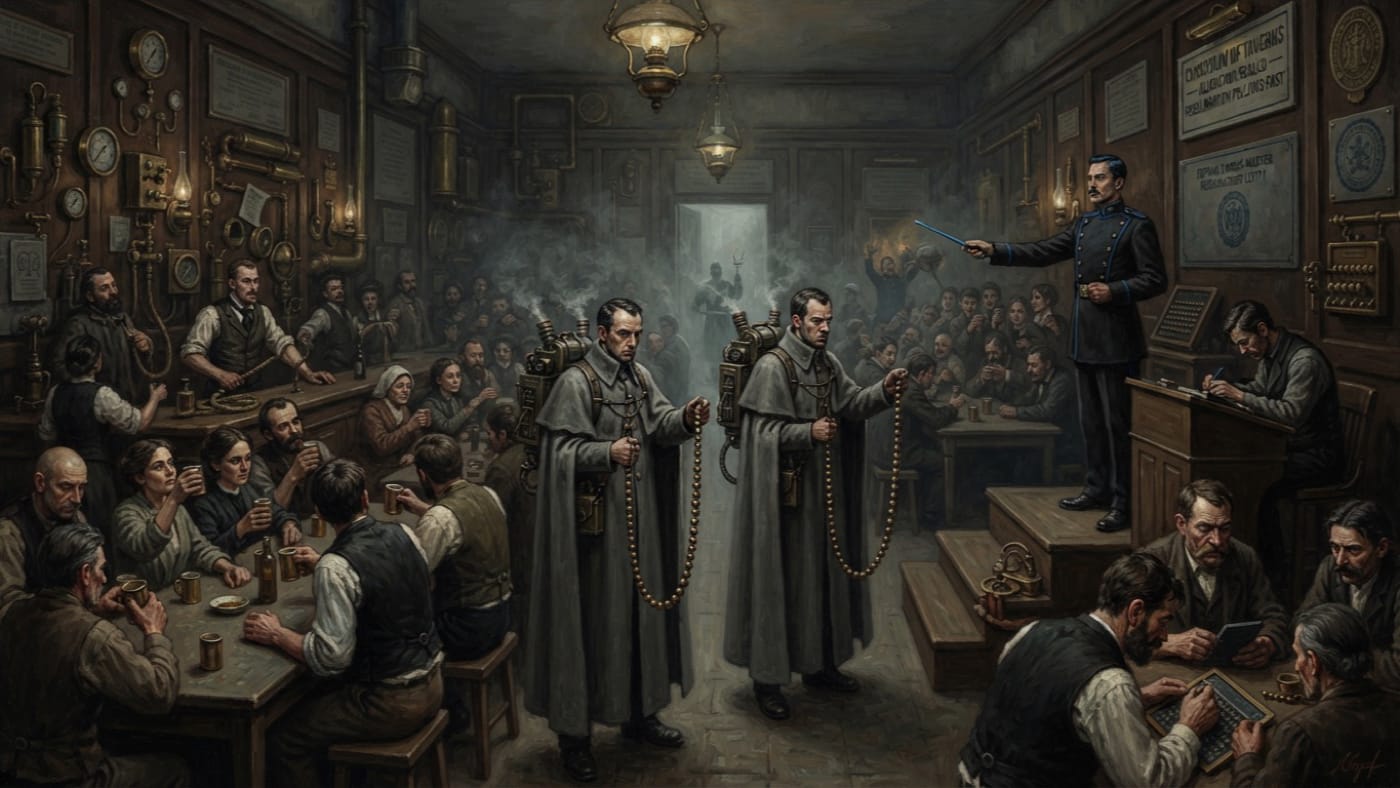
The keepers work in rooms small enough that they can smell each other. Fog Clerks of the Censorium of Taverns enter licensed houses in pairs. They wear grey capes, carry chains of graduated beads and have incense vents strapped between their shoulders. One counts the room and the other counts the keeper. The Licensed Housewarden stands at the bar watching the bead chain rather than the drinkers, because the beads report sooner. When a song climbs, the Housewarden cuts it with a word, a slammed shutter, a wet cloth wound round the bell-rope or a coin passed beneath the ledger. Patrons learn to break a laugh into a cough. The clerks have learned to count coughs.
At feasts the Chorus-Master directs the crowd's responses from an approved script. A cue bell opens the sanctioned laughter and a cut of the blue baton closes it. A crowd still laughing after the baton falls has passed from celebration into evidence. Festival Attendance Auditors work alongside, with slate and bead-frame, recording who rejoiced and by how much. Their corps belongs to Festivals. The auditors of sky-sermon attendance answer to Orison and Song, whatever the older digests claim. The arrangement cuts both ways. A ward may be fined for spontaneous excess at Ninth and reported for insufficient zeal at the noon procession, and no one in Strasbourg considers these positions incompatible.
Escalated files pass to Purity. Records keeps the outcome. Tithes keeps the fines and has never once petitioned for a quieter Iberia.
#On the Seville Breach
Twelve years before Seville, the Heresy of Siena in A.S. 141 had shown the Church that a collective celebration could be closed by doctrine and the closure entered as mercy. Iberian calendars were revised in that spirit, and Seville was a city that laughed with its whole chest.
In A.S. 153, three taverns of the Triana district exceeded their permitted laughter during the Feast of the Cracked Bell. That feast honours service that is flawed yet faithfully continued, and the reporting file describes its local Triana observance as penitential. A junior auditor with an unblemished promotion file filed the breach. The provincial remedy fits in four lines: half-volume mirth for ninety days, all public songs cleared in advance, tavern doors kept open through the evening hours, and a Chorus-Master posted in every licensed square.
On the third night the Bellfounders' Hall laughed for seven minutes. The cause is disputed. The witnesses in the riot file contradict each other, and the Form 19-M dossier names a joke that the riot file does not confirm. I decline to rule on a punchline for the Bureau of Doctrine. What followed is not disputed. Houses and guildhalls exceeded their allowance in turn, so that runners reached each breach after it had ended and as the next began. Market criers sang quota clauses as though they were selling oranges. Clause 7, concerning "unscheduled hilarity during penitential transit," became a drinking song, bellowed by mule-drivers who could not have read the notice it came from.
That was the quota's true defeat. Seville never disputed the measure. It learned the text by heart, set it to a tune and returned it to the auditors at full volume. The grievance and the instrument of resistance were one document, bearing the Bureau's own seal.
Doctrine later wrote that the riots proved mirth combustible. Records wrote that they proved the quotas too lenient. Both opinions were filed, and Seville was asked for neither. The Laugh Riots file passed to Purity on the fourth day.
#On Correction
In ordinary seasons the quota is defended with paper. A first excess earns a fine. Repetition brings suspension of the licence, shortened hours and fog pumped from the street cart until the room coughs itself into compliance. At the end of the ladder comes closure: shutters nailed and the licence returned to Strasbourg in a pouch. Most houses never climb past the second rung. The Housewarden sees to that, and the cost usually falls on whichever patron laughed loudest.
Seville climbed every rung in a week. The Lictors of Purity arrived with braziers and tongs. Each offender's quota citation was read aloud before the cut, and the tongues were taken in public. Purity imposed the Fast of Silence across five wards. By the second day of Lictor action, three hundred and nine citizens had been processed. That is an intake count, not a death roll, and every later figure is classified. Records entered "mass corrective muting." Festivals entered "calendar interruption." Both phrases are accurate in the way a receipt is accurate.
The calendar punishment was separate and came two years later. The Subjugation of Seville in A.S. 155 struck thirty feast days from the city's year, posted additional auditors permanently and cut the tavern licences down to a remnant. Western grain was redirected toward Bastion-Constantinople. The famine of A.S. 157 followed, and the Bureau of Agriculture was dissolved the next year. Seville had overspent its mirth, so Strasbourg reduced its bread. The Ledger enters this as proportion.
#On Present Application
In A.S. 201 the allocation remains sealed. It is recalibrated after each fast, entered nightly in the Lists and published under its gentler name. Housewardens still watch the beads, and Chorus-Masters still carry blue. Seville still hosts the auditors posted in A.S. 155 and still lacks the thirty days it lost.
This entry is filed under the heading "mirth quota."
Corrected under the A.S. 199 terminology revision. Public copies shall read "devotional levity allocation." Internal copies retain "mirth quota" for continuity of enforcement. The heading therefore stands, as does the quota, in every copy a citizen will never see.
Seville has also kept something for which the allocation provides no column. Drinkers tap their cups twice before drinking. Two fingers rise to the lips when a Festival baton passes. Children learn the rhythm of Clause 7 by rapping their knuckles on table wood: short, short, long. No Fog Clerk has yet been issued a bead for it.