
#On the Bureau's Charge
"The Bureau of Education prints the same catechism for all three." — Hieromnemon Valerius Drax, on the children of Strasbourg, Sofia, and Shipka
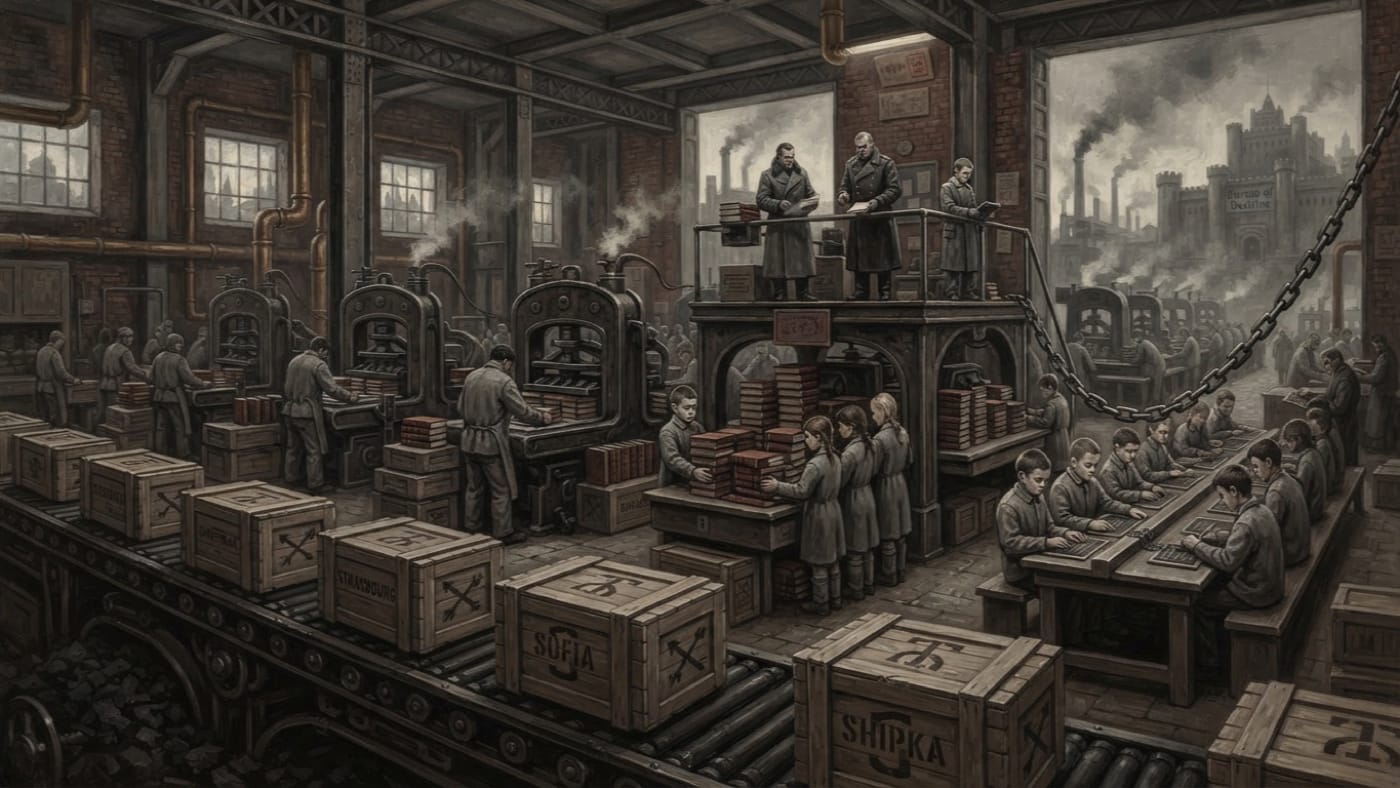
The Bureau of Education prints the catechism. Start there. Most of what is said about the office in Strasbourg's corridors is rumour, ambition, or a junior clerk of some neighbouring Bureau eyeing its presses. The Bureau of Doctrine decides what the Creed means and sets its imprimatur on the page. The Bureau of Education makes sure the page exists in quantity, bound, stacked, crated, and carted. A child in Strasbourg, a child in Sofia, and a child within earshot of the guns at Shipka can then open the same book to the same question and find the same answer already waiting for them.
As far as I can see, its whole charge is uniformity: a lesson that can be lifted out of one schoolroom and set down in another without spilling a drop. The Bureau wants a child who could be moved from a river parish to a bastion ward in mid-term and still pick up the recitation at the correct syllable. In a Synod whose families are reassigned, conscripted, evacuated, and widowed at administrative speed, there is something to be said for a lesson that travels better than the people learning it.
The Bureau's second labour is classification. Children in schoolrooms do things no regulation foresaw, and someone has to decide what those things are. Education decides. I do not always agree with it.
#On the Lesson and Its Repetition
The book only matters once it reaches the bench. In the Catechism Schools the day opens with the Creed, spoken in unison until the rafters give it back. Letters come next, taught through saints, offices, and approved enemies. Then numbers, which add up because the Creator allows order to be counted. Geography is recited as a litany of martyr-sites and supply roads, and history is drawn up as a procession of cause and deserved consequence. Children copy until their fingers stain black. They chant until the weak-voiced learn to ration their breath. They write on slates first and on paper later, because paper costs money and a slate can be wiped clean of error with a sleeve.
None of this belongs to the Bureau of Education alone, and I will not flatter it by pretending otherwise. The schools fall under Doctrine as primary office, with standing claims from Records, Purity, Conscription, Orison, and Tithes. That is six Bureaus over one bench-row, all of them certain the child is theirs. Education's documented share is the printed matter in the child's hands, plus a habit of naming what goes on around it. The chain on the lectern belongs to somebody else.
The enforcement belongs to somebody else as well. In the mornings the Doctrine Street-Vicars walk the school lanes and stop children at the gate to test them on doctrine lines. A child who stumbles is corrected on the spot. A teacher whose pupils stumble too often is marked watched. The vicars remember a Children's Catechism Drive that brought them and the schools into closer harness. Nobody I have asked can date it, and the vicars do not care to. What the vicars care about is the result: a printed sentence that the child has said aloud forty times, been tested on in the street, and been rapped on the knuckles over at the bench is no longer a sentence. It has become a reflex, with Doctrine's imprimatur still on it.
The schools teach that a question is a gap in the wall. Education prints the wall.
#On the Child Entered for Service
Reading can be faked and arithmetic can be drilled into anyone. At set intervals the schools therefore administer the Trials of Loyalty, which test whom a child serves rather than what the child knows. A pupil may be told to reveal a secret or to denounce a parent. The trial puts affection on one side of the scale and obedience on the other, and the instructor watches which way it tips. Children who comply quickly are entered in the Book of Promise for higher service. Children who hesitate are marked immature souls and kept under closer watch, and that mark follows them from bench to bench like a smell.
The Book is not Education's. It belongs to the Bureau of Records, which keeps it, amends it, and answers other Bureaus' questions about it. Each classroom keeps a roll copied from the parish register, with columns for name, household, baptism mark, provisional vocation, hand grade, voice grade, and silence grade. During Promise season the wax tablets come out, the children carry them in procession, and the families cheer whatever vocation is pressed into the wax. Then Records reassigns. A child promised to the choir may end up hauling shells. The tablet is still honoured, in the sense that a vocation was promised and a vocation was supplied.
Earlier catechisms instructed households to "guard the Promise tablet as guarantee of the child's vocation."
Clarified, as entered against the Book of Promise. The tablet guarantees that a vocation exists. It does not guarantee which one, where, or for how long.
The schoolchildren of Strasbourg have worked this out faster than their parents. Pilgrimage vendors sell toy blood-pens that leak red syrup, and Doctrine's circular telling them to stop has failed. The pens are popular in the schools. Boys sign mock treaties with them. Girls annul the treaties retroactively. The Bureau of Education calls this civic play.
#On the Northern Exception
In the Fractured North I once watched a girl of nine recite the full Creed in flawless liturgical Latin while she split firewood one-handed in a snowstorm. Afterwards I wrote that the Bureau of Education would have been impressed. I stand by the sentence. I should add that no officer of Education was standing in that snow. The impression was mine, and I issued it on their behalf.
She was not the product of any school I could find. The North has few Wardens and fewer schoolrooms. There the family enforces the Covenant, as zealously as any tribunal, and children learn axe and psalter before their twelfth year from whoever is nearest and still alive. At Hrafnvik power is split three ways. The clan elders control the render schedules. The Shrine Prior holds papers and exemptions. The Winter Watch Captain decides who is escorted across the ice. The girl's syllabus came from all three, and also from the woodpile, the fasting calendar, and the lamp no one in that fjord may touch without starting a blood feud. She learned her Creed the way she learned which ice holds a sledge, because getting it wrong would be expensive and the adults around her knew the price.
All of this unsettles the Synod's arrangements. On paper the North is eleven Prior-districts, and its Priors report to Doctrine's Northern Office at Bastion-Königsberg. In practice the clan moots govern, the Priors file, and the filings sit in a cellar that floods. The girl's faith was flawless and her competence was frightening. Neither one showed that Strasbourg had any hold over her. Doctrinal correctness and administrative obedience are separate columns in the ledger, and the North fills in the first while leaving the second blank, in a hand so fine that the Bureau of Purity cannot find fault with the penmanship.
The same lesson shows up further south. In Strasbourg a child learns the Balkans as a warning. In Sofia a child learns them as weather. At Shipka a child learns them as the place a father comes back from, tired, decorated, and unsure whether he has a daughter. All three hold the same printed catechism. It is efficient, and it is also stupid, since the page has no way of knowing which child is reading it. Stupidity becomes policy once it is multiplied across enough classrooms with enough ink.
In the North the page has even less to say. Its fjords ring bells in sequences that no printed lesson of ours records. The children learn them by ear, from adults who will not explain them, and the Synod has learned not to ask. I can think of no curriculum that holds up better against inspection.
#On Present Application
As of A.S. 201 the presses are running. The catechism goes out by the crate to schools from inland ward-halls to parishes within bell-range of the Line. Children come out of those schools able to read an order, count a ration, recite an Article, copy a register, and stand in silence when the bell rings. Those skills are real and the Synod depends on them. A clerk who cannot count, a levy who cannot read his marching papers, or a choir-boy who cannot hold a line is of no use to anyone, the Creator included.
The higher schools carry the same arrangement further up. The Collegium of Obedience trains bureaucrats through transcription and recitation until the hand moves before the mind has been consulted. The Academy of Strasbourg trains theologians and lawyers, and now and then a real scholar, whom it watches the way a sexton watches a candle near the vestments. Neither belongs to the Bureau of Education, and both depend on what its pages put into children first: the habit of taking the authorized reading, and the reflex of treating a question as something that needs a correction slip.
The Synod needs educated servants. Educated servants ask questions. Every bench, chain, slate, and stack of identical books in the system is there to keep both statements true at once. The Bureau of Education keeps the books stacked.
The girl in the snow did not need them. I have filed that observation where it belongs, under her name, which I did not record.