
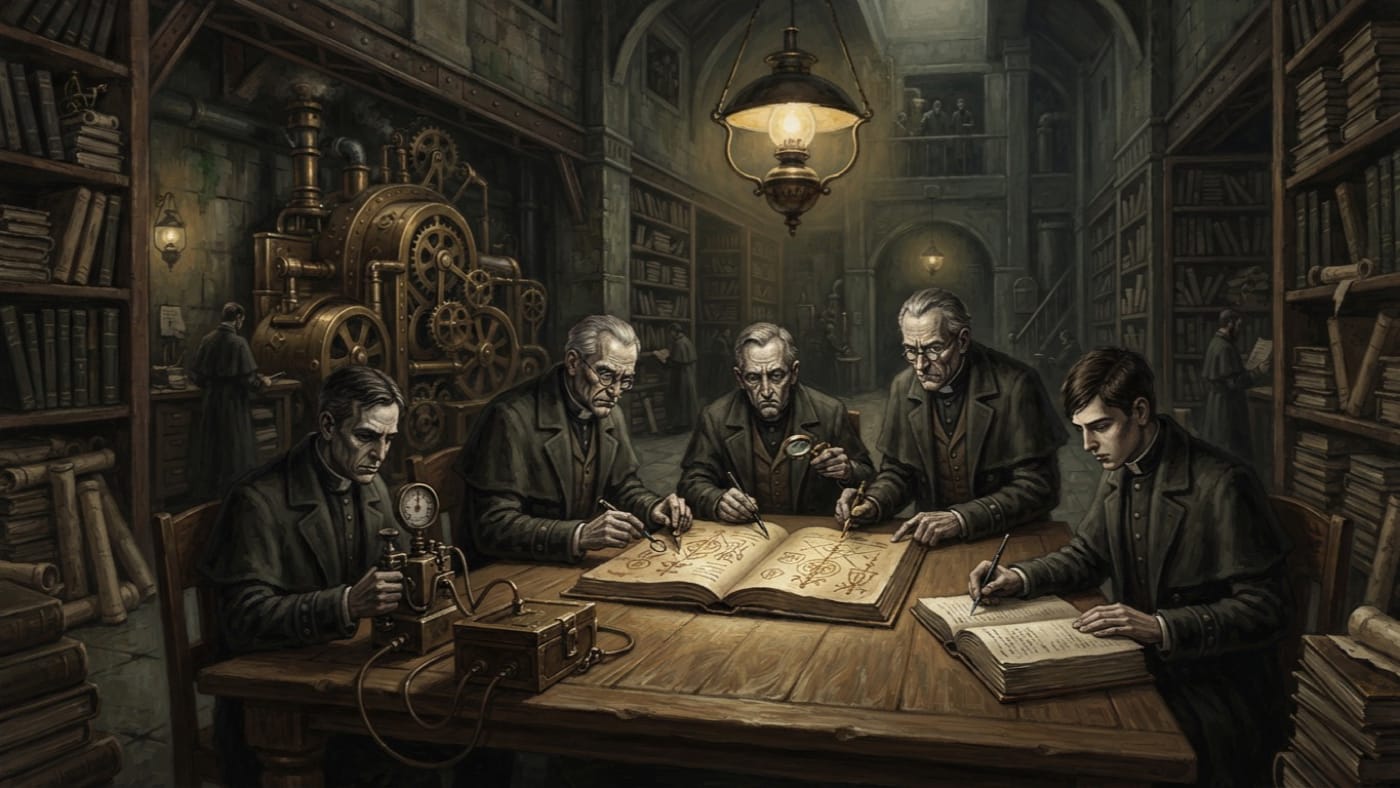
#On the Received Declaration
The Bureau of Doctrine dates its oldest unaltered instrument to A.S. 23, which the vulgar calendars call 1733. It calls the thing the Declaration of A.S. 23, and it does so with the confidence of an office that did not exist when the ink dried. The year belongs to the Bureau's received account. I do not have the room, the hands, the season or the original vellum. I have looked for them, which is more than most catechists can say.
Mind the arithmetic, since the Bureau prefers that you skip it. The Declaration comes eight years after the tower burned at Toledo, twenty-two years before the Sundering, and sixty-seven years before the Concordat of Strasbourg gave the Synod its formal constitution. In 1733 the Church kept its doctrine in cellars and borrowed rooms, copying by tallow and hoping the neighbours were deaf. It had no Bureau to issue anything. The title is a later attribution, fixed upon the instrument once the Bureau had grown large enough to want ancestors.
Who composed it, who signed it, where it was first read aloud, and how it reached Strasbourg's keeping are questions on which the received account says nothing. I will not supply a signing ceremony with candles just because readers like candles. Some inventories call the instrument the Declaration on Source and Instrument. That is a cataloguer's convenience. No one has shown it to be the original title.
The rule survives, and the Church has measured every disputed flame against it since.
#On Source and Conduit
The Bureau receives the Declaration as three propositions. In the absence of an authenticated text I paraphrase them, and I refuse to number clauses that nobody living has seen numbered.
First, all sorcery proceeds from the hostile will that the received doctrinal wording names the Adversary, and that ordinary speech in the Church now calls the Great Deceiver. Second, all miracles proceed by the Creator's permission. Third, both are power passing from beyond the mortal sphere through a material conduit, and only the source decides whether the practitioner is canonised or burned.
The third proposition makes timid preachers sweat. It admits that the saint and the sorcerer handle the same kind of thing. Each reaches through matter. A bone, a bell-rope, a throat shaping a psalm, a cup of oil: any of these may serve as a conduit, and the conduit has no say in its own classification. A censer does not choose its smoke. Having admitted the shared mechanism, the Declaration draws the only distinction that survives a fire, which is the question of where the power came from.
Two questions follow, and clerks constantly mistake one for the other. Miracle against sorcery is a question of source: whose power was it? Miracle against mechanism is a question of means: how did the thing happen? The Declaration governs the first question outright. Through the Bureau's later use it also disciplines the second, because a full account of how cannot by itself answer whose. A diagram of the conduit does not tell you who the author was.
The rule has limits that its zealots forget. It does not say every engine runs on grace, every fire is holy, or every Engineer's measurement is idle chatter. A powder-wagon lit by a careless pipe stays a careless pipe. Doctrine does not canonise tobacco.
#On the Jawbone's Testimony
The Bureau's favourite proof of the rule predates the rule, which troubles the Bureau less than it should.
Relic 14-T(Provisional) was a jawbone set in silver, its provenance ruled "probable." On the seventh day of bombardment in A.S. 15, during the agonies of the Atheist Wars, Father Clemente de los Rios of the Order of Saint Iago raised it above Toledo's parapet and intoned the Psalm of Consuming. Three Rationalist ammunition caissons went up, and forty-seven artillerists died in a single white flare.
Doctrine affirms a miracle. The Bureau of Engineering proposes an incendiary, a monk in the bell tower with a Greek-fire variant and remarkable aim. On the Declaration's terms the two verdicts answer different questions. Engineering is describing the conduit. Doctrine is naming the source. If some future Engineer produces the monk, the pot and the firing table, I will congratulate him warmly and the miracle will stand, because he will have found the hand and mistaken it for the author. Until then, the physical cause is unresolved in every file I have read, and I have read the ones they hide.
The final assault came on 29 November, A.S. 15, and the last tower burned with Clemente, the defenders and the bone. The faithful account says the relic blazed at the second Psalm. The Rationalist account says the defenders fired the timbers with consecrated oil. The Bureau of Relics later sifted out four silver beads, two fused clasp fragments, some ash and one blackened mandibular fragment, and it still files the whole as provisional because the chain of custody has holes a cart could pass through.
So Relics doubts the bone, and Doctrine does not doubt what the bone did. That is the rule at work. Authentication asks whether this is the jaw. Interpretation asks whose fire answered through it. The two Bureaus may disagree without quarrelling, which makes this the one subject on which they are polite.
No document I have handled shows that Toledo prompted the Declaration or appears in its wording. Toledo is the case through which the later rule is taught. It is not a clause.
#On the Jurisdiction of Cause
The Bureaus that administer the rule today grew up long after A.S. 23. Their arrangement should not be read backward into some imagined cellar committee with its own letterhead.
As things now stand, Doctrine claims authority to interpret: it alone pronounces on source. Engineering supplies competing accounts of means, and the Church tolerates them, because a well-measured mechanism is useful right up to the moment it claims to have measured Heaven. Relics examines provenance and custody, and it asks whether the bone is the bone. The Bureau of Purity enforces what may be believed aloud. Its street-vicars correct the tavern philosopher who says "only powder" over his third cup. They are not correcting his chemistry. They are correcting his conclusion.
The rule has a harder burden than Toledo, and the Bureau's own literature shows it. The later teaching on miracle and sorcery holds that a miracle is paid for by faithful bodies through hunger, fatigue, memory or years of life, while sorcery feeds on the world around it, on soil and river and the meanings of words. Under the Declaration, cost is evidence. Source is the verdict.
Miracles do not break reality at all.
Withdrawn by the Bureau of Records in a later revision. The approved formula is "breaking without blemish." The older sentence was never in the Declaration of A.S. 23, though zealots have quoted it as if it were, a habit that should be met with a ruler across the knuckles.
Even "without blemish" is under strain. A Blightmarsh report records relic-fire purging a Flesh Litany and leaving the ground sterile for a season, white and husked, with not even gnats willing to breed there. A leaked note from an Engineer correlates high-pressure reliquary events with new Wound-Sites. The official answer is that grace does not corrupt. The Engineer's answer is a column of figures. Under the Declaration the figures can describe the conduit but cannot convict the source, and that is precisely why the figures frighten the people who keep them. What Toledo paid, and in what coin, no ledger in my keeping records.
#On the Unrevised Rule
The Bureau of Doctrine holds that the Declaration has never been revised and calls it the Bureau's oldest unmodified instrument. That is the Bureau's testimony about itself. I report it as testimony. I have not audited every vault from Strasbourg to the coast, and anyone who claims to have done so is a liar or a Records clerk, which saves time.
In A.S. 201, which is 1911 for the unconsecrated, the rule is still in daily use. Canonisation tribunals cite it, and so do Purity writs. Every quarrel between a reliquary and a pressure gauge ends with it. Doctrine treats its stillness as proof that it is true. A doctrine that has outlived every Bureau that claims it is either perfect or untouchable, and the Church has never needed to find out which.
My own anxiety is simpler. A rule that leaves source to Doctrine's judgment never has to lose an argument about means, and a rule that cannot lose cannot be corrected. Every other instrument in the archive carries emendations and counter-seals. This one sits unannotated, like a confessor who has never confessed.