
#On the Name of the Blow
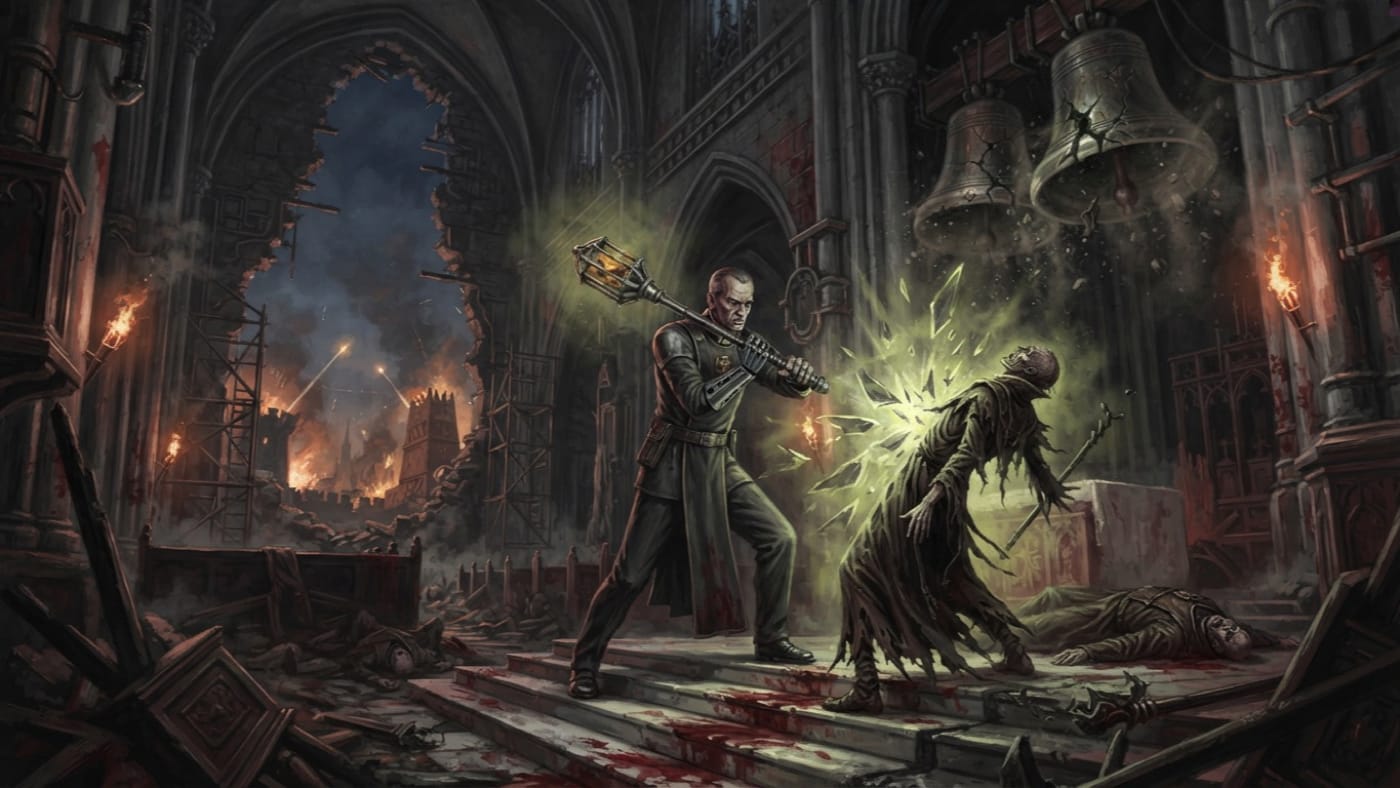
The Blow of Saint Rupert is the single strike delivered by Bishop-Warden Clemens Stahlhand on the altar steps of Saint Rupert's cathedral in Vienna, A.S. 95 (1805 CE), in the last hours of the Siege of Vienna. It destroyed Althazar of Pest and broke the command of the Rationalist remnant outside the walls. In the account the Bureau of Doctrine ratified nine years later, it also set the cathedral's ruined bells pealing with no hand on any rope.
The name is wrong, and the name is approved. Saint Rupert struck no one. The weapon was the reliquary mace of Saint Aldebrand, and it was Aldebrand's bone that sat inside the cage. Saint Rupert supplied the altar, the tower and the bronze that told the city what had happened. Provincial preachers had merged the two saints within a decade, and the devotional plates followed the preachers. Faced with ten thousand stamped plates on one side and one correct sentence on the other, the Bureau kept the plates.
Infantry chapbooks issued to the Vienna companies describe "Saint Rupert's mace" slaying the sorcerer.
Corrected for literate personnel. The mace was Aldebrand's reliquary. Rupert's bells sounded after the strike. This entry is still titled the Blow of Saint Rupert, by order. Readers who find that untidy may take it up with the plates.
#On the Last Defence
The garrison held Vienna for nine months. That is the full military reckoning. Popular accounts shrink it to the final eleven days because starvation makes poor theatre and eleven days fit on a broadsheet. The besiegers were Rationalist remnants allied with the daemon-cults of the East: batteries, deserter companies, cult surgeons and things the Bureau of Purity has never managed to classify. Their commander was Althazar of Pest. He was a mortal and a sorcerer-lord. He was no king and no Sin-General, and if he had an infernal patron, the Ledger has not yet been told its name.
Clemens commanded the defence. He had earned the name Stahlhand years earlier with supply manifests so exact that quartermasters called them iron-fisted. The steel arrived later. At the Battle of the Outer Ramparts in A.S. 93, a Rationalist shell took three fingers of his right hand, and the garrison fitted him with steel where they had been. The documents say nothing more about the hand, and this article will say nothing more either.
During the siege he turned communion wine into antiseptic and burned the pews for heat. He ordered the Bells of Saint Rupert taken down to be melted for shot, then countermanded his own order at the last hour. The Rationalists had tried to requisition those bells before him and failed. His reprieve came from inside the walls and under his own seal, and the Bureau now calls it prophecy. By the ninth month the garrison was eating boot-leather and plaster scraped from the cathedral walls. Clemens moved his command post into the nave, beside the altar.
#On the Strike and the Peal
Althazar came through the breach with his column and advanced on the altar. Clemens went down to the cathedral vault and took out the mace.
The object is described in the Reliquary of Saint Aldebrand file, and I will not improve on that description: an iron haft, a squat silver cage and an ambered viewing aperture, with saint-bone sealed in the core where an honest mace would carry lead. The bone is commonly called a femur. It had a long record of insult by A.S. 95. In the Year of Letters, −32 A.S. (1678 CE), the ecclesiastical authorities who preceded the Synod answered the Amsterdam scholars by erasing the relic from every inventory. In A.S. 11, the Rationalist tribunal at the Amsterdam trial called it pig bone and made two bound priests sign their agreement. One hundred and twenty-seven years separated the erasure from the blow, and the object spent them in a vault, polished by a custodian whom no payroll admits.
Clemens met Althazar on the altar steps. Accounts disagree about posture, distance and the words spoken. Some place the meeting at the western breach or the inner wall and send it to the altar only later. Doctrine's ratified sequence settles none of those quarrels. It fixes only the order of events: one strike, then the sorcerer destroyed, iron split and stone broken, and the hostile auxiliaries scattered into ash-clouds. After that came the bells. Bombardment had shaken them from their frames and no one had roped them, yet they pealed. The sound crossed the city, the trenches and the Rationalist lines, and the besiegers broke.
The surviving depositions add particulars that Doctrine did not need and did not strike out. Seventeen witnesses describe a low note lasting nine seconds, felt in the sternum more than heard. Glass shattered in the Hofburg. The paving of the Heldenplatz opened in radial cracks. Two men standing beside Althazar died with him. War's casualty clerk recorded the sorcerer as "killed in breach action by blunt-force trauma," which is correct as an autopsy and idiotic as history. The Bureau of Engineering suggested that the tower's cracked frame had produced sympathetic motion. Engineering has since been encouraged to keep its distance from miracles while explaining them.
The testimony still divides on the bells. One party says they began before the strike and another says after. The bell-ringer Krenn heard the smallest bell first, and heard it ring backward. I record that disagreement and do not adjudicate it. Adjudication is above my seal and well beneath my dignity.
#On the Ratification
The first official reading was operational. The garrison's summary is now filed with the Bureau of War, an office that received its own charter only after Clemens was buried and has filed itself backward ever since. The summary speaks of a "fortuitous acoustic effect," of breach action and of a broken enemy. Someone in that chain of clerks wrote a further annotation in the margin.
"Miracle unverified; but useful."
Withdrawn. The annotation has itself been reclassified as an erratum. The Bureau of Doctrine verified the miracle retroactively in A.S. 104, concurrent with Clemens Stahlhand's beatification. The officer who wrote the word "useful" has been reprimanded posthumously, which is the only form of discipline that cannot be appealed.
Clemens died in A.S. 103, his heart worn out by the work of rebuilding walls. The ratification came the following year. Nobody in the Bureau will explain the timing to me in writing. A living Bishop-Warden can contradict his own miracle. A beatified one has only a feast.
He did, on one occasion, try.
SEALED TESTIMONY — BISHOP-WARDEN CLEMENS STAHLHAND "It was not I who struck." Doctrine: battlefield confusion. War: modesty. Orison: sanctity. Further annotation: ████████████████████████████
Each of those offices has filed its reading and none has withdrawn it. I will not supply a fourth. Who, or what, held the haft that day is a question the Ledger keeps open on purpose, and I keep it open with the Ledger.
Pay attention to what was actually ratified. In A.S. 104 Doctrine verified the miracle: Vienna was saved by the Creator's will acting through relic and altar. It did not verify a mechanism. The bells, examined as objects, remain Miracle, Category Two, Under Review. That classification allows reverence and funding and postpones any conclusion for as long as the files can bear it. Clerks who apply the bell classification to the whole Blow, or the Blow's verification to every particular of the bells, are corrected at their desks.
#On What Remains in Custody
The mace hangs above the altar-site in Vienna, chained to the wall with consecrated iron. Pilgrims who come along the processional approach report that it is warmer than the iron around it. No one is permitted to touch it, so the report cannot be tested. A second mace is displayed through glass at Strasbourg Cathedral on the Feast of Saint Rupert, at the regulation distance. Both carry seals and both claim descent from the Blow. The Bureau of Relics does not call either one a copy, because copies belong to printers and heretics. It calls both "valid custodial manifestations."
The steel gauntlet is held in the Strasbourg Basilica tradition, behind glass, and pilgrims are welcome to believe it is the fitting made after the Outer Ramparts. The Ledger has not been asked to certify that. The true Bells of Saint Rupert are preserved in Vienna under restriction, with fragments held elsewhere. They are inspected by sight, never by touch, and always with a choir present to drown out any note that should not occur. The feast peals pilgrims hear today come from substitute bells cast in A.S. 112. Any pilgrim who claims to have heard the true bells must report to a confessor.
#On the Use of Victory
Vienna's survival became the "Shield of the Synod." By A.S. 95 the formal Synod had already sat at Strasbourg for five years under the Concordat of A.S. 90, and Vienna did not create it. What Vienna gave an existing institution was a founding story, a martyr in waiting, a relic with two addresses and a sermon that could be preached to infantry without footnotes.
The Rationalist remnant's command died on the altar steps. Rationalists themselves did not, and neither did their arguments. Their councils scattered and their ledgers burned, but their arguments resurface in every generation that discovers arithmetic and mistakes it for courage. The Blow settled who held Vienna and who would tell the story. It settled nothing else.
War names barracks after Clemens. Doctrine cites the miracle in every sermon on the efficacy of relics. The Bureau of Records files the whole affair under two headings that refuse to share a drawer: PERSONNEL, DECEASED, BISHOP-GRADE, VIENNA, and RELIQUARY INCIDENTS, ANOMALOUS. Every new clerk asks which heading governs. Every new clerk is told both, and is told to stop asking.
Requests to examine the bone are to be routed to Relics. Relics will route them to Doctrine, and Doctrine will route them to the altar.