
#On the Outer Ramparts
Entered in the Ledger under Vienna, pre-Siege engagements, A.S. 93.
Every schoolboy in the Central Corridor can recite the Blow of Saint Rupert. He will tell you about the altar, the mace, the bells and the sorcerer on the steps. Ask him about the Outer Ramparts and he stares at you as though you had asked for the tithe tables of a parish that burned before his grandfather was born.
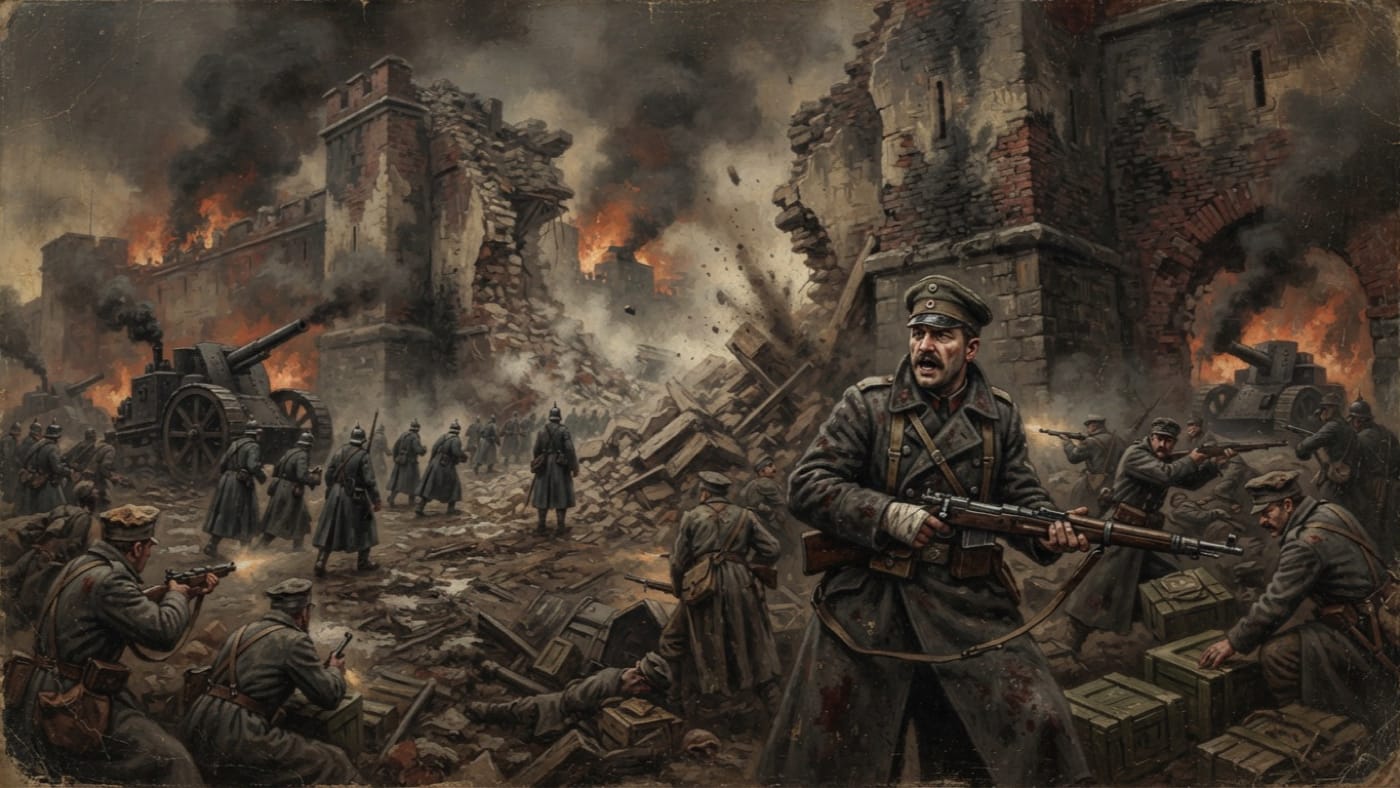
The Battle of the Outer Ramparts belongs to A.S. 93 (1803 CE), two years before the Siege of Vienna turned Vienna into a shrine and its defender into a candidate for sainthood. The Ledger files it among the pre-Siege skirmishes. The Bureau of Records keeps that category for violence too large to ignore and too small to commemorate. Rationalist guns reached the city's outer walls, and the walls did not hold. A shell burst took three fingers from the right hand of a man the Codex now indexes as Bishop-Warden Clemens Stahlhand.
That is the battle as the documents give it. The rest is hymnody.
By then the formal Synod was three years old. In Strasbourg that same year, a successor council was working through the business of a government still learning where its seals belonged. Vienna was busy being shot at.
#On the Breach
The entry in the chronology is spare to the point of rudeness. During the skirmishing before the Siege, Rationalist artillery breached Vienna's outer walls. The record names no sector, no battery and no commander. No force strength survives, and neither does a roll of the dead. If one does exist, it sits in some press the Bureau of Records has not yet admitted to owning.
I will not supply what is missing. Lesser archivists would, and have. The Codex groans with engagements whose regimental numbers were added afterwards by clerks who could not bear an empty column. A breach is a breach. Masonry that had stood came down. The Ledger records that much, and I record it after the Ledger.
What the breach meant is a separate matter, and the Bureau answers it with all the confidence of an institution that was not present. An outer wall is built to be the first thing broken. It takes the shot so the inner works need not, and once it falls its office is discharged. Engineers understand this. Preachers do not. So the Outer Ramparts have been read from Viennese pulpits as warning, humiliation, trial and foreshadowing, as if stone could be faithless and a curtain wall could apostatize.
The Rationalists had artillery. They always had artillery. It is the one sacrament they kept.
The documents do not say whether the breach was exploited, sealed, contested or abandoned. I say so plainly because the prayer-card trade has a habit of turning a missing sequel into a glorious one. No assault is recorded here, no recapture and no rout, and none will be recorded by me.
#On the Hand Before Steel
You must understand the man as he was before the shell found him. In A.S. 93, Clemens was not yet a figure of the altar. The documents do not settle what rank he held that year, or whether he commanded anything on the walls that day. Bishop-Warden is a courtesy the Codex extends backwards, and I extend it with the care of a lender who expects repayment.
The documents do settle his trade. Clemens rose in the Vienna garrison through supply. His manifests were so exact that quartermasters called them iron-fisted, and the name Stahlhand came to him through tallies, requisitions and ration columns that balanced to the last sack. Steel Hand: a clerk's compliment, earned in a clerk's medium. I admit to a professional warmth about it.
On the order of events I will be pedantic, since the Ledger requires it. The epithet came first. The shell did not name him. It made an existing name literal, and in doing so it gave the prayer-card engravers something they could draw.
I will not decorate his competence with some particular convoy or heroic ration delivered to the ramparts. None is recorded. A supply officer's greatness shows in the fact that nothing happens: the men eat, the powder arrives dry, and nobody writes a hymn about it.
#On the Shell Burst
A Rationalist shell burst near him, and three fingers of his right hand went with it.
The Codex does not name the three, and I will not supply the anatomy for pilgrims who want to know which knuckle to venerate. Whether the Creator spared the rest of the hand or Rationalist gunnery simply lacked ambition, I leave to Doctrine. The Great Deceiver has been blamed for worse with less evidence, and the Bureau does not need my help assigning fault.
No account of the moment survives in a form I would admit to this entry. There is no recorded cry and no deathbed tableau. There is no surgeon with a name, a saw and a line worth quoting. Devotional imagination supplies all of these readily enough: the ruined hand raised to heaven, the unbroken gaze, the soldier kneeling in the rubble. Devotional imagination was not on the wall.
A steel prosthetic followed. The documents do not say when it was fitted, who made it, or how it was built. It replaced what the shell had taken, and I credit it with nothing further. No articulated wonder of clockwork, no relic that flexed of its own accord. Pilgrims who want a miracle can wait two years and go to the altar of Saint Rupert, where the Bureau keeps its miracles in better order.
#On the Wound Enlarged
The Bureau of Orison's approved hagiography says that Clemens lost the hand entire.
I have read the surgeon's report. I said so in the dossier, and I say it again under the same seal. Three fingers.
The reason for the enlargement is obvious to anyone who has sat through a relic committee. A whole hand is a relic-sized loss. It calls for a gauntlet worthy of a reliquary, a votive candle and a feast-day procession. Three fingers is an industrial accident. It calls for a fitting, a strap, and steel where the flesh had been. The first sells prayer-cards. The second belongs in a quartermaster's ledger, which is the one place Clemens would have been content to see it.
There is a cost, and Orison pays it in later chapters. A hagiographer who removes the whole hand must eventually explain how the mace was swung. I have watched the Bureau of Orison's writers sweat over smaller problems, and I have not offered to help.
"He lost the hand entire." — approved hagiography, Bureau of Orison
He lost three fingers of his right hand. The surgeon's report governs. The hagiography remains approved for devotional use, where anatomy is not audited.
The Bureau of Doctrine has neither ratified the enlarged wound nor troubled to correct it. Doctrine ratifies miracles. A missing hand is no miracle, merely a better advertisement, and Doctrine does not concern itself with advertisements unless someone gets them wrong in public. The Bureau of Records keeps the surgeon's account and the hagiography in separate folios, on separate shelves, under separate classifications. Records calls this archival discipline. I call it a truce. And the Bureau of Orison goes on printing cards on which the right sleeve ends in an empty cuff, because empty cuffs move pilgrims and three missing fingers move nobody.
#On Its Place in the Record
Two years later the Rationalists came back to Vienna in earnest, and the Siege began. The man who reached the altar of Saint Rupert in A.S. 95 went there with steel where three fingers had been. That is the whole connection the documents allow. The shell burst at the Outer Ramparts did not produce the Blow, predict it or earn it. It changed the hand the Blow was struck with, and some pilgrims find that fact moving.
The steel gauntlet in Strasbourg, viewed through glass on the Feast of Saint Rupert at a regulation distance, belongs to Clemens's relic tradition. Pilgrims are welcome to believe it is the same steel fitted after the Outer Ramparts. The Ledger has not been asked to certify that, and I am not about to volunteer it.
Clemens died in A.S. 103 and was beatified in A.S. 104. By then the Outer Ramparts had shrunk to a single clause in his legend, after a Rationalist shell took his hand, and even that clause had been enlarged by the Bureau of Orison. The battle itself has no feast, no chapel and no columns that radiate warmth without fuel. It has one breached wall, one wounded quartermaster, and one surgeon's report the hagiographers would rather not have to read.
So be it. Not every engagement produces a saint. Some produce a correction.