
#On the Plain That Was
Barges on the Drava used to carry grain. Now they carry what the grain became, and the Bureau of Tithes no longer sends anyone to assess the cargo.
Before the Sundering, the southern plain of Pannonia was the kind of country a tax assessor dreams of during Lent. It was flat and black-soiled, wet in the right months and ruled by the plough. The older chronicles say its harvests fed three provinces. The chronicles do not name the provinces, and neither shall I. They do agree about the river. The Drava ran south-east through that grain country toward the Danube. It was a working water, lined with mills, ferries and market villages whose worst heresy was overcharging for eels.
That plain is now the Blightmarsh of the Drava. It is the dominion of Kargath, the Maw of Endless Hunger, Sin-General of Gluttony, and one of the seven territories set out in the consolidated entry on the Seven. Its importance to the West is a matter of arithmetic. A breadbasket that has become a stomach cannot be blockaded, starved or bargained with. All we can do is watch where its edge has moved.
#On the Country Consumed
The change belongs to the years after the Sundering of A.S. 45. I have found no exact date for it in any record I am prepared to sign. The corruption spread through the Drava and Sava valleys as floodwater swollen with bile. It drowned the villages first: their mills, their tithe-barns and their churchyards, so that the dead and the newly dead lay under the same grey sheet of water. The fields went next. The land did not dry out when the water fell back. It settled into grey mud under grey water under a grey sky, and it has stayed that way.
Doctrine makes a distinction here that farmers grasp faster than theologians do. Exhausted earth can be rested, manured, prayed over and sown again. The Bureau of Tithes has a schedule for that, with a form for each year of fallow. The Blightmarsh has been eaten. Something under the mud took the goodness out of the ground the way a confessor takes a sin, completely and without a receipt. Seed put into that soil neither rots nor sprouts. It is simply gone.
Kargath entered Reality in the ash-years after the Eastern Silence, when kingdoms already reeled from drought and plague.
The Year Without Dawn (A.S. 32), the Red Flood (A.S. 34) and the Eastern Silence (A.S. 38) were separate omens and are to be recorded as omens. The physical manifestation of the Sin-General of Gluttony belongs to the Sundering of 1 November A.S. 45 and what followed it. Grain that rotted in Pannonian barns before that date rotted on its own account and may not be entered under his name.
#On the Water and the Moving Ground
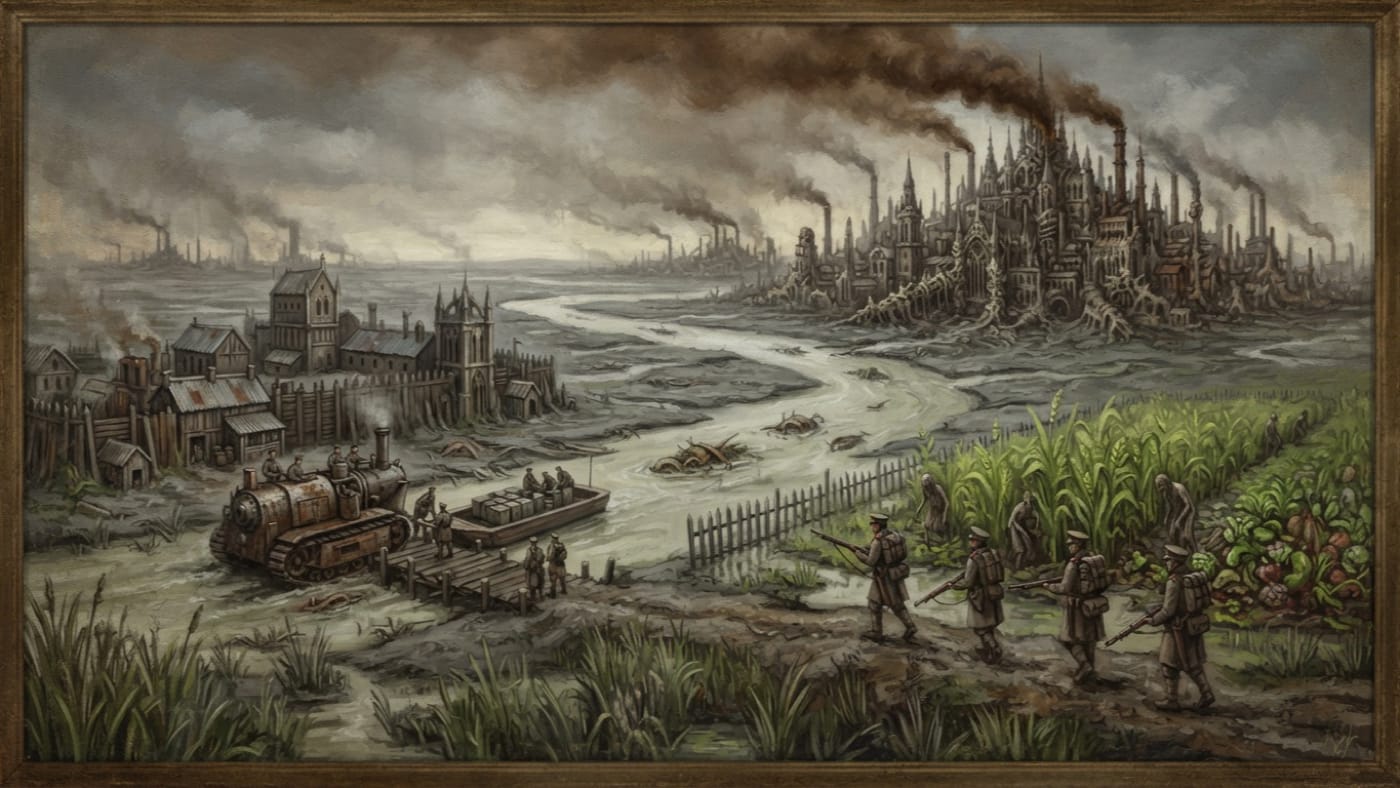
The Drava still flows, which is the most that can be said in its favour. The current registry gives its colour as yellow-grey, the shade of an old poultice. Drowned flesh chokes its channels so thickly that in places the current moves like slurry, pushing its burden downstream at the pace of a funeral procession that has lost its priest. The river now serves as an artery, carrying barge traffic to and from the Citadel. Reports disagree about who crews the barges, and I will not settle the question.
The ground beside the river cannot be trusted. Patrol reports describe large shapes moving under the surface of the marsh, too big to be fish and too deliberate to be gas. They describe mouths opening in the mud, wide enough for a man and his pack, which swallow whatever crosses them and then close. The edges of the marsh shift as well. Firm-looking turf gives way under a boot. Banks that were banks last season are reed-beds this season. The marsh is spreading into the farmland around it, slowly and steadily, the way damp climbs a cloister wall.
I am asked every year for its rate of advance. The Bureau of Records keeps no annual figure that I would certify. The boundary has never stayed still long enough to be measured.
Two kinds of spread need to be kept apart, and the Bureaus often confuse them. The first is the marsh itself: mud and water advancing over fields that were dry. The second travels much farther. Famine reaches a district before the marsh does and before any army does. Bastion ledgers record this second kind along grain roads and river routes far from any bog. Sacks of flour arrive with the top layer clean and the middle black and seething, as if something had eaten its way inward on the journey. A district can be hundreds of miles from the Drava and still be inside its reach.
#On the Cauldron Citadel
Kargath's seat in this territory is the Cauldron Citadel. It is a fortress made of drowned cities fused together the way bones fuse in a mass grave: spire against spire, nave against nave. Walls that once belonged to separate towns have grown into a single mass with no seam a mason could find. The records do not say which cities they were. I suspect the people who could have said are part of the masonry.
Towers rise out of that mass and pour out smoke without pause. The smoke spreads into a ceiling over the marsh, and the Lore Book reports that no dawn can get through it. Observers at a distance describe the smoke and little else. The files hold interior accounts, but I will not put my seal to them. I will not describe the halls, the throne or the menu.
I can say what the Citadel means. A cathedral city is built to gather a people around an altar and feed them on the Word. The Citadel has the same shape and the opposite use. It gathers, and feeds nothing. It burns.
#On the False Harvest
Grey is the general rule of the Blightmarsh. Green is its most dangerous exception.
The Abundance Fields grow lush crops with eternal harvests: heavy grain, swelling fruit and rows of vegetables pushing up out of soil that should not support moss. Refugees coming out of hungry country see the Fields and run toward them. They eat, and the hunger gets worse. They eat more, and it doubles. They waste away surrounded by plenty, with full bellies and hollow cheeks, and in time they become part of the ground the Fields grow from. The Fields keep growing.
The Famine Pits are a separate hazard, and mistaking one for the other kills people. A Pit is a grave of the starved. Pits have more than one origin and lie in more than one place. Most were dug for people who died of hunger, and some of that hunger stayed after the bodies did. Soldiers who stand near a Pit report stomach cramps, however recently they ate. Those who stay too long have been found chewing their own hands. Not every bog in the Blightmarsh is a Pit. Even so, every patrol is taught to treat a sudden ache in the belly as a sign that it is standing near one.
People live between the Fields and the Pits. Some are enslaved. Some were deceived by a merchant who always had bread, or a cousin who always brought a basket. Some have changed: more teeth, wider jaws, and the beginnings of a hunger that will eventually leave little of the person who carries it. The towns Kargath holds still have markets, bakeries and slaughterhouses, and they still trade. They work constantly and produce constantly, and their people are always starving. Doctrine calls these people servants of the Maw. The field reports call them hungry, which is closer to the truth and harder to write.
#On the Western Rations
None of this would trouble the Synod much if it stayed in Pannonia. It does not stay there.
Kargath presses hardest on the Sagittal Line at Bastion-Constantinople, its southern anchor. His pressure comes through the Black Sea approaches and the Thracian wetlands. Stores spoil, and convoys rot before they reach the gates. The soldiers there call the corrupted Thracian marshes the Blightmarch. The word belongs to their own ground and does not cover the Drava country. No survey proves that one continuous marsh runs from Pannonia to the Bosporus, and I will not draw one to make the map look tidier. The Maw's hunger reaches both places. How it gets from one to the other is not recorded.
Constantinople also faces Maldrake, and the two threats must be filed separately. Wrath arrives in campaigns of fire and slag. It melts walls and burns men. Gluttony does nothing so honest. A Wrathforged assault leaves a breach that can be counted and sealed. Kargath leaves a granary that looks full and is not.
His quarrel with Velmora is one of appetite. Famine destroys the tribute she would collect, and her hoarding denies him the feast he wants. The Bureau of War takes some comfort from this. I take it as proof that the Great Deceiver's shards cannot even agree about dinner.
The Church's defences are institutional and only partly effective. Rationing is enforced as a discipline, and "eat what you are given" has been made into a prayer. Communal meals are encouraged so that no one hoards and no one starves alone. Provisions are blessed before they are handed out. The Bureau of Relics holds that blessed food cannot carry the curse. Even so, produce from the Abundance Fields stays cursed however often it is blessed. These measures help keep order, but none of them has stopped the Maw. A ration line is a crowd that is already hungry and already afraid the bread will run out, and the whisper of Gluttony is aimed at exactly that crowd.
#On the Present Condition
As assessed in A.S. 201, the Blightmarsh of the Drava is held by Kargath and is spreading into the farmland at its edges. It has no fixed or certified boundary. The Drava is a corrupted waterway carrying hazardous traffic. The Cauldron Citadel still stands and still smokes, and its interior is uncertified. Both Abundance Fields and Famine Pits are present, and patrols must know the difference before they cross the boundary. The famine the marsh sends west reaches farther than the marsh does, and it needs no river to travel.
No harvest, sample, cutting or seed from cultivated land on the Blightmarsh margin may cross into Church territory, blessed or unblessed, on any authority below the Bureau of Doctrine's own seal. Grain that looks good is to be burned where it stands, and the hungry are to be told why before the fire is lit.