
#On the Ruin Under Orison
The Bureau of Orison files the Black Dome of Brașov as a silence-class acoustic hazard of the Wound-Site register. It sits in the devoured ruin of Brașov, in the Charnel Lands east of the watch kept from Bastion-Sibiu. This survey was commissioned for the present year, A.S. 201, and it has walked nowhere. No rope team entered on its behalf. No instrument was lowered and no fresh witness was paid in bread. What follows is the standing record: Orison's maps, Records' abstracts and testimony already on file, set in order by a man who has read more of it than its authors did.
History needs one paragraph, so it gets one. In A.S. 110 Kargath consumed the city proper in a single week, and the sources count roughly one hundred thousand dead. Velkara's host then drove fifty thousand Ash-Fodder from the surrounding lowlands into the Danube to make the Brașov Flood. That was a separate operation on a separate population. Strasbourg answered both with the first Continental Levy. Reports place the city's acoustic unreliability after the devouring. None names the hour it began, and none proves that the feast made the Dome.
Older teaching chronologies list the devouring of Brașov under A.S. 153.
Corrected. The city was consumed in A.S. 110, the same year as the Flood and the Levy. The forty-three spare years were a copyist's gift. Hell showed no such patience.
#On the Rings in Ink and Pencil
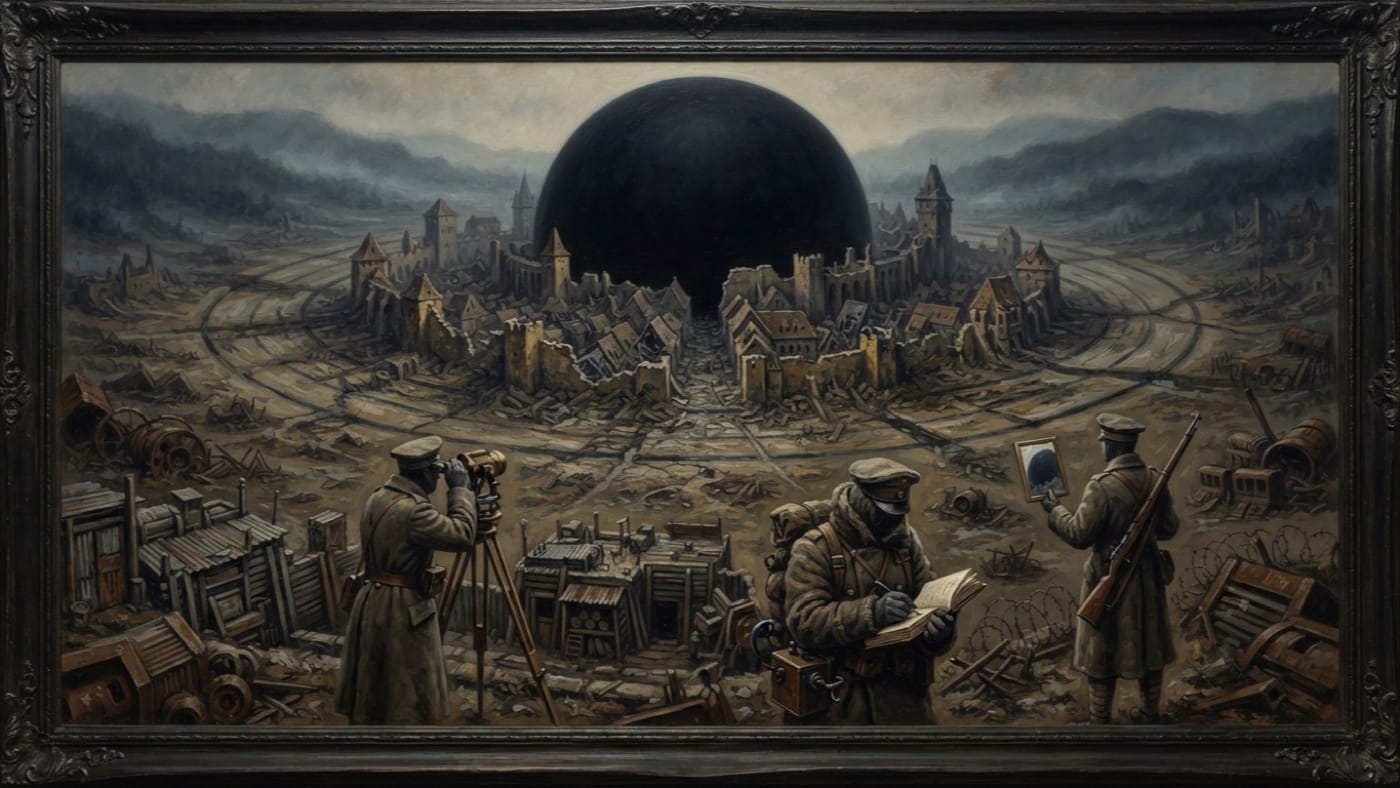
No one agrees where the Dome begins. One school sets the limit at the old eastern gate, which now survives chiefly in drawings. Another sets it at the market square, where footsteps reach the ear later than the foot that made them. A third holds that the whole ruin lies under the Dome on damp days, which makes the boundary a question of weather and the weather a question of jurisdiction.
The current Orison map settles the dispute in the usual manner, by drawing all of it. Three nested hazard rings are inked around the ruin, and a fourth is drawn in pencil. The copy on file gives the rings no names, no radii and no certified order of danger. Readers who assume the innermost ring is the worst are assuming. The pencilled ring records doubt, and it does not prove that the Dome has grown. Pencil can be erased by the next clerk with a firmer opinion. Ink has to be burned.
Inside the rings the landmarks are few and badly behaved. The Saxon walls survive in bitten segments. The guild towers stand roofless. The market square appears lower than it was, and the surveyors who say so cannot agree on why. The churches are entered only by rope team. The fortified nave of Saint Bartholomew has been reported empty, furnished with chairs, flooded, dry, and occupied by a choir of children. These are separate inspections, and Orison accepted all of them. Nobody has reconciled them, and this survey declines the honour.
The sound is the hazard, and the sound is unreliable rather than absent. The general doctrine of Silence Domes describes noise dying at the teeth. Brașov's accounts describe something more insulting: a shout that no one hears, a whisper that wakes a tower, footsteps that arrive late across the market square, and a dropped cartridge answered from a cellar by the soldier's mother's baptismal name. The file names no speaker and no mechanism, and it measures no delay. It records that these things were reported and that the reporters were believed enough to be filed.
The survivors of A.S. 110 disagree with each other as well. Some described a black quiet settling over the upper city after the feasting. Others heard no quiet at all, only continuing wet industry. Orison later classified the ruin on the strength of that contradiction, and the contradiction was never resolved.
#On the Regiment Without Passes
The standard Orison warning is short because the record is short. A regiment entered the Black Dome without Dome Passes and came out days later. The men's eyes had been gouged and their tongues were gone. They carried a banner inscribed in an alphabet that no one could read. The Bureau of Records copied that alphabet once and then ordered the copy burned.
That is the whole of it. The file does not give the regiment's designation, its commander, its strength or the year it entered. It does not say how many days "days later" means, who or what did the mutilating, or why. It does not say how the men were recovered or what became of them afterward. Nothing on file says whether the banner itself was destroyed or whether any translation survives. Recruits routinely fold this incident into the devouring of A.S. 110. They are wrong. The city's death has a year, and the regiment's ruin has none.
The Bureau of War once asked whether the regiment had achieved its reconnaissance objective. The question remains unanswered on the record. It is the most honest sentence in the file, because it shows exactly what a regiment is worth to the men who post it.
#On Entry and the Liturgy of Signals
A Silence Dome Pass bears the Seal of Orison. It grants regulated entry, assigns an escort, registers the bearer's exposure, and authorises the use of approved signals without later prosecution for unlicensed signalling. It does not restore sound or protect the body. A Pass is permission written on the near side of the hazard, and the hazard has never been asked to countersign it.
The local prohibitions read like the regiment's obituary turned into rules. Singing is forbidden, so the men who once marched in by hymn now go in with closed mouths. Roll call is forbidden, which means an officer must count his men by touch and sight, without asking any of them to answer. Unsanctioned prayer is forbidden because Orison claims every utterance made in its ground, devout ones included. Naming the city aloud is forbidden, and the file gives no reason. I can supply one free of charge: a place that answers cartridges with a mother's name should not be handed its own.
The exit inspection is the ugliest list on the stamp. Throat, eyes and banner cloth are counted as entered. Memory order is checked last, so a man who comes out with his recollections in the wrong sequence is detained like a man who comes out carrying the wrong flag.
Presumed hostile survival is Bureau policy. It is not proof that every unlicensed survivor is possessed. It is a legal presumption about bodies that should not have come back, applied because the regiment did come back, and nobody wished to learn the second time what it had carried out.
Mirror-code completes the paradox. Orison authorises mirror-shard signalling under escort. General Dome guidance also warns that reflective surfaces can carry hostile substitutions and names. The Bureau resolves this by having the escort hold the mirror and making the escort accountable for what appears in it. Supervision is required. Safety is promised nowhere in the regulations.
#On Causes Filed Under Certainty
Every Bureau knows what made the Black Dome, and none of them agrees with the others.
The Bureau of Doctrine attributes the Domes to hostile sorcery and to wounds in Creation. In its more devotional moods it suggests that a Dome guards the faithful against the Lie, so a punishment becomes a protection whenever the sermon calendar needs one. The Bureau of Engineering notes, off the record, that Domes correlate with over-pealed bells, reliquary pressure, ash saturation and choir-engine activity. Its least careful members have said aloud that the bells themselves may cause the fractures. Both positions are institutional, and both are filed as certain. Neither has been demonstrated at Brașov.
No source establishes that Kargath formed this Dome. Nothing proves he did not, and nothing proves another power did. No source names an apparatus that would undo it. Orison holds custody of the procedure, Doctrine holds custody of the explanation, and Engineering holds a grievance. The cause belongs to no one, and every Bureau has its procedure. The file is complete in every respect except the one that matters.
#On the Present Restriction
As of A.S. 201 the approaches to Brașov are watched from a distance. Entry is restricted to Pass-holders under escort, the churches are entered only by rope team, and no formal recolonisation is authorised. Scavengers still go in when hunger makes the risk look cheap. Some of those who return have been reported with duplicate shadows. Others carry spoons from houses that no longer stand and insist that the spoons are warm. These are reports, attributed and filed, and nobody has verified the mechanism behind any of them.
The rings will be redrawn when someone with a seal enters to redraw them. Until then the pencil stays where it is.