
#On Her Station
Her name was Bérénice. The Ledger will swear to that much, and to very little else.
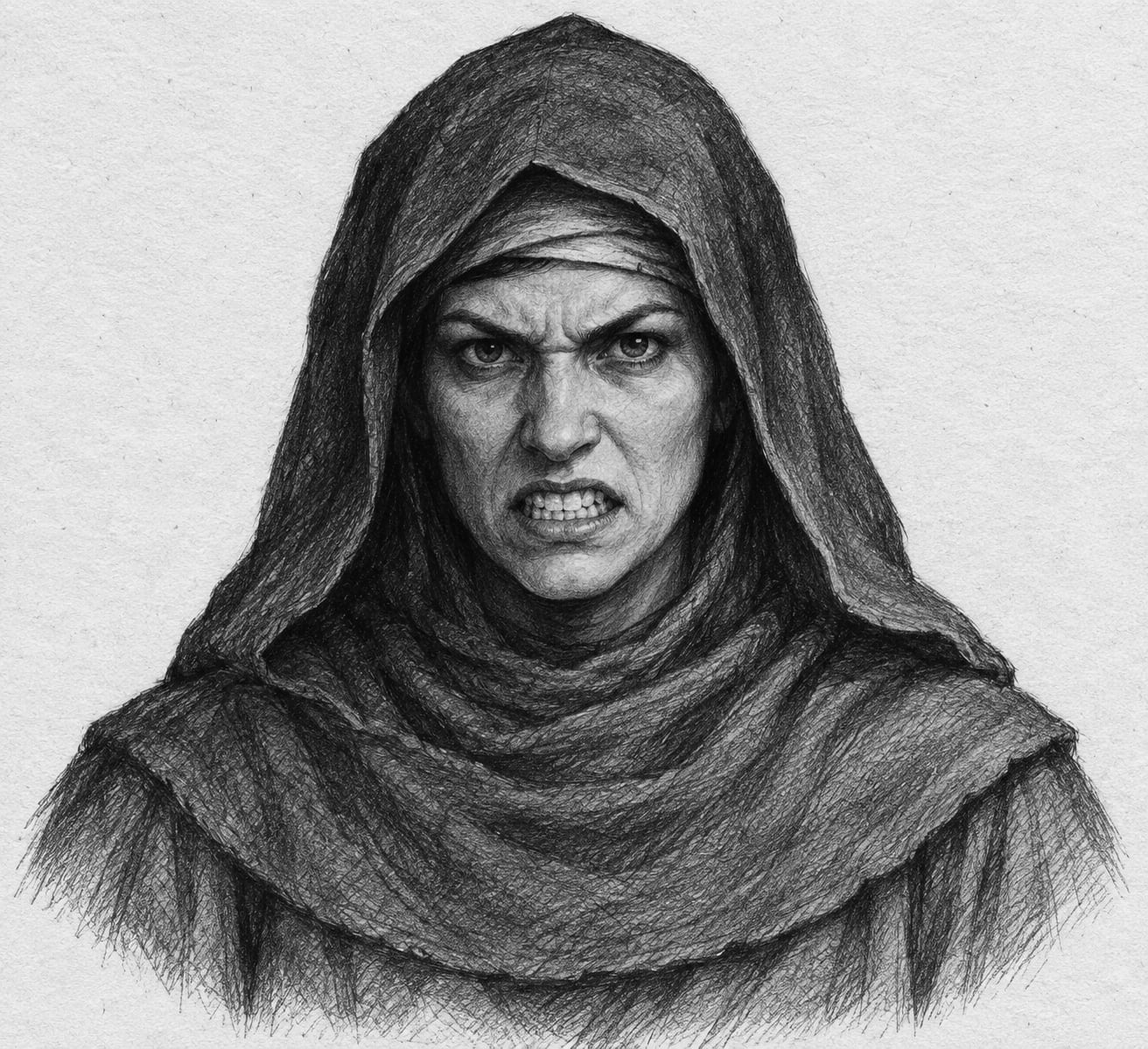
She is remembered as one of the Sisters of the Martyrdom, the women who denied river crossings to advancing columns during the Atheist Wars, and she is remembered at Châlons. The clerks added "of Châlons" to her name because it made her easier to file. It records where a bridge fell. It does not record where she was born, whose daughter she was, what surname she gave up, what work her hands knew before the war, or whether her superiors ever called her Sister in writing. I have no age, no vow-day, no letter and no face for her. I have a name, a bridge, and one paragraph.
This dossier is retrospective. It was opened in A.S. 201 at the commission of the present review and is dated by that commission. The year belongs to my desk. Her own year is missing, and I will not lend her one.
The order's chronology is well enough known. The Massacre at Saint-Malo took place in A.S. 10. The Church recognised Sister Margaux in A.S. 14, by an ecclesiastical tribunal that met long before any Bureau existed to ratify it. The first confirmed Sister action was at the Pont des Tanneurs in A.S. 15, and the order is attested through A.S. 25. Those years belong to the order. They do not fix hers.
The master chronicle of the age calls the Sisters nameless. Most of them are. Bérénice is one of the few who kept a name, which makes her rarer than a relic and harder to shelve.
#On the Arch at Châlons
The other Sisters stood on the bridge. That is what made them famous. At the Pont des Tanneurs, three women in grey knelt at midspan in full view, and the Rationalist column halted because it took them for a parley. Visibility was the method. The enemy had to see the woman before it saw the fire.
Bérénice was under the bridge.
The account says she waited beneath the central arch rather than on the deck. When the column reached midspan, she cut the oil bladders tied along the underside of the span. She lit the taper with her teeth. The fire rose from below, the bridge breathed flame through its own stonework, and the deck collapsed inward under the men standing on it.
That is the whole of it. I have read the sentence perhaps forty times. Each time it holds more tactical sense than any Bureau field manual written since.
Look at what the arch gave her. The Rationalist column could not see her. No officer could call a halt for parley, no marksman could take her from the bank, and no forward party could sweep the deck and find nothing worse than a nun at prayer. She did not have to stop the column at the threshold. She let it come out to the middle, where a bridge is weakest and an army has the furthest to run in either direction. The Tanneurs Sisters bought hours. The woman at Châlons was trying to take the column down with the bridge.
Whether she chose the arch or was placed there, the account does not say. Someone tied the bladders to the underside. That takes time, rope, a boat or a ladder, and somebody who knew which stones would carry the weight. The account names nobody. I know nothing about who brought the oil, who gave the order, if there was an order, or who stood on the bank afterward and remembered.
The hymn-writers have made a great deal of the teeth. I make of them only what the account makes: a taper, her mouth, a flame. Perhaps her hands were busy with the blade. Perhaps they were simply full. Nobody wrote it down, and I will not supply her with a flint, a miracle or a broken wrist to tidy up the sentence.
The account ends when the deck goes down. It does not say what happened to her. No body, burial or ash has been filed under her name. Devotion assumes she burned with the bridge, because the rest of the order burned on theirs. Devotion may be right. The Ledger records only what it holds.
#On the Masonry Account
The Rationalists blamed the masonry.
Their reason is plain enough. A column lost to bad mortar is a matter for the procurement office: someone is reprimanded, a contractor is hanged on paper and the advance continues. A column lost to a woman under an arch is a matter of doctrine. It means bridge sweeps, inspections of every arch and a standing fear of whatever is underneath. In time the Rationalists adopted exactly those measures, with oil inspections and screening of detained women at every crossing. Their first explanation for Châlons was the cheaper one. Armies that have just lost to a nun almost always grab the cheaper explanation.
The masons of Châlons would not have it. They had built the span in their fathers' time, as the account puts it. I do not take that phrase for a construction date, and neither should the reader. They resented secular criticism of their work more than they feared death. According to the account, they later testified that the masonry had performed admirably once it was asked to become a furnace.
That reply is the best thing any guild has ever said in its own defence, and I am wary of it for that reason. It reaches me through my own tract on the order and through the parish memory behind that tract. I have no sealed deposition, no list of the masons' names, no survey of the ruin and no dated transcript. I have a retort good enough to be repeated in taverns, which tends to preserve a sentence and wear away its source.
Three parties with three interests have offered three causes. The Rationalists blamed the mortar to protect their doctrine of the column. The masons blamed the fire to protect their stone. The Church credits the woman because the Church needs her. I am a theologian, not an engineer. I cannot say whether fire under a stone span is enough to drop its deck, whether the mortar was poor, or whether both were true at once. On this single point I have the humility to admit it.
#On the Vow and the Volunteer
The order's habit was grey wool. Its kit was a taper, oil and a blade. Its vow, as reconstructed from fragments, promised to stand where passage must be denied, to spend the body before the bridge was taken, and to leave no retreat for fear. These are things the order shared. They are not facts about Bérénice. I can dress her in grey wool because her Sisters wore it. I cannot prove she spoke the vow, and I cannot tell you what she said, believed or wanted at the moment her teeth closed on the taper.
The question of consent is equally unanswered. The Bureau of Shadows keeps a later file under Seal Obsidian that attributes the order's early organisation to Cardinal Kratz. That attribution is disputed, and his age at the time of the earliest actions sits badly with it. One redacted woman in that file was taken from her household after a debt judgment and later handed the oil. She is not Bérénice, and nothing in the file says she is. It is a warning against generalising. It is not evidence about the woman under the arch.
Some Sisters ran to their bridges. Some were driven to them by war, debt, obedience and the plans of others. Bérénice's single paragraph records what she did. It does not record why she did it, and it settles nothing in either direction. A deed done with that much skill shows that she acted. It does not show that she chose to die, and it does not show that anyone forced her.
A.S. 92 instructional materials stated that "all Sisters of the Martyrdom were free volunteers, moved solely by divine inspiration."
Corrected for internal editions only. Public editions keep the sentence pending pastoral review. The correction reaches Bérénice as far as it reaches every other Sister: it withdraws the universal claim and puts nothing in its place.
#On Her Present File
The order remains unratified. The Bureau of Doctrine keeps its drawer locked in Strasbourg until Shadows clears it, and Shadows has never done so. Present policy lets the faithful commemorate individual Sisters locally as Witnesses of Transit Denial. Ash attributed to the order may be venerated under provisional status, case by case, as long as nobody claims to know whether the woman consented.
Bérénice fits inside that policy and gets nothing more from it. She has not been canonised. The record before me contains no shrine, feast, relic or parish petition in her name. If a chapel near Châlons ever produces an urn and calls the ash hers, the provisional rule will apply, and the Ledger will want to know how the ash got from under a fallen arch into a gilt box.
I can give her these things. She had a name. She belonged to an order whose war is dated even though her own part in it is not. She chose the underside of a bridge when the rest of her order chose the top, or she was put there. The column reached the middle, she cut the bladders, the fire rose and the deck fell. The Rationalists blamed the stone and the masons blamed the fire. Everything after that, and everything before it, is outside the record.