
#On the Tower's Authority
"Time is Holiness, Holiness is Time." — motto of the Bureau of Bells
A city keeps its law in three places: in the ledger, on the scaffold, and in the air. The ledger requires literacy. The scaffold requires an audience. The air requires only ears, which the Creator handed out with a generosity the Bureau of Bells has always found convenient.
Strasbourg, capital of the Synod and seat of the protected western heartland, keeps that third law in its most concentrated form. The great carillon hangs in the Bureau's tower rooms at the Cathedral of All Saints and Settled Accounts, and from this city the Bureau coordinates the regional bells by which the Dominion wakes, prays, trades, bolts its doors and sends its soldiers to the wall. A citizen who has never read a decree has obeyed ten thousand of them. They arrived on the hour, struck in bronze.
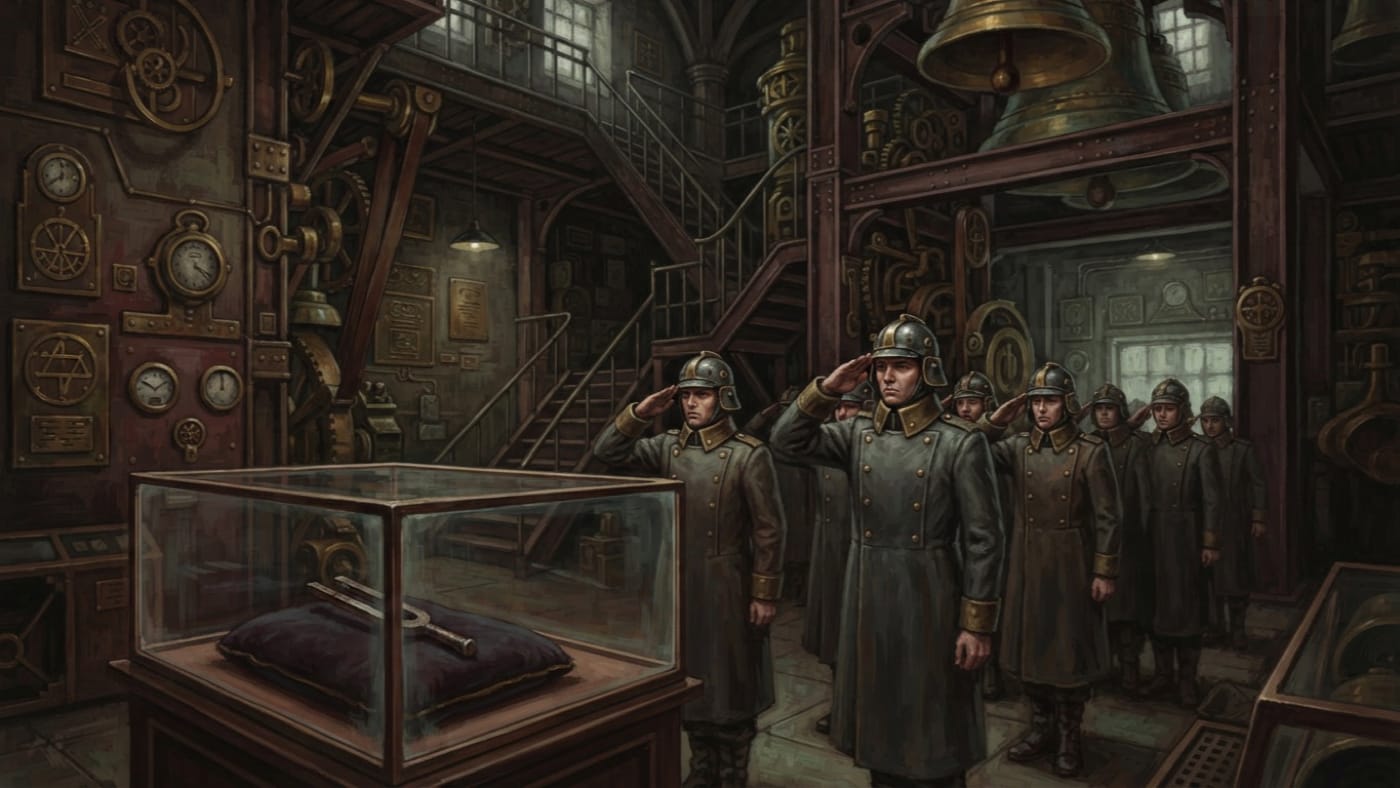
The Bell Tower is where this authority keeps its memory. On the seventh floor, in a glass case, lies the personal tuning fork of Canon Veyl, first commander of the Counter-Toll Corps. Recruits salute it. The Bureau sees nothing comic in this. By the end of their first rotation, neither do the recruits.
#On the Hours Made Law
The Office of Bells was constituted in A.S. 52, sixty-three years before the Bell Codex of A.S. 115 ratified the present standard. Older folios and parish customs survive beneath the Codex the way old boundary stones survive beneath a new survey. Every clerk trips over them eventually.
Under that standard, no lawful peal is ever simply rung. It is licensed. The licence fixes what may sound, at what hour, at what pitch, under whose key and for what purpose: prayer, curfew, alarm, market, gate, convoy, muster. The schedules differ by city and by station. A stroke that opens a fish market in a river town may stand a bastion to arms, and the Bureau prefers that the citizen learn their own schedule rather than wonder about anyone else's. Along the Bellways, licensed sound moves gates, convoys and troops in recognized order from the heartland to the Sagittal Line. The arrangement is efficient and it is total. Its weakness lies in that same totality.
Three offices keep it. The bell-master is an ordained officer whose acoustic jurisdiction can outrank a local cleric's preferences, and he decides what the city hears. The Bellwarden checks pitch, tension and timing, guards keys chained to their own body, verifies the seals, and makes sure the city hears exactly that. The Counter-Toll Operator makes sure it hears nothing else.
Only the third salutes the fork.
#On the Answer to Cologne
The Bureau assumed for decades that its bells were the only bells worth hearing. Cologne corrected the assumption.
On the Night of Borrowed Curfew, a foreign peal entered the city's bell-grid and rang curfew three hours early. Cologne obeyed, as it had been trained to. Doors locked and streets emptied. The garrison stood down. Through the silence the Bureau's own schedule had swept clean of witnesses, something moved. The casualties numbered in the hundreds; the detailed report is sealed. The Bureau of Bells files the night under A.S. 134 and the Bureau of Records under A.S. 136. The Bureau of War files it under Pending Classification. It was one night. The disagreement has lasted a good deal longer.
The Counter-Toll Corps was chartered in A.S. 135, and Canon Veyl, a bell-master of famous lungs and a modest diplomatic vocabulary, was appointed to command it. Master-Carillonist Aldo Venn, whose authority over Strasbourg's cathedral bells needs no elaboration from me, supplied the doctrine's epigram: prevented, no; answered, yes. Veyl supplied the answer, and the answer was volume. He formalized the graduated bands by which hostile sound is buried under sanctioned sound, each tier locked behind a rank.
Pay attention to what the Bell Tower keeps. Cologne's wound has no case on the seventh floor. Strasbourg remembers the reply.
#On the Fork in Glass
The object itself is unremarkable, and that is why it works. It is a plain fork. The stem is darkened where Veyl's hand wore the metal, and the left tine carries a small nick. Every Bellwarden covets a personal tuning fork as a mark of standing. This one marks nothing except use.
The nick has a story. It is said to date from the first Rhine demonstration of Hard Dominance. Records disputes this, and the Bureau of Bells ignores Records, as it does in every matter requiring ears. I record the claim as the Bureau tells it. I do not certify it. A nick on a fork proves only that the fork once struck something harder than it was expecting, and the same can be said of most careers.
The glass is polished weekly. Recruits stand before it in their first issue of brass-and-leather hearing protection, the ear-caps still stiff and uncracked, and render the salute. Senior operators pass the case on the stairs and pretend not to. Their hands sometimes lift anyway, a half-inch, before the elbow remembers its seniority. In this way a working instrument has been promoted to a relic, which in the Bureau's grammar is a tool that no longer does any work and still collects obedience.
Recruit primers describe the fork as "the instrument with which Canon Veyl restored harmony to the bell-grid."
Corrected. Veyl restored dominance. Harmony is for choirs and festival committees. The bell-grid required that every competing sound be overwhelmed, and the primers have been instructed to say so.
The Bureau holds that the salute honors a man. It honors a sentence. Veyl told his doubters that panic under Synod authority was preferable to calm under the enemy's, and the Bureau promoted him for saying it. Each recruit who lifts a hand to the glass accepts that sentence as a condition of service. Louder is cleaner. They say it before they understand it. By the time they do, they are usually too deaf to object.
#On Wrong Answers
A doctrine of volume has a body count among its own practitioners, and the Bureau keeps that count under a clinical name. Sustained Resonance Exposure Syndrome, the operators call bell-sickness, and it comes in order: first phantom peals, bells heard that rang three days ago or will ring tomorrow; then compulsive cadence, fingers and jaw keeping rhythms the operator cannot name; then the terminal stage, in which silence itself becomes intolerable and the operator strikes desk, wall and skull to fill it. The vaults call this going brass. The Bureau calls it a staffing matter.
Four-month rotations are mandated. Front-line bastions commonly ignore the mandate. The rotation review of A.S. 199 recommended remedies and received a stamp reading UNDER ADVISEMENT, which in the Bureau's dialect means it has been filed.
The Corps quarrels over how much of Veyl to inherit. Loud Mercy claims him outright: overwrite early, overwrite hard, drown the hostile signal before the street notices a second voice. Clean Silence prefers dampening, which spares eardrums and windows at the price, its critics insist, of leaving the enemy room to stand in. Both factions salute the same fork. Loud Mercy means it. Clean Silence calls it courtesy.
The fork has one limitation the salute does not mention. It cannot tell the Bureau's voice from a perfect copy. In the Mimic Incident, at a bastion the Bureau has not named and in a year it has not released, a hostile tone reproduced official patterns closely enough to redirect a garrison for seventeen minutes. The Bureau has never identified the source or explained the method. The answer was the living key: authentication spoken by the operator's own throat, on the assumption that a throat cannot be forged. The Bureau holds that assumption as doctrine. I hold it as a reasonable hope.
Ring-back carries the same lesson more sharply. When an overwrite is mirrored back at equal volume and identical cadence, Veyl's answer fails. Procedure orders the operator to stop striking, seal the vault and summon a Dominance Marshal. On the one occasion when louder is fatal, the Corps falls silent. Records lists three such reports in Strasbourg, classified by the Bureau as calibration anomalies. Nothing in the file places any of them within the Bell Tower, and I place none there.
COLOGNE — BORROWED CURFEW — CASUALTY SCHEDULE Filing year: A.S. 134 (Bells) / A.S. 136 (Records) / PENDING (War) Dead: hundreds — itemization █████████ Agent moving in the silence: █████████████ Report status: SEALED
#On the Present Holding
As of the present survey of A.S. 201, the Bell Tower serves the doctrine it was given. The Bureau keeps the hours lawful, the Bellwardens keep the instruments honest, and the Counter-Toll crews keep everything else under bronze. The command chain still begins on the Bureau's ninth floor and ends in an operator's larynx. The fork still lies on the seventh. The glass is still polished weekly.
Recruits arrive with clean ears and leave with Veyl's sentence lodged in them deeper than any peal. Some smile at the salute. Some swallow. The Bureau records both reactions as compliance.