
#On the Towers Along the Wire
"Count the peal, not the prayers." — Bellwarden idiom
The published survey of Bastion-Brest gives the bell-resonance towers one sentence. The Bureau of Engineering has given them none, so this is generous. The sentence is sour: the soldiers ring the bell-resonance towers along the Wire and still wake to find a token valid, a booth compromised, a sentry bribed and a manifest subtly corrected in someone else's favour. I wrote that sentence and I stand by it. This tract is its footnote, enlarged to the size the Bureau of Doctrine considers respectable.
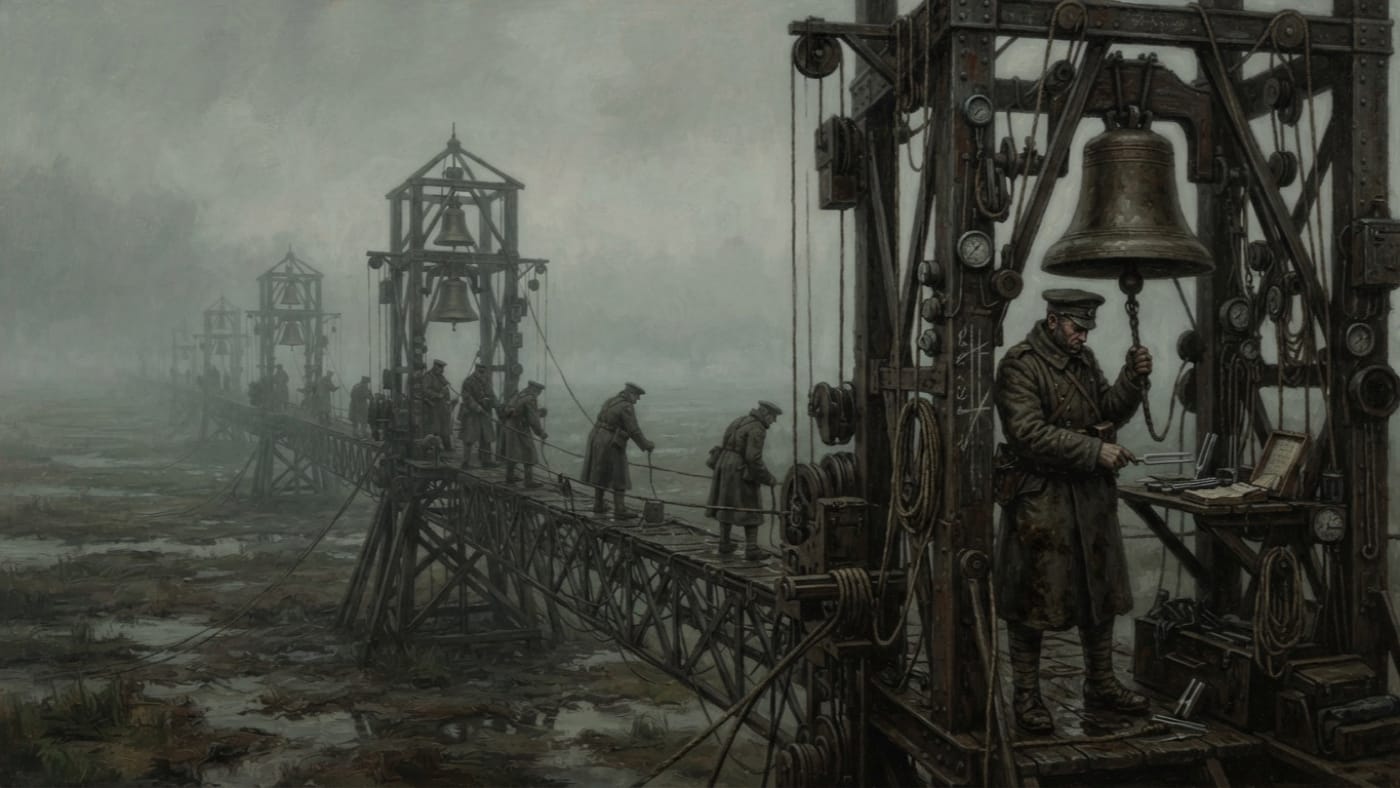
The towers stand along Brest's forward wire, east of the Bug, on the flat and sodden Polish lowlands that the northern sector of the Sagittal Line was given in place of a mountain. Nothing there is high enough to hang a bell from, so the bells are raised on whatever can be planted in mud. I have not been shown how many stations there are, how tall they stand, what bronze they were cast from, or in which year and by whose order they went up. The Bureau of Engineering holds these particulars, or says it does. I record what the garrison can confirm: the towers exist, soldiers ring them, and they are rung every day.
The doctrine of these towers depends on one distinction, which the Bureau prefers left vague. A bell can prove that an order has been given. It cannot prove that the people who obey the order are who their papers say they are, or that the ground they stand on is safe.
#On the Authority of a Peal
"No sin, no step." — Proverb of the Ribs
A peal at Brest has authority because the Bellways give it authority, and the Bellways get theirs from paper. The Office of Bells was constituted in A.S. 52 (1762 CE). Local bell practice is older, as local practice usually is, and it was not consulted. The present Bell Codex was ratified in A.S. 115 (1825 CE). It turned the general noise of the Church into a lawful grammar of peals, silences, curfews, alarms and licences. Since then, a bell rung without a licence is speech outside jurisdiction, and the Bureau of Bells prosecutes it accordingly.
At Brest that grammar governs the crossing. The dawn toll opens the booths. Patrols set their rounds by bell-time. The hush bell ends the day, everyone on the deck kneels for the curfew, and the Ribwalk becomes single-file truth lanes, lit by lanterns, with a confession stop every few pylons. On the Wire, the towers carry warnings, stand-tos and the sanctioned hours to men who cannot see the bridge through the mist and would not trust it if they could.
Authority over all this is divided, as it is everywhere the Synod has had time to work. The Bureau of Bells licenses the practice. Doctrine supplies its meaning. The Bureau of War supplies its demands, usually after dark. Gun-Cantor Marshal Vonn holds the curfew bells. Judge Elsbeth Krail judges whoever breaks them, and Seal-Registrar Hett Ruis stamps the papers that let a person move when the bell says movement is allowed. Each office can show that the peal was lawful. None of them can show that the person moving under it was honest.
#On the Keeping of the Tone
"Keys don't sleep." — Bellwarden idiom
Keeping these towers is manual work, and Doctrine dislikes describing manual work because it so seldom needs a theologian. The Bellwarden's process is fixed by profession and by audit. First he confirms who ordered the peal. Then he calibrates the bell to its tolerance band, checking pitch, decay and strike interval with tuning forks, tension gauges and chalk pitch marks on the frame. He turns the toll-key and checks it against the seal. He listens for any tone that should not be there. Every deviation goes into the log in ink, and where the log demands it he issues a wax-sealed hush or quarantine order.
The Bug makes this harder. Damp gets into the ropes, rust into the fittings and mist into the timing wheel. The oil kit is the warden's most devout possession. He uses it more than his breviary and with better results.
Where a hostile or counterfeit tone gets into the system, the doctrine of the Counter-Toll Operator applies. The source is verified by two listeners before anyone escalates. An authorized overwrite pattern is chosen and confirmed by wax slug and spoken phrase. The response then goes out in rising bands, from a soft drowning of the false tone up to full dominance, while the operator watches the crowd as closely as the interference. I am not told whether every station on the Wire keeps such a crew. The doctrine applies wherever there is a bell, whoever happens to be holding the rope.
The trade puts it bluntly: never ring on a rumour.
#On What the Bells Do Not Stop
"Never chase a wrong note alone." — Bellwarden idiom
East of the Wire is the Nameless Tide. It is not the Grey that walks at Königsberg, and it is not anything the Seven have put their names to. The garrison's reports agree on one point. The bells ring across the Bug and the pressure keeps coming. The Tide does not keep to curfew bells, feast days or the schedules of the Bureau of War. Hymns go into it flattened and come back useless. Relics sweat. A warning peal still has value against it, because it gets men to the firestep before the wire bends. It does not make the wire stop bending.
A Doctrine memorandum described the Nameless Tide as "possibly resistant to current liturgical treatment."
The Tide dossier has already corrected this, and the correction stands here as well: "possibly resistant" meant that the hymns failed, the relics failed and the bells failed. The bells at Brest go on being rung. The memorandum's author has been reassigned to a warmer bastion.
The second enemy uses the bells. Velkara has no need to drown a peal when she can obey it. Her applicants arrive at the hour the dawn toll allows, carrying seals altered too finely for the naked eye, absolution that has been paid for, and passage that is fraudulent but looks correct in every particular. They kneel on time at the hush bell. Their papers are immaculate. No bell has yet been cast that can read a seal, so a schedule kept perfectly protects a forged traveller as well as an honest one. The profession lore records the rest without shame. A warden can sell a "borrowed peal" by lining up a smuggler's window with a sanctioned labour toll, or a "half-hush" that hides an escape and does not alarm the auditors. On the Wire, corruption keeps the timetable better than anyone.
Then there is the Confession Echo. Since A.S. 199 (1909 CE), sins spoken into Brest's booths have come back hours or days later, whispered on the deck in the voice of the person who confessed them. Booth 77, nailed shut, sometimes speaks confessions before anyone has made them. The local countermeasures include salt-wax on the booth seams and shock bells, struck to break the echo loops. The Bell crews also offer clean chants, which the bridge's own records call largely theatre. I have no evidence that the towers on the Wire either cause the Echo or cure it, and I will not invent any. Judge Krail attributes it to the nameless crossings of the Blank-Sheet Circle; that is the Tribunal's theory and has not been ratified. My own suspicion is that whatever presses from the east has learned to use the machinery that hears confessions. It was filed under Outside Current Doctrinal Scope, where it sits in the dark beside better men's suspicions.
There is also the cost to the bell crews themselves. Wardens and operators lose their hearing. They suffer ringing ears, brass-lung, rope burns and frostbite from the wind. Later comes bell-sickness: they hear peals no one has struck, count compulsively, and flinch whenever the air goes quiet. The Counter-Toll manual says crews must be rotated fast because bell-sickness ruins judgement. Brest's rotations are, as the parent survey records, extended routinely.
#On Present Service
"Brest does not break soldiers. Brest files them." — Gun-Cantor Marshal Vonn
In this year of A.S. 201 (1911 CE), the bell-resonance towers along Brest's forward wire are working. They sound the dawn toll and the curfew. They pass warnings down a line of men who cannot see one another through the mist. Every movement on the crossing is timed by them, and the Tribunal, the Crossing Bureau and the gun-crews all depend on that timing. Take the bells away and Brest would have no shared hour at all. The Tide would still be pressing and Velkara's applicants would still be crossing, and the garrison would not even agree on when to stand to.
That is the whole of their usefulness, and it is real. They order the hours. They do not certify anything about the people living through them. The Bureau of Bells will not say so in a sealed report, so I say it here. A garrison that confuses the two will ring perfectly on schedule until the morning it wakes to a valid token, a broken booth and a bought sentry. That has already happened, and the bells were rung on time that morning too.
The Doctrinal holding follows. The towers are to be kept, calibrated, logged and rung. They are not to be cited as evidence that the people who hear them are safe.