
#On the Origin
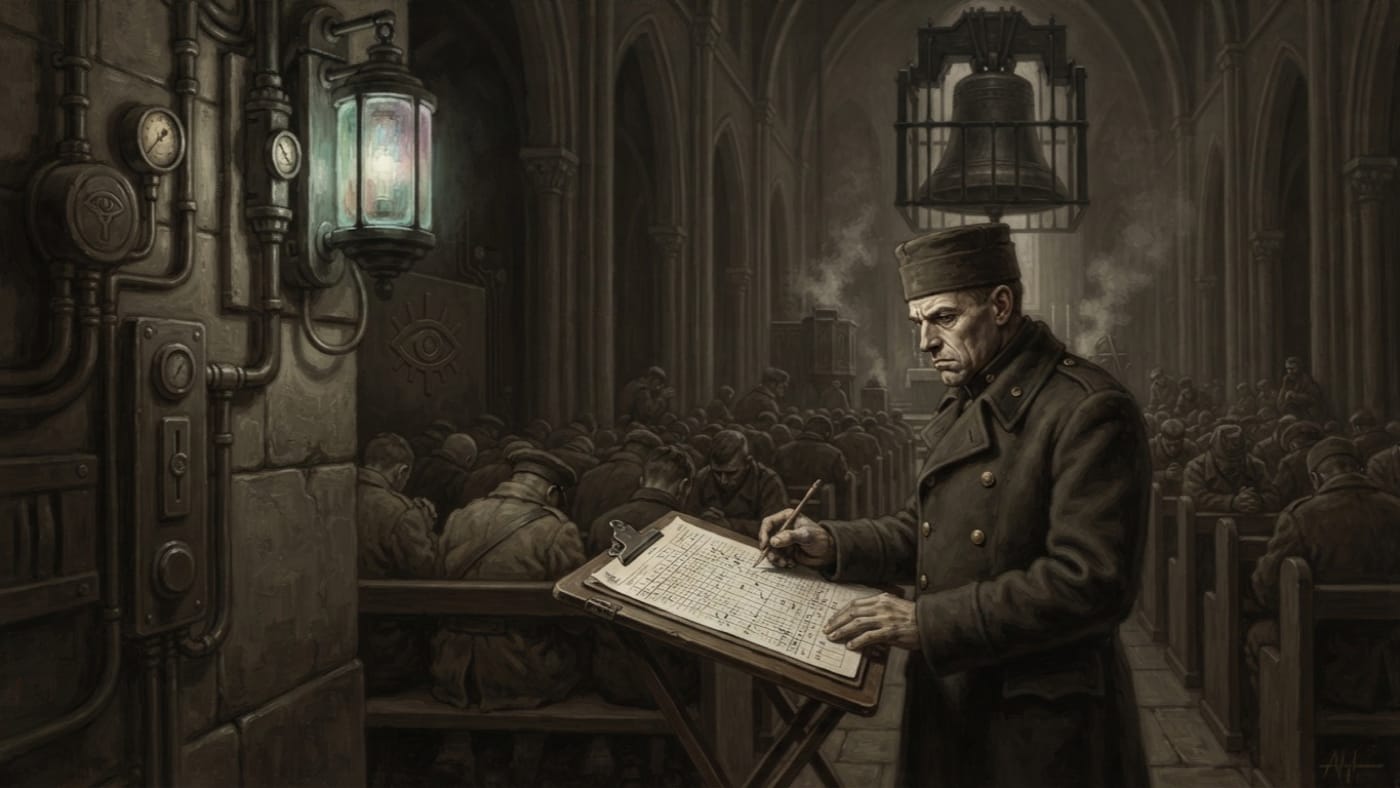
The bell-pause chart is a ruled sheet. On it an examiner sets the answer a congregation owed beside the answer it actually gave, and marks the distance between the two. That is the whole instrument. It has no gears and no bronze. It is paper, ink, a pencil and a trained ear, and it has kept the faithful prompt more reliably than any bell ever cast.
It descends from the southern garrison silence of A.S. 78–83, set down in full under the Schism of the Unspoken. Three regiments on the lower Sagittal Line stopped receiving communion. Their names are sealed, and their chapels are filed variously under Irongate, Shipka and a southern operational annex. They went on drilling, saluting and dying on schedule. Every attendance roll was clean and every duty roster was signed. By the ledgers of obedience those men were faithful, and still they stood motionless before the chalice.
The Church learned an expensive lesson there. Attendance proves there is a body in the pew. It proves nothing about the amen. Heads can be counted. Assent cannot, and assent was what had gone missing, half a second at a time, between the bell and the response.
In A.S. 84 the Bureau of Purity issued Standing Order 22-D. It classified silence as communicable and required any congregational hesitation beyond Bureau Standard 7-C to be reported to a Variance Assessor. You cannot report a delay unless somebody has first written it down. No folio this office will certify says when the first chart was ruled, by whose hand, or in which annex. The lineage is plain. The birth certificate is missing, which suits an instrument whose business is absence.
District primers describe the bell-pause chart as the instrument by which the Schism of the Unspoken was contained in A.S. 84.
Withdrawn. The first cluster was contained by rotation, replaced chaplains and burned hymn boards. The chart belongs to what came afterward, which was the habit of watching for the silence to return. The primer's authors have been invited to reread the record slowly, pencil in hand.
#On What the Chart Measures
Every rite turns on small hinges: the bell and the kneel, the question and the amen, the confessor's prompt and the penitent's approved reply. The chart is concerned with those hinges and nothing else. The cues the rite will give run down the sheet. Against each one the examiner records when the answer came, whether it came whole, and which part of the nave was slow to join it. A late kneel is marked. An amen that comes out thin, or from only half the room, is marked. So is a response that drops a clause or swaps in a word of its own. Here the chart relies on the Confession Reform of A.S. 104, which made approved phrasing uniform enough that a missing word shows like a missing tooth.
The threshold that governs is Bureau Standard 7-C. Purity sets its value and Purity keeps it, and it will not be printed here. A published number is a number the faithful can rehearse to.
Two confusions should be ended. First, the chart is not a bell timetable. The hours of ringing belong to the Bureau of Bells. The strike intervals, peal charts and calibration logs kept in the towers are the work of the Bellwarden, who checks whether the bronze spoke on time. The bell-pause chart measures the people who were meant to answer it. A Bellwarden's log can show that the bell rang late. It cannot show that the congregation doubted. The examiner's chart cannot show that either, and examiners are trained not to say so aloud.
Second, not every quiet interval belongs on the sheet. The Church commands silence as readily as speech: at the elevation, during the Quiet Hours, and in the cloister after the closing bell. A silence the rite prescribes is obedience. The chart records the other kind, silence in the place where a word was owed.
What the chart records is time, sound and omission. What it is used to allege is belief. The gap between the two is exactly as wide as the examiner's discretion, and the Bureau has always preferred to leave that gap unmeasured.
#On the Passage from Pause to File
One pause is nothing. A pause written down is a datum. Written down twice, in two ledgers, it becomes a pattern, and a pattern becomes a case.
Auditor practice fixes the order. The examiner first takes the baseline: the approved responses, the district's ordinary tempo, and the habits of this particular nave compared with the last. Next the drift is marked on the chart. Then comes the comparison, where the Records Scribes earn their bread. The chart from the chapel is laid beside the ration-hall attendance, the factory roll, the schoolroom recitation log and the confession abstract. A clerk who hesitated once at the amen is a tired clerk. A clerk who hesitated at the amen, missed a clause at recitation, and confessed in phrasing two seasons out of date is a clerk with a file.
Next comes the interview, scripted at first and less so afterward, in a room with a bright lamp and a clean chair. Then the case is classified as benign hesitation, contagious doubt, organized heresy or infiltration. Then comes the response. The profession's own lists give it as penance, public recitation or reassignment, and in some cases blackmail or erasure, which the Bureau does not discuss in articles that carry pictures. The chart prescribes no sentence. It supplies the first line of the file, and every later reader trusts the first line.
The reports come from many hands. A Street-Vicar whose corner cadence test turns up a slow tongue sends in a referral slip. A schoolmaster notes which pupils mouth the Fourth Article a beat behind the rest of the room. A foreman keeps the tally at the factory's devotional bell. Each of these is a small observation, and on its own each would die. Gathered onto the chart's ruled lines, they gain the durability of record. A record in the Church never dies of age. It is only refiled.
#On the Authority of the Measure
The Bureau of Doctrine defines a correct amen. Purity decides what to do about an incorrect one. Records keeps both opinions in neighbouring drawers. The chart sits among all three. In practice Purity's examiners hold it, and in principle everyone claims it. Every quarrel over jurisdiction comes down to one question: whose reading of the pencil marks governs? Doctrine says the marks are evidence of drift, that drift is a theological term, and that theological terms are Doctrine's. Purity replies that a theological term nobody enforces is a hymn. Records replies that it holds the original.
The trouble lies in the human material. Fear delays an answer exactly as doubt does. On paper both take up the same quarter inch, and the chart cannot tell them apart. Grief slows the tongue as well. Widows at requiem respond notoriously badly, which is why novices train on them. The rehearsed answer is worse. The street practises its responses aloud, and a man who drilled his amen at the kitchen table delivers it in perfect tempo. To a cold reader that is performance. Performance reads as fear, and fear reads as doubt. The profession keeps an idiom for this: a clean tongue is trained.
Then there are the quotas. Judge an examiner by the variance found, and the examiner will find variance. When a chart comes back empty from a district, it accuses the examiner who ruled it. The manuals name this failing, and the Bureau goes on counting.
Blessed Marrow-Eye Lestine, patron of the profession, is said to have condemned an entire choir because its harmony hesitated. The legend is attached to no chart, and the Bureau credits no instrument to the Blessed. Auditors tell the story to prove that a holy enough ear has no need of paper. Then they go back to their paper.
The southern files carry a warning of their own, which Purity preserved and everyone else ignored. The trench chapels at Shipka stand in the pass. There the rock throws a bell's note back late, the men answer after sleepless nights, and the guns keep a tempo of their own. A pause measured at Shipka measures the pass, the fatigue and the soldier all at once, and no column on any sheet separates them. Doctrine has ruled this a matter of interpretation. The examiners interpret.
#On Its Present Application
The chart is used wherever an answer is owed. It is used in factory halls after Ninth Bell, where the shift recites before release and the foreman's tally goes up the stairs with the soot. It is used in schoolrooms during the Fourth Article, where children learn the response and its tempo in the same lesson and are never told which of the two is graded. It is used in the trench chapels on the Shipka front, where men sleeping upright are asked whether their souls are still awake. There an examiner in a dry coat stands at the back by the stone wall, the same spot the southern regiments once chose for the opposite reason.
The population has learned the instrument without ever seeing it. Congregations answer on the last shiver of the bell. Mothers teach hesitant children to cough instead, because a cough is a bodily event and the chart is not a medical form. Penitents arrive with the approved phrasing written inside their cuffs. The examiner hears the amen land early and reaches for the pencil anyway. Early is also a tempo.