
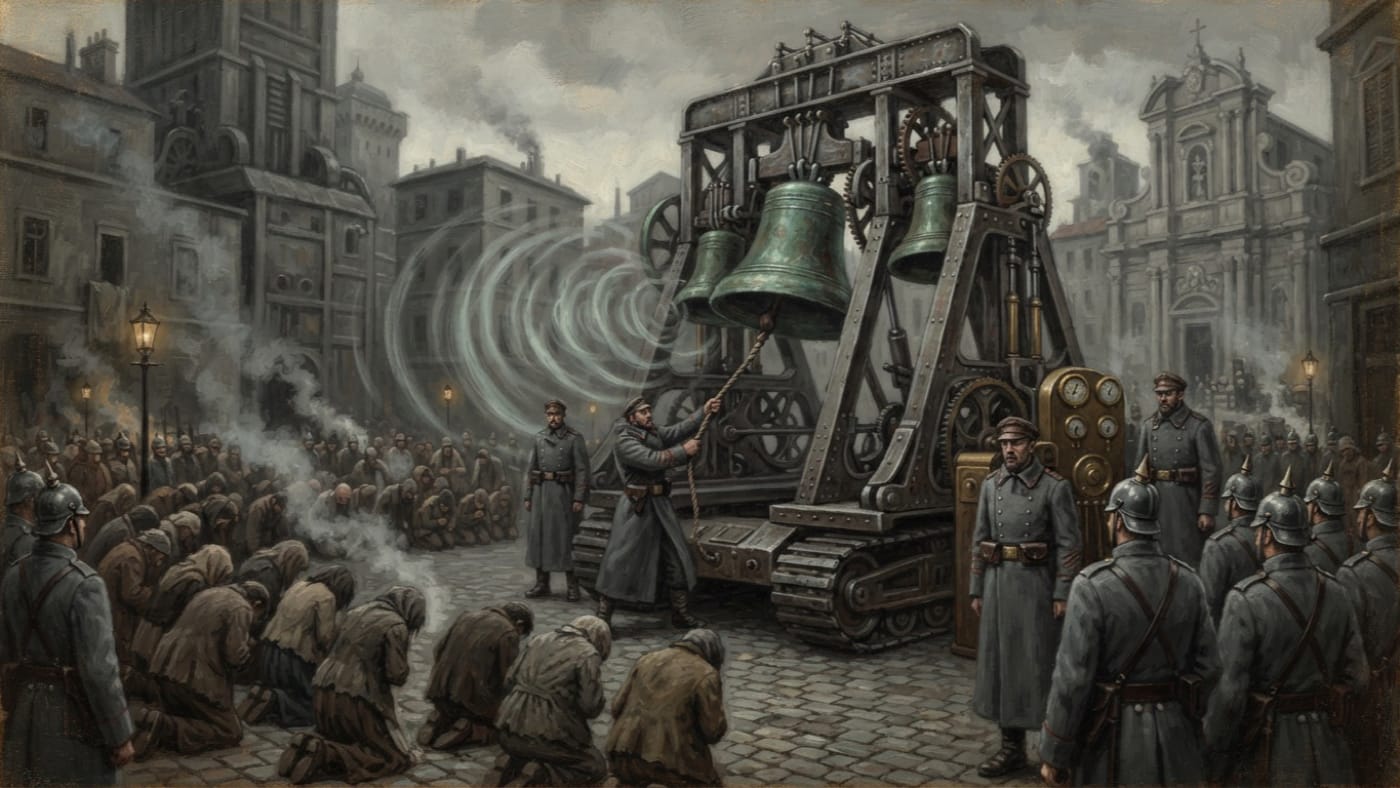
Bell-Litanies: a survey of the sanctioned peal that commands the body. Prepared in A.S. 201 for chaplains, bell-teams and the clerks who must reconcile the debit afterward.
#On the Sanctioned Sound
A Bell-Litany is a peal that the body obeys. The Bureau lists it among the sanctioned techniques of miracle, beside Reliquary Fire and the Ledger-Bindings. The list gives its uses in one plain line: to rout a mob, to halt a riot, to call stragglers back to their banners. A mob routed by a Bell-Litany has not been persuaded of anything. A recalled straggler has not weighed the arguments for returning to his company. His legs took him there. He arrives looking like a man who has been asked a question he does not remember hearing.
The Synod rings a great many bells, and nearly all of them are something else. The dawn toll, the labour peal, the ration peal and the curfew are schedule, set down in the Bell Codex and kept by the clock. They command by habit and by fear of the bailiff. Bell-hour accounting is clerical arithmetic. The covert instructions alleged in the Bell Codes belong to another file and to listeners nobody has identified. The Bell of Names stands so high on the ladder of grace that no chaplain should mention it in the same breath as a regimental peal. The Bell-Litany sits low on that ladder. It is licensed, portable and routine enough to be issued against a chit. What sets it apart is that the hearer is never consulted.
I have read the licensing returns for this survey. They are in good order. I mention it because it is the last comfortable sentence in the entry.
#On the Keeping of the Peal
Doctrine holds that miracle and sorcery use the same mechanism: power from beyond the mortal sphere passing through a material conduit. The source decides which is which, and licence establishes the source. For the Bell-Litany the conduit is bronze, rope and air, and each of the three answers to a different office.
The Bureau of Rites licenses the technique and prescribes the observance a chaplain must keep before anyone touches the rope. The Bureau of Bells regulates the instrument: casting standard, tonal tolerance, strike interval, the schedule into which a Litany must be fitted, and the debit afterward. The Bureau of Orison and Song governs hymnals, voices and choirs. It also supplies the doctrine that sound is the lash of Heaven, and defends that phrase whenever Bells tries to claim it. The Bureau of Doctrine certifies what the peal meant. The Bureau of Records writes down what it cost. That makes five seals on one rope. No bell-team has ever rung faster for any of them.
Licensing is the theology. Keeping the peal is the work. A Litany pitched a fraction flat is ordinary noise at best. The Bellwardens who maintain the instruments wear their toll-keys chained to their bodies. They carry tuning forks wrapped in wax paper, tension gauges, oil, and chalk for marking pitch on the frame. They wear leather caps over their ears, and their forearms carry rope burns like service stripes. They count. Most of them cannot stop counting. The Bureau records this as an occupational condition of the trade, and so as no business of grace. Deafness, rope burn and the counting are the wages of the tower. Grace keeps its accounts in a separate book.
The Office of Bells was constituted in A.S. 52, three years after the Miracle of Cologne showed what unscheduled bells could do to Wrath and what they did to their own ringers. The present Bell Codex was ratified in A.S. 115. The Bureau likes to fold the two dates into a single founding. They are sixty-three years apart, and I have the folios. Cologne is the Bureau's precedent for sacred bronze. Nobody has shown me a document that calls it the first Bell-Litany, and I decline to be the first to write one.
#On the Cost of Obedience
The faithful pay for grace. The doctrine is old, and for the bell it is exact. When a battlefield peal is rung, fear leaves the soldiers within earshot and courage takes its place. They taste iron. A fatigue settles into the marrow that no ration will reach. They pay for valour with weariness, and they pay it standing up.
The company pays a second time on paper. A bell-hour chit is drawn from the allotment, and the Bureau of Bells marks the debit. Quartermasters often treat the two payments as one. They are separate. The chit is the entitlement, the permission to spend. The body is the purse. A company with chits to spare can still be too spent to stand. A company that has used up its allotment may not ring at all, however fresh its men. The Bureau of Tithes will explain why at length, in writing, to whoever survives.
A community that spends grace too often builds up devotional debt. Its symptoms are bread that tastes of ash, bells and hymns heard at night where nothing is ringing, and a joy that cracks in the throat when it is needed. These are general symptoms. They do not follow every peal on a schedule, and no chaplain should promise a widow that her husband's sleeplessness was a Litany's doing. It may have been the trench. Records will decide.
So the cost falls on the bodies of the faithful. That is the doctrine, and the doctrine calls the payment willing.
#On the Three Bells at Ragusa
At Ragusa, on the Adriatic, three bells were sounded in sequence. The first said rise. The second said kneel. The third said burn. The crowd in the square obeyed each command in turn and set itself aflame. No Warden drew a blade.
That is the whole of the record I am permitted to cite, and the whole of what anyone has written down that I trust. It gives no year. It names no commander and counts no dead. It does not say what offence brought the crowd into the square, or which square, or what burned beside the bodies, or how the fire was lit. Those columns are empty, and I leave them empty. A historian who fills them is writing fiction. A clerk who fills them is committing forgery. I have been both in my career and do not intend to be either today.
The sequence shows something the Bureau declines to print. Rise is an order any sergeant gives. Kneel is an order any priest gives. The Litany's real property shows only at the third bell. There the body carries out an order that every instinct in it refuses, does so without delay, and does it to itself. The crowd struck no ringer, broke no line and did not run. The bell-team stood at its frames and kept time.
Doctrine teaches that the cost of grace falls on the faithful who invoke it, and that they pay willingly. Ragusa sits beside that teaching in the same file, and the file makes no attempt to reconcile the two. It does not say who paid the miraculous expenditure: the ringers, the company whose allotment was drawn, or some other account. It does not say whether anyone in that square resisted, or tried to. Doctrine has supplied no consent for the crowd and no waiver. I will not supply one either. A chaplain who asks me what the burning cost in devotional debt will get the answer I have: unrecorded.
The Bureau's fondness for Ragusa over gentler cases is easy to explain. A routed mob proves the technique works on an unwilling crowd. A recalled straggler proves it works on a deserter. Ragusa proves the work has no floor. A war ministry wants to hear exactly that, and it is what the Bureau of Orison and Song means when it calls sound the lash of Heaven. A lash is useful exactly to the degree that it cannot be refused.
Earlier editions of this Codex described miracles as "not breaking reality at all."
Deprecated pursuant to the Bureau of Records, Fourth Revision. The preferred formula is "breaking without blemish." The Bureau of Doctrine holds that sanctioned fractures heal. Readers who consult this entry beside the Ragusa file are instructed to apply the formula to reality and not to the square.
#On the Foreign Peal
A sound that commands the body commands it no matter whose hands are on the rope. The Bureau knows this better than any heretic, which is why Bellwardens chain their keys.
The bellways carry schedule, alarm and command along the same bronze. A captured tower can ring a lawful cadence for an unlawful purpose. A counterfeit fork can teach a foreign bell the Synod's pitch. A crowd routed by a false peal runs as obediently as one routed by a true peal, and usually toward someone waiting for it. Along the Sagittal Line the danger is military. Behind it the danger is civic. In both places the hearer has no means of checking the licence of the bell that moves him.
The Synod's answer is volume. When a hostile tone enters the grid, crews of Counter-Toll Operators flood the corridor with sanctioned patterns, louder and longer, in rising bands. They keep going until the foreign signal is drowned or the crowd can no longer stand. It often works. It works less well when the enemy holds the pattern sheets. It never guarantees which way the crowd will move once the competing commands have finished with it.
Grace rarely meets its rivals tidily. At Skopje a bell was rung against a contract that Greed had written into a debtor's bones. The clause demanded obedience. The chime demanded repentance. The debtor himself pulled the rope. The parchment burned blue, and his heart burst before the altar. The Bureau files Skopje as a successful countermeasure. It was no Bell-Litany. I cite it only to show what happens when two commands claim one body: the body settles the dispute.
#On Present Application
In this survey year, A.S. 201, the Bell-Litany remains in ordinary service. Chaplains apply for it through Rites. Bell-teams in grey greatcoats carry bronze to the riot and to the field. Companies spend their chits to bring stragglers back to the banner and get the iron taste in return. The licensing returns come back stamped and complete. No column on them asks what the crowd was told to do.
I have filed this survey with the Ragusa sequence written out in full, as the Codex requires: rise, kneel, burn. The clerk who copied my draft underlined the third word. I had the page redone. The Codex prescribes no emphasis.