
#On the Guild and Its Clapper
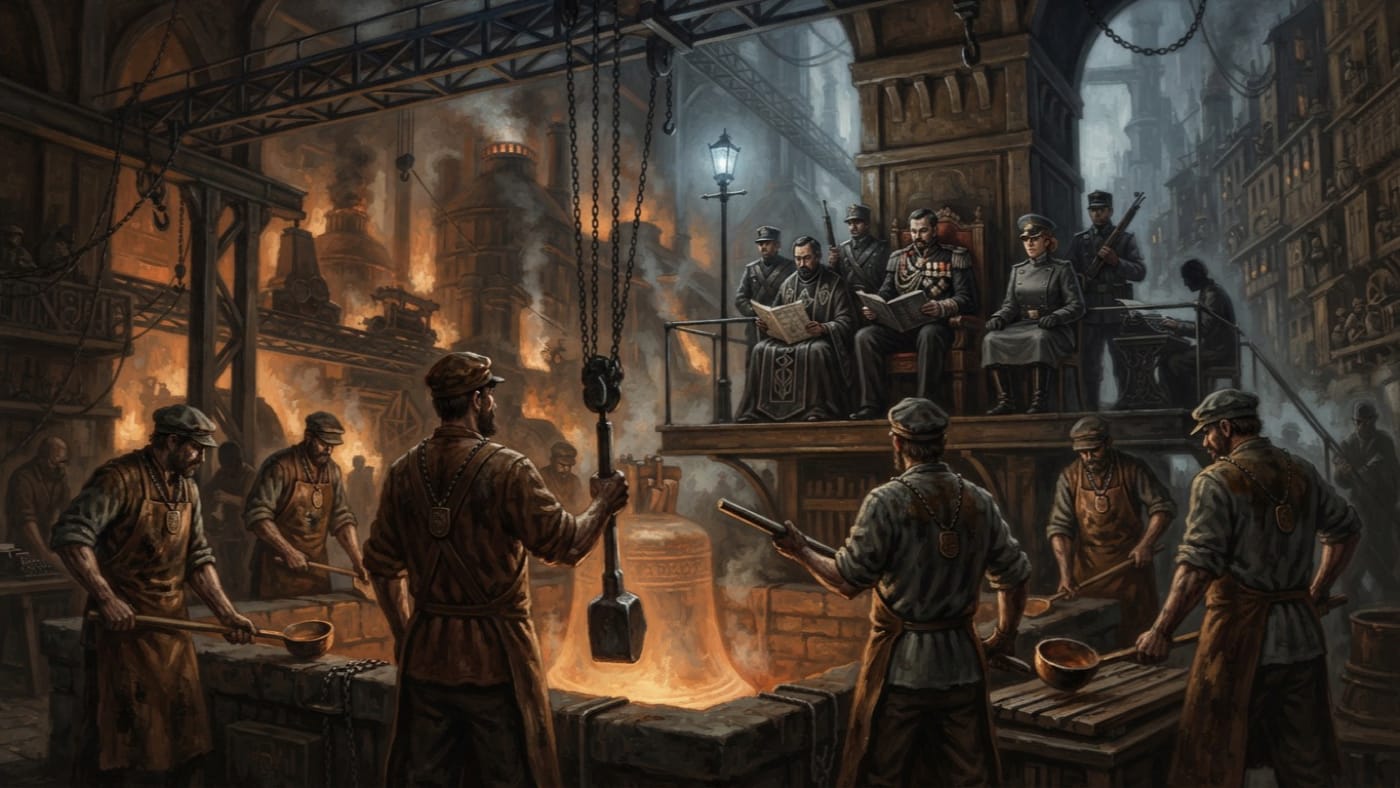
The Bell-Founders of Essen came to the Second Concordat of Münster in A.S. 105 with six masters and a portable clapper. The record stops there. It gives no names, no charter and no founding saint, and it gives no list of earlier masters reaching back into the smoke of the old river forges. It gives a number and an object. Six masters in chains of office stood beneath the west vault of Münster cathedral. The account does not trouble itself with their faces. Among them was one clapper, carried the way another delegation might carry a banner.
I admire the clapper. A banner tells you what a guild wishes to be called. A clapper tells you what it can do. Swing it against bronze and the bronze answers. Hang it in the wrong bell and the whole tower is embarrassed. The Bell-Founders chose the one object in their trade that means nothing without the bell it strikes. They set it before three presiding delegates who, by the end of the proceedings, owned the right to decide what every bell meant.
A guild that casts a province's bells cannot be done without. Being impossible to replace has never given anyone the right to ring what they make. Münster made that distinction permanent, legible and hereditary, which are the three conditions under which a distinction becomes law.
#On the Thumb and the Descendants
Three delegates presided. Archon-Mediator Havel sat for the Bureau of Tithes and Canon-Praelate Odmar Voss for the Bureau of Doctrine. Guild-Commissioner Elsbeth Renn needed no Bureau behind her to be feared. Nine hundred and ninety-nine guilds entered the compact by blood. I stress guilds. The vellum carries the opened thumb of a chief artificer for each signatory body. It does not carry the thumbs of every journeyman, apprentice and widow those bodies contained, and there lay the economy of the instrument. One wound bound the household, and the household bound its descendants.
Whose thumb bled for Essen the file does not record. It may have been the eldest master's, the loudest's, or the one who lost a wager on the road. I decline to invent a hand.
What the thumb bound is better documented. Craft, household, apprentices, descendants, tools, debts, methods and every future improvement in method all passed into obligatory production. The clauses applied alike to all nine hundred and ninety-nine. The Bell-Founders got no annex and no exemption, and the file shows no sign that anyone thought to offer them one. A bell-founding household felt the clauses in this order.
The guild rolls went into Synod custody. From then on a master learned who his journeymen were when the Bureau of Records saw fit to tell him.
Every child born into the craft was registered at birth according to projected craft-value. An infant of the Bell-Founders therefore came into the world already appraised as a likely caster, a likely mould-maker, or a likely nothing.
Tool-patterns were filed. The strickle-boards and loam templates a family had kept beside its hearth became documents in another man's cabinet.
Secret methods passed into Doctrine's custody. The guild could still practise the mix of copper and tin, the timing of the pour and the tuning of a bell by paring its lip, but it could no longer own them.
Maker's marks were standardized, licensed and taxed. A founder who cast his sign into a bell's waist now paid a fee for admitting that he had made it.
Summaries formerly prepared in this office describe the Bell-Founders' incorporation at Münster as a partnership between guild and Synod.
Corrected. Partnership was the language of the first draft, which nobody signed. The delegates signed the third. A partner is someone who may leave.
One guild did not sign. The thousandth artificer refused hereditary registration. By dawn the district tied to that refusal was gone, and the maps were amended to agree. The surviving file does not say which guild the artificer served, and nothing in it points to Essen. By then the Essen delegation had given its blood and gone back to its lodgings, like every other delegation with a bandaged thumb. Doctrine calls what followed a miracle. The Bell-Founders went home to Essen with their obligations and, as far as any ledger shows, asked no questions on the road.
#On Making and Permission
A bell is the loudest instrument of obedience the Church possesses. The people who pour it have almost no say over its voice.
This division did not begin at Münster. The Office of Bells was constituted in A.S. 52, fifty-three years before the Essen delegation bled. The present Bell Codex, which fixes the Ninefold Matins, the Widow's Toll and the High Angelus, was ratified in A.S. 115, ten years after Münster. Any founder who swears the Codex was read aloud over the basins is selling you a cracked bell.
Consider how the offices divide the work. The founder casts the bell. The Office of Bells decides when it may ring, how often, and in which tones. Bellwardens hang it, calibrate it, ring it and arrest whoever rings it without them. The Bureau of Orison & Song decides which stanzas may accompany it. The Litany-Engineer maintains the mechanism and recites the authorized liturgy as the work proceeds. The Furnace Catechist explains why a pour went well. Doctrine explains why it went badly.
When the miners of Liège rang their own shift bells without sanction, the Bureau scourged the guild and melted its bells into shackles. I mention the precedent so the Bell-Founders may reflect on how a product can end its career. The foundry pit is where a bell is born. Its voice belongs to other offices from the moment it is lifted out.
#On Essen's Furnace Schedule
That was the obligation in A.S. 105. What follows is its condition now.
Essen-of-Hymnsteel lies in the central German heartlands. It is a rear supply city, well behind the Sagittal Line, and it sends freight south by rail spur to Bastion-Constantinople. According to the registry, the city has been governed since A.S. 110 by the Tri-Bureau Compact. That later municipal settlement joined the Bureau of Engines & Furnaces, Records, and Orison & Song. It is not Münster, and nobody at Münster could have known it was coming.
Today three officials divide the city's working day. Furnace-Marshal Kord controls the furnace schedule, the fuel and the overtime. Master-Calibrator Sister Rauth controls which calibration stanzas are approved. Arch-Notary Veyl controls certification. None of the three is a Bell-Founder, and the file does not suggest any of them was ever apprenticed to one. Every master in Essen pours when Kord permits, under stanzas Rauth permits, and ships when Veyl stamps.
Major pours go forward with paired choirs, so that no stanza ends alone. Orison holds that the Psalm-Measure sung over the crucible aligns the grain of the metal. I record Orison's position with the deference it demands and the attribution it deserves. Nothing leaves the city without clearing the Seven Locks, and nothing clears the Seven Locks without a seal.
Essen makes bell-cannon throats, hymn-drive housings and reliquary fasteners for the Line. Those are the city's capabilities. The Ledger does not tell me what share of that work the Bell-Founders cast, and I will not flatter the guild with a monopoly it has never been granted.
The costs of the city are the city's own. Guild quotas, debt bondage, labour-hours and the voice tithe organize its work. The poor rent warm floor near the vents and are half-deaf by thirty. Ear-plugs are stamped and serialized, and unlicensed ones count as contraband. The skilled buy rooms in the Quiet Gradient lined with felted ash and pay for an extra hour of silence. A master founder with a good stamp may afford a quiet bedroom. His apprentices sleep beside the ducts.
This is the bargain the guilds pretend they never struck. The Line does not haggle. It requisitions, pays, and requisitions again. A foundry fed by an endless war cannot fail for want of orders. It can fail for want of permission, and permission is issued in triplicate by three offices that dislike one another.
#On the Continuing Obligation
The clauses from Münster have not gone quiet. Every child born into the craft is still registered and valued. Every method remains in custody, licensed for use and not for ownership. Every mark is still taxed. The six masters are long dead. Their descendants still owe what the thumb pledged, even though none of them ever saw the vellum.
Production is pressed from three directions. Engines & Furnaces asks for more. Orison asks for stability. Records profits from both demands. Beneath all three runs the city's established hazard, which Orison calls holy alignment and the workers call the Wrong Choir. On certain nights of the Resonance Bloom the foundations sing back: tools hum on the benches, teeth ache, rivets shear and ears bleed. The foundries go on pouring through such nights, because the quota does not recognize the foundations as a party to the compact.
The clapper they carried to Münster has not been traced. Its absence troubles me less than it should. The Synod took the guild's rolls, patterns, methods and descendants into custody, and left the Bell-Founders what they had started with: the knowledge of how to make a bell speak, and no say in what it would be made to say.