
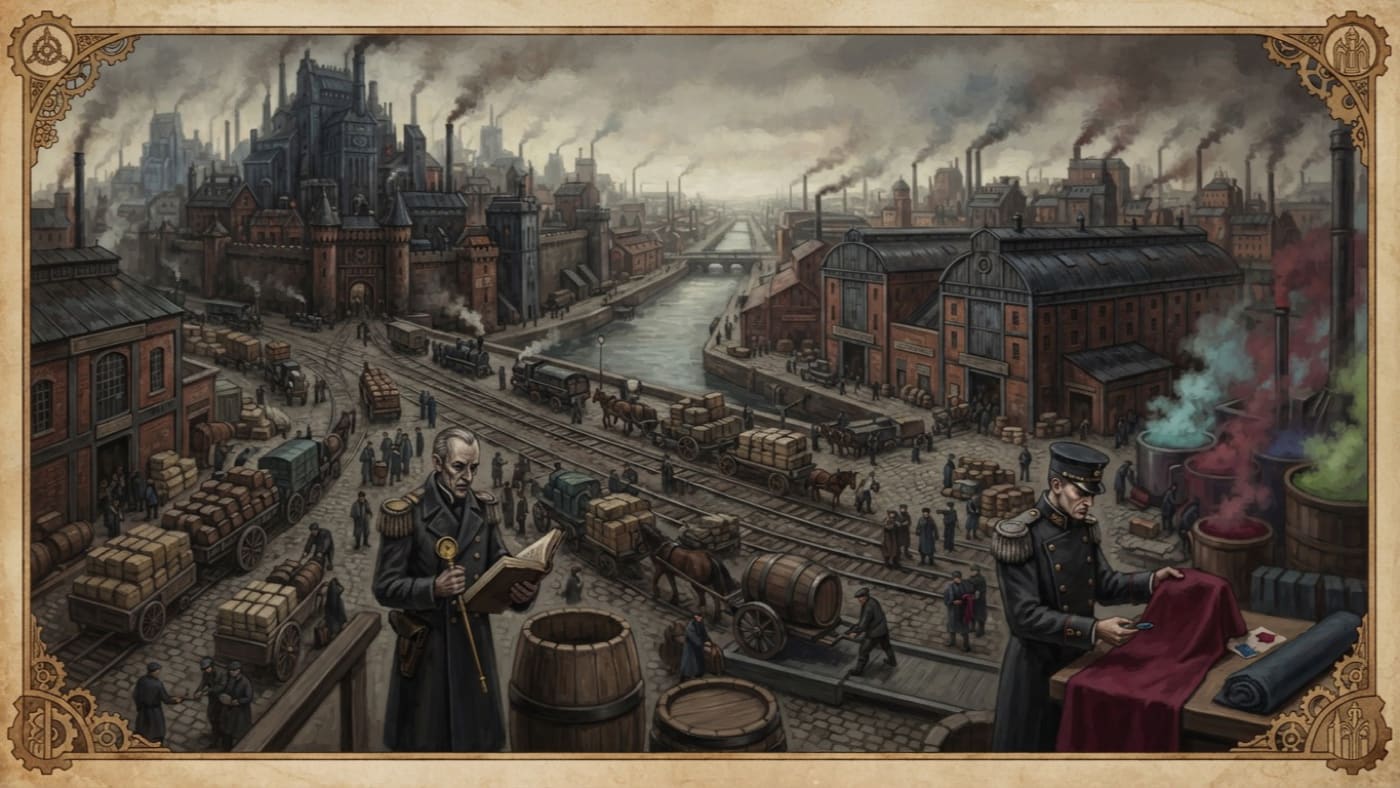
#On the City's Supply Function
Beaune is a wine city in a province of wine and the one Burgundy names when it means the wine itself. The provincial plate puts it briefly: Dijon sends clerks, Beaune sends wine, Autun sends saints. The clerks file and the saints are revered. The wine has to be counted, loaded, carted, tasted, taxed and drunk, and every one of those verbs belongs to a different office of the Synod.
This plate is the survey commissioned in A.S. 201 for the Burgundian supply and craft registers. It records the city as it works now, with its casks going out, its dyers under watch and its coopers on the register. It offers no founding legend. My reach holds no founding charter, no reliable census and no municipal map, and I will not paint one for you. Beaune lies in Zone 1, the western heartland, safe behind the Sagittal Line (Unregistered). It is safe enough that its dangers are mostly clerical.
The roads from the city run toward the Rhône corridor and the intake road for Lyon. Wine goes down them, and so do sons. This survey is about the wine.
#On Wine and the Counted Cask
A Beaune cask goes to a cellar before it goes to any road. Each office treats it there as a different object.
To the Bureau of Tithes it is a volume. The provincial apparatus of cask gauges, evaporation tables, mould allowances and spoilage schedules applies in Beaune as it does anywhere vines grow in Burgundy. A gauger lowers his rod, notes the reading, consults the evaporation table for the season and the cellar's depth, and enters a figure that is already a small fiction. The vintner disputes it. Burgundian loss categories multiply faster than inspectors can disprove them, and Tithes calls this fraud. The cellar calls it the angels' portion and asks whether Tithes means to audit angels.
To the Bureau of War the same cask is a ration. Wine keeps, travels and disguises bad water at a mustering field, and it steadies a boy who has just been told which yard he will sleep in. It goes to chapel stores, officer tables and fever wards, where it is the only medicine the patient asks for twice.
To the Bureau of Temperance it is appetite in a container. Temperance regulates what War requests and what War denies requesting, and the two exchange memoranda on the subject with the courtesy of men who share a cellar and dislike each other.
Beaune's place in this arrangement is supply to the provincial system. I hold no record assigning it a fixed quota, a sole customer or a weekly convoy. The carts are loaded in the yards. The ledgers are checked against the casks. The casks go south by roads the province has used since before anyone stamped them.
Early provincial surveys described Burgundy as "principally a devotional wine province of limited military significance."
The A.S. 110 levy tables corrected this when they showed the province supplying recruits, transport teams, cask rations, chapel stores and cloth. Beaune's wine stopped being devotional the moment War discovered it could be issued by the cup.
#On the Dyers and the Approved Shade
Beaune dyes cloth for a living in a province whose name was once a prohibited colour. Nobody in the city thinks this amusing.
The Chancellery of Colors, a sub-body of the Bureau of Heraldry, licenses dye lots and revises the approved palette every quarter. Swatch sets are cut, numbered and sealed in blue wax, then issued to the Sigil Inspectors, who hold them against sleeves, ribbons and bolts in market light. A dyer's lot either matches the folio or it does not. Since the palette changes four times a year, a dyer can mix his vat to the spring swatch and find by summer that he has made evidence.
The burgundy ban lasted three years. The Chancellery issued it after reports that Velkaran fogs in distant districts stained the air with a similar shade. Nobody reported such a fog in Beaune. Beaune lost the colour anyway, because Strasbourg banned the shade wherever it occurred. During those three years the city's dyers sold legal substitutes, which the provincial plate records as permitted plum, penitential rust and Marian dusk. Each was uglier than the colour it replaced. Each sold, because a city cannot stop wearing clothes while it waits on a swatch book.
The ban lifted, and the colour came back by inches. As of this survey the Chancellery has reopened its review of deep red variants after new reports from southern fog districts. That is a review. It is not a ban, and a blanket prohibition is not in force. But a review means the inspectors carry an extra swatch, a dyer with a deep vat stirs it more slowly, and buyers ask what shade a bolt will be in the autumn quarter.
The rule governs cloth and displayed pigment. The wine is the same colour, and nobody has proposed fining it. The province's name has not been prosecuted either, though I would not give the Chancellery ideas.
#On Cooperage and the Cellar Record
Beaune's wine cannot be shipped without casks, and the casks cannot be made without coopers. The coopers have to be registered.
A registered cooperage is a small office of the state disguised as a workshop. Its staves are oak and its hoops are iron. Its products travel under seal, and each one becomes a unit in someone else's ledger when it is filled. The cooper shaves the stave and the clerk counts the barrel. Between them they decide how much Burgundy the Synod receives. The cooper's share of the decision is larger, and he is paid less for it.
Burgundian cellars hold more than wine. Across the province contracts are witnessed in them, marriages negotiated, feast wine blessed and sons hidden behind the third cask. Those are provincial customs, and I do not charge Beaune with every one. But the city has cellars and cooperages, so it shares the provincial liability, and the Bureau of Shadows has been down at least one of its stairs.
BUREAU OF SHADOWS — BURGUNDY CELLAR NOTE, A.S. 198 Location: below registered cooperage, Beaune district. Recovered: sealed cask without wine, containing thirty-seven children's shoes, six red ribbons, one ducal seal cracked through the face, and a parchment list of names corresponding to Levy absences A.S. ███–███. Disposition: cask burned; shoes transferred; ribbons retained for colour analysis; list copied twice and denied once.
That is the note as filed. It names no cooperage, accuses no cooper and records no fate for anyone on the list. I have no more than that, and I will not invent more for you. The years of absence remain under the black bars where Shadows put them. The cask was a made thing, bound by a trade that is registered in Beaune, and it held no wine.
#On the Letters Indexed Elsewhere
The city has one appearance in the life of a famous man. It was not flattering to anyone.
According to the dossier of Archon Benedict Veyrault, the future archon entered a Benedictine house at fourteen, took minor orders at nineteen and had reorganized its archive by twenty-three. His index cross-referenced the abbot's private correspondence with a vintner in Beaune and forwarded it to the diocesan auditor. The abbot wept. Veyrault was transferred to Strasbourg.
The house, the abbot and the vintner are unnamed. The contents of the letters are unrecorded, and the year is unsettled because Veyrault's own birth is filed in three versions, each stamped definitive. I give you no affair, no bargain and no scandal, because the dossier gives me none. It establishes only that a Beaune vintner wrote to an abbot, and that a young monk with an index made the letters readable by an auditor.
Long before this survey, the city's trade already ran through other people's archives. Veyrault went on to consolidate the Bureau of Records. Beaune went on selling wine.
#On Present Condition
As surveyed in A.S. 201, Beaune ships wine into the Burgundian supply system and on toward the Rhône. Its casks are gauged by Tithes, requisitioned by War and deplored by Temperance. Its dyers work to the current quarter's swatch while deep reds are under review. Its coopers are registered, and at least one of their cellars has been entered by Shadows.
The Continental Levy presses on the households here as it does across the province. That pressure dates from A.S. 110 and was renewed in its seventh form in A.S. 185, and its present ratios are sealed beyond this plate. The Citadel of Lyon continues to ask the vineyard cantons for boys. A cooper's apprentice can be called away to a yard where nobody makes barrels.
The cellars are quiet. The province says that is how wine is kept. Shadows says the same, and means something else.