
#On the Extent of the Collapse
"Balkan Collapse" is an archivist's label, applied after the fact to a season of failures that never agreed to share a name. It appears on no campaign roll. The Bureau of Records uses it the way a physician uses "fever": to put several dying organs under one heading so the bill can be itemised.
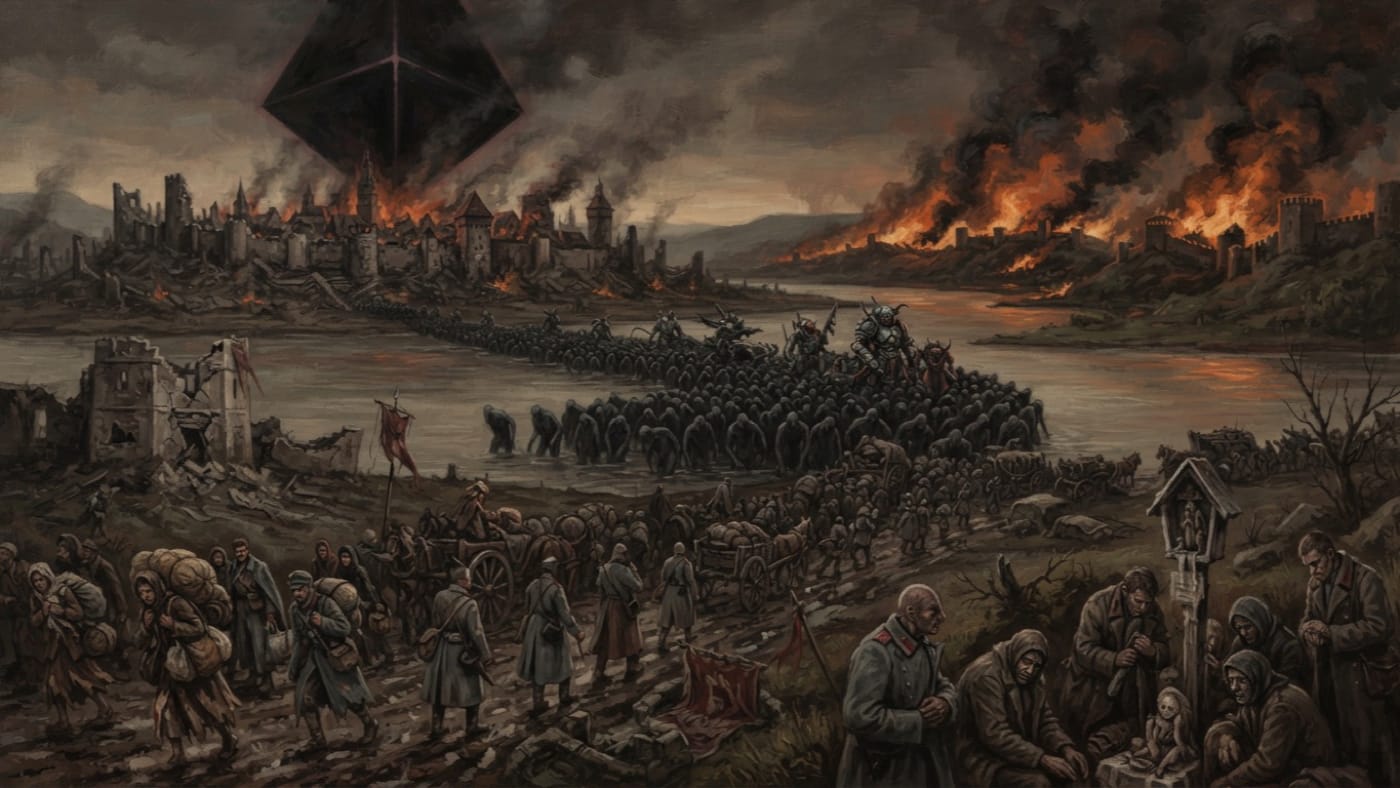
Everything it covers belongs to A.S. 110. Gluttony consumed Brașov. Velkara's host crossed the Danube on the drowned. Wrath burned the Thracian passes. The local forces had held their valleys by habit and kinship. They broke, and what remained of them walked west. Within the year Strasbourg had learned that a frightened continent will accept a fraction it would have stoned a tax-collector for proposing.
The reader must keep the calendar straight, because the collapse did not begin the war. The Eastern Silence fell in A.S. 38. The Sundering came on 1 November A.S. 45. The long retreat followed, and by about A.S. 65–68 a defensible but incomplete Sagittal Line was standing. The formal Synod was settled at Strasbourg in A.S. 90, and the Bureau of War was chartered in Crimson Ink in A.S. 105. By A.S. 110 there was already a front, already a state, and already a Church with soldiers. The collapse supplied the one thing they lacked, which was an excuse large enough to claim every household at once.
#On Brașov and the Failure of Local Arms
Brașov was a Saxon-walled Transylvanian city below the Carpathians, a merchant town on the approach toward Sibiu. It had guild halls, churches and men who believed walls were for keeping out other men. Kargath's host consumed the city proper. The inherited account gives roughly a hundred thousand dead and allows the thing a single week. I enter both figures as reported scale. No authenticated census survives to argue with them, and nobody who could have taken one was left to hold the pen.
The surviving abstracts filed the dead as epidemic mortality. "Plague" was the favourite word of Rationalist clerks and of more than a few early Synodal ones, because plague is a category that asks no questions of the garrison. A plague does not require the adjutant to explain why his pickets were eaten at their posts. It fills a column neatly and lets the clerk close the book.
The region was defended by feudal levies and border companies raised by lords, parishes and towns. These were men who served a named master, drilled when the harvest allowed, and knew every stile in their own valley. Such forces fight bravely for ground they own. They fight poorly for ground they have never seen, and they cannot be moved by letter. When Brașov went into the Maw, the nearest companies had no common command and no reserve. Nor could they expect relief from the next valley's lord, who was busy counting his own sons. Each banner answered alone, and each was wiped out alone, which at least saved on correspondence.
#On the Danube Crossing and the Thracian Passes
The Brașov Flood carries the city's name and none of its dead. It was a separate operation, attributed to Velkara. Fifty thousand Ash-Fodder were driven into the Danube until their drowned bodies formed a crossing, and her host walked over them. The Danube does not run through Brașov. The Flood borrowed the name because the clerks who first recorded it had one catastrophe's heading open and could not be bothered to rule a second. The sources I have consulted do not say where on the river it happened. I will not improve on them.
So there are two populations and two ledgers. The citizens of Brașov were consumed in their city. The Ash-Fodder were the conquered of the east, men taken in the Charnel Lands and spent as material, and they died as a road. Adding the two columns into a single figure for "Balkan dead" is an error Records has corrected in three separate hands. I give no total. A total would be a lie with a signature.
Further south, Maldrake's forces burned the Thracian passes. By the account the Continental Levy already preserves, the fire had no evident need of ordinary fuel. Doctrine has not ruled on the mechanism. The consequence was plain to any quartermaster: the roads closed, supply broke, and the formations holding those routes were destroyed or scattered. Thrace had already been transformed at the Sundering, so this was a fresh wound laid over an old one.
Did the Sin-Generals act in concert? The Bureau has no treaty, no common order and no captured dispatch. What it has is three pressures on one southern flank in one year. The demons need not have planned it. The Synod certainly found it convenient.
#On the Roads West
What remained went west. Shattered companies came down out of the high country without officers, carrying provincial standards that nobody west of the mountains could identify. Refugee columns followed them or overtook them: families with carts, priests with whatever relics they had managed to carry, the wounded and the merely frightened, all heading for the Line and the heartlands beyond it. Behind them, the southern spine of the Sagittal Line was the only fixed thing in the region. That spine ran from the Transylvanian Alps above Sibiu, through the Danube gorge at Irongate and the high road at Shipka, to the Bosphorus under Constantinople. I do not say those works fell, and the Bureau has no record that they did. I say the country in front of them emptied.
Panic travels faster than carts. The survivors brought no maps worth the blood on them and a great many stories. The stories reached the Rhine cities, where printers and preachers finished the work. A mother in Lyon who had never heard of Brașov learned within a month that it had been eaten. From the next sermon she learned that her sons were the cure.
#On Strasbourg's Answer
Strasbourg answered with the First Continental Levy: one son in ten from every household between the Baltic and the Tagus, under the joint seals of War and Doctrine. The seals matter more than the fraction. A War seal alone makes a requisition, and a sensible bishop can haggle a requisition down, delay it or bribe it away. With a Doctrine seal beside it, the requisition became a sacrament of the state, and refusal was classified as apostasy. A prince in a good mood may pardon treason. Apostasy goes to Purity, and the Index has no moods.
The emergency was real. Nobody who reads the Brașov figures honestly can say otherwise, and I do not. But look at how the instrument is written. The Levy did not ask how many men the south required. It asked how many sons each household held. It assessed the family, which survives every catastrophe and can therefore be taxed after every catastrophe. A campaign levy ends when the campaign does. A household levy ends only when there are no households left.
The Balkan lords lost because their men answered to names. Strasbourg's cure was to make every man answer to a number. The Field of the Sixth Psalm at Strasbourg became the continent's first true mustering ground. The men who marched out of it were drilled by War instead of by any lord, and they were forwarded by clerks instead of summoned by kin. Walls, armies and Church soldiers all existed before A.S. 110. Centrally drilled armies fed by a continental quota did not.
The inherited chronicle states that, though protests rumbled from Paris to Seville, none dared open defiance of the First Levy.
Corrected. Protests burned in Lyon, Bruges and Cologne. Lyon pulled up its cobblestones, and Bruges killed Assessors. The defiance was open, loud and in places fatal. Compliance followed it swiftly, which is the part the earlier hand preferred to remember. The same page's marginal gloss of "ten sons per household" is withdrawn as well. The public rate was one son in ten. A copyist who turns a fraction into a massacre has done Purity's work without a licence.
The first musters were chaotic enough that the Bureau of Conscription was set up in A.S. 112 to impose forms on them. Assessment, barracks and renewals belong to the Levy's own articles, where Records keeps them in better order than the south was ever kept.
#On What the Collapse Left Behind
Brașov remains an Orison-restricted ruin, and no resettlement has been authorised as of A.S. 201. Surviving witness fragments fed the Bureau's later doctrine on the Black Dome. Doctrine has not settled how the Dome relates to the city's death, and I will not settle it for them. Thrace remains Maldrake's. The Danube has kept whatever it was given.
The emergency has outlived them all. The decree of A.S. 110 was issued to meet a collapse, and it now meets every birth. Ninety-one years later, the Levy is a permanent obligation passed down through the generations and renewed under seal. No province between the Baltic and the Tagus has escaped giving it sons. The Balkan dead paid for that, and nobody consulted them either.