
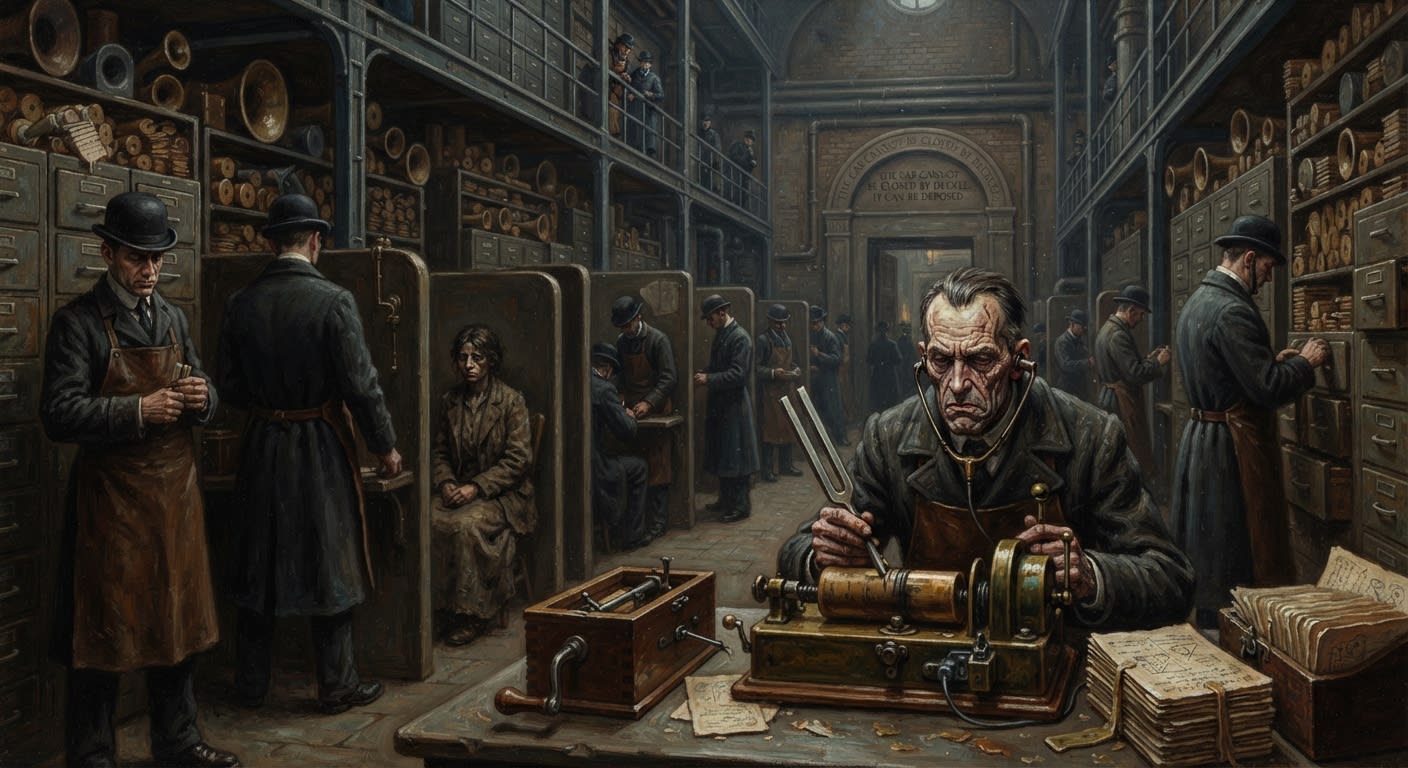
#On the Office That Made Listening Liable
The ear cannot be closed by decree. It can be deposed. — inscription over the lower-gallery door, Cloister of Calibrated Breath
The Auditory Heresy Division is the enforcement apparatus of the Bureau of Orison and Song. It was constituted in A.S. 96 (1806 CE), two years after the Orison Licensing Acts declared that every melody, cadence, work-bar, lullaby, market call and devotional tone in the Church was either licensed or criminal. The Acts wrote the crime, and the Division was built to prove it. Its field officers are the Tone Inquisitors, and the public knows and fears their forks and boxes. The public rarely sees the rest of the Division. There are clerks and card-wax boilers. There are registrars of informants and interval magistrates. There are storeroom wardens who keep confiscated music-box drums in numbered felt, and liaison secretaries whose whole career consists of asking the Bureau of Purity for more pre-signed writs.
The Inquisitors are the teeth. The Division is the jaw, the gullet, and the filing cabinet at the bottom of the stomach.
The problem it was founded to solve was one of evidence. Between A.S. 94 and 96, prosecution rested on denunciation, and denunciation is the cheapest commodity in any tenement. Neighbours heard humming from tenants who were behind on rent. Landlords heard sedition in rent disputes. Magistrates began to notice that the loudest accusers were often tone-deaf, which embarrassed everyone. Orison needed a witness no defendant could impeach. It found one in the ruined ear, and built an institution around that ear so its testimony would arrive stamped.
#On Its Birth from Broadcast Ruin
The Division's first intake came from the broadcast galleries of the Cloister of Calibrated Breath. They were failed Orison Signal Engineers: Dustcasters whose lungs had been scarred by Saint-Dust, and whose sleep relic exposure had bent until the Orison Hour kept playing in their skulls long after the coils went cold. They could no longer keep the Synod's voice clean, but they could still hear everything. The qualification was perfect pitch, sharpened past comfort by years in the carrier rooms. The damage was the credential.
Training was moved downstairs. The Quiet Walk audition cells had been built to test licence candidates. They were refitted as examination rooms, where recruits sat behind screens and picked out forbidden half-steps hidden in coughs, floorboards, kettle-whistles, and licensed hymns sung a hair wrong. Recruits who failed went back to the infirmary. Recruits who passed were issued a fork, a clerk, and a quota.
The Personnel Circular of A.S. 96 describes the Division's founding intake as "engineers reassigned to lighter duties in recognition of honourable injury."
Corrected. The intake was selected for its injuries, and the duty was heavier. The Circular's author was later reassigned to lighter duties himself, and found them adequate.
#On Evidence and Its Manufacture
The Division's legal genius lies in one move: it made the ear a witness against the body that owns it. The Acts turn on permit and intent. An acoustic reading cannot tell a licensed lullaby from a criminal one, because they may be the same notes. So the Division stopped prosecuting sounds and began prosecuting recognition.
Its Melody Intent field schedule lists the signs:
- an audible hum
- movement in the throat with no sound
- a finger correcting the rhythm against a cup
- the flinch of recognition
- protective silence when boots reach the landing
- an infant calming during exposure
- neighbours falling into the same breath
- possession of coded notation, stitch-score, or a music-box drum pinned with three bad bars
Two signs are enough to prosecute. So is one sign with a carrier. A claim that the melody is harmless is recorded as an admission of familiarity.
The signs rarely offer themselves, so the Division provokes them. The bait-cadence is four bars of prohibited melody played through a hand-cranked resonance box, wrong enough to pass for an accident and right enough to wound memory. It is Division property. It is issued from the Vault of Tuning under countersignature and returned with its wheel counted. A box lost in the field is a disciplinary matter. A box that comes back playing a fuller tune than the one it left with is a different matter, handled on a different floor.
Every exposure produces paper. The listening card is waxed so it survives rain and saliva. It records the interval, the response, the witnesses, and the clerk's estimate of intent. The card becomes the prosecution slate, and the slate goes before an interval magistrate. This is a Division officer who sits with Purity authority. He has never been asked to identify a note in open court and would decline if asked. The accused may speak. The accused may not hum in their own defence. That rule was added after an early defendant tried to demonstrate the difference between a work-bar and a lullaby and had convicted herself by the third measure.
#On Registers, Assets, and Converted Ears
Below the listening chambers sits the Registry of Ears, where the Division keeps its informants. These converted ears include:
- former melody smugglers
- hosts of listening cells, and their clients
- dismissed wet-nurses
- penal-choir survivors
- bitter neighbours
- children who were asked kindly
Each has a card, and each card has a column headed Condition. By custom the entries go downhill: informant, asset, liability, closed.
The Registry also holds something the Division does not mention before magistrates: the smugglers it lets run. A carrier left free carries songs to new households, and new households produce new cards. Some Whisper Runners have been raided so punctually, always just after their useful fragments moved on, that the street now treats a Division raid as a courtesy notice. Several retired Inquisitors own route maps no pension paid for.
REGISTRY OF EARS — RETAINED CARRIERS (EXTRACT) Routes under sufferance: ███. Cells under sufferance: ███. Raid to follow ███████████ transfer, not before. Retention justified by ████████████████████████████████. Not to be cited in Melody Intent proceedings. Copy to Bureau of Silence.
Seized sound is stored next door, in a room the clerks call the Wax Room. It holds confiscated drums, notched cuffs, laundry receipts scored in pencil, and a century of listening cards, all in felt-lined drawers. The Division forbids anyone to play the evidence. The room's wardens are chosen partly because they are deaf. The Bureau of Silence audits the drawers once a year and removes the index.
#On Jurisdictional Quarrels
Every Bureau that touches the Division complains about it.
Purity supplies the writs, the cordon men and the tongue-irons. It regards the Division as a band of nervous tuners who could not arrest a sparrow without a signed schedule. The Division regards Purity as a hammer that has learned to read. Necessity holds the marriage together. The Division owns the expertise and Purity owns the violence, and neither can sentence a mother alone.
The Sky-Sermon Attendance Auditors draw the maps. Their statutory authority dates from the Metric Sanctification Edict of A.S. 158. Their Choir Rate returns flag the blocks where the answer to the broadcast runs thin, or comes back with a household tune murmuring underneath it. The Auditors circle the street and the Division finds the mother. Auditors do not climb stairs.
The Orison Signal Engineers upstairs despise the Division as the Cloister's infirmary with badges. The Division regards the engineers as future recruits.
Its real antagonist is the Bureau of War. Soldiers carry songs from home the way pilgrims carry relics. A verse can hold a man at his loophole through a third watch in which the licensed Orison Hour would lose him. At Bastion-Przemyśl in A.S. 199, War deferred prosecutions for unauthorised singing because desertion was already costing more than heresy. The Division filed a protest. War filed it too.
#On the Present Division
As of A.S. 201 (1911 CE), the Division operates in every Orison district, in the River-belt ports, the Candlewick tenements, along the pilgrim roads, and in the rear-towns of the Sagittal Line. First possession has carried tongue-branding since A.S. 118. A network that implicates twelve households or more may be referred for erasure from the Great Ledger of Souls. Recruits still study the Vienna Incident of A.S. 112. It is the case that taught the Division how much the phrase "potential for contamination" could carry: five thousand branded mothers, on a finding that required only the possibility of harm.
The Division keeps one open file it cannot close. Saint Hessa of the Closed Mouth has never been canonised or condemned, and Doctrine considers her a composite. She is the patron of the lullaby passed on without sound: four taps, a pause, two taps, a palm on the cradle. The fork hears nothing. The box provokes nothing. The card has no column for it.