
#On Recognition
The box asks the question. The face gives the answer. — Auditory Heresy Division field saying
A bait-cadence is a fragment of prohibited melody, played wrong on purpose in a public stairwell, at a person who never asked to hear it, so that an officer can watch whether that person knows how it ought to go. That is the whole method. The rest is brass and paperwork.
The Orison Licensing Acts of A.S. 94 made unlicensed melody a crime. They also allowed Melody Intent to be prosecuted without a completed performance, because Auditory Heresy has never required a finished song. Two years later the Bureau of Orison and Song constituted the Tone Inquisitors within its Auditory Heresy Division. The new office quickly found that the law had outrun its proof. A song seized on paper leaves a copy in the laundress. Orison learned this from the eleven laundry women of Candlewick, whose receipts burned while their tunes stayed in the building. If any decree ever turned the Division from confiscating paper to provoking recognition, it has not reached the Codex. The method's inventor has never been credited. In a Bureau so fond of commendations, that means the idea was either too obvious to claim or too ugly to sign.
Memory cannot be seized. It can be made to twitch.
#On the Box and the Broken Phrase
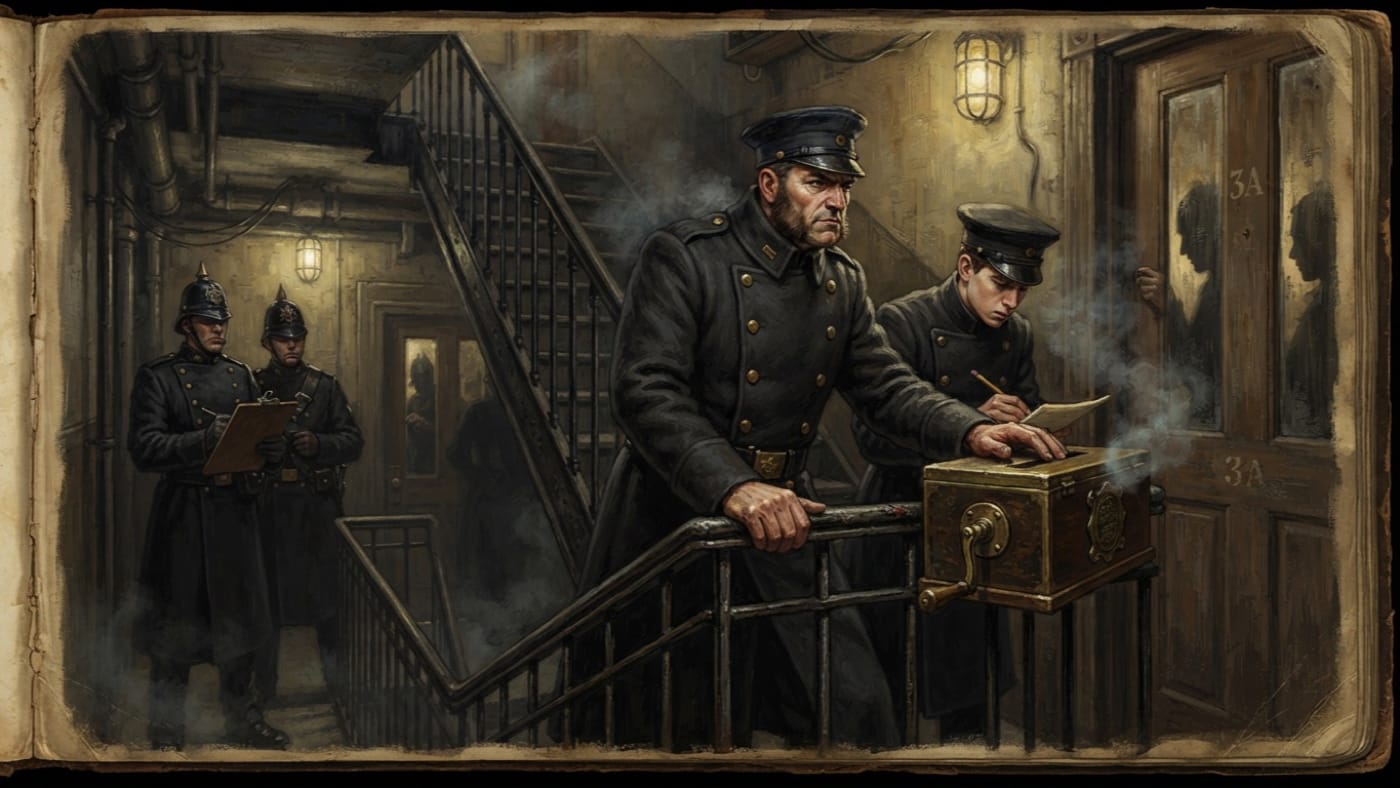
The instrument is a hand-cranked resonance box. It has a brass throat, a pinned drum, a felt brake, a crank arm, an interchangeable cadence wheel, and an Orison seal bolted where an honest maker would put his mark. It is an ugly little thing. It gives a faint wheeze on the upstroke, and it sends a phrase through a tenement door more reliably than any preacher sends a sermon through a nave.
The wheel carries the fragment. The Division's shorthand is four bars, and four is common practice. Three bars will do. A short hook of a few notes, the kind a child learns before it can say its own surname, does best of all. The phrase is always pinned with an error. One interval is shaded flat, a bar goes missing, or the rhythm limps where the true tune runs. The error is the craft. A perfect rendering sounds like a performance, and it puts every listener on guard. A broken one sounds like a neighbour's clumsiness, so the ear that once loved the true tune leans forward to mend it.
Boxes are Division property. They are issued from the Vault of Tuning under countersignature and returned with the wheel counted. The same pinned drum found in a cradle runner is a smuggler's contraband and goes to the Wax Room in felt. Found in an Orison box, it is equipment and goes back to the Vault. The pins are the same. Only the seal differs.
The boxes are set at landing corners, stairwells, alley mouths, ward corridors and pilgrim barns. The officer turns the crank with one hand and watches a doorway. A clerk stands a pace behind with a card. Two men from the Bureau of Purity wait three steps lower, holding a writ that was signed before anyone climbed the stair.
#On the Listening Card
The listening card is waxed so that it survives rain, sweat and the spittle of the arrested. It is scored with staff lines, interval fields, a column for witnesses and a block headed Melody Intent Indicators. A competent officer fills it in while the crank is still turning. The clerk finishes it. The clerk's pencil is the real instrument of the method. The box only supplies the occasion for it.
Read the list slowly and you will see how it is built. A woman who hums along is recorded. A woman who stops humming when the officer appears is recorded under protective silence. A man who prays loudly over the tune to drown it is recorded under hostile prayer. A throat that moves without sound is recorded. A finger that taps the right rhythm against a tin cup is recorded, and it is the best evidence on the card, because a correction proves the ear knew the true tune. A child who falls asleep on the third bar condemns the lap it sleeps in. The form has no line for no response. Stillness is the only clean answer, and the Division trains its officers to regard perfect stillness as a skill someone has taught.
The preferred arrest moment deserves the most attention. The officer takes the subject after the correction and before the explanation, because an explanation might separate things the prosecution needs joined. My grandmother sang it shows familiarity. It is only a lullaby shows an opinion about harm. Neither shows intent. The card has fields for recognition and for intent, and no field for the difference between them. The clerk bridges that gap with a pencil. A subject who insists the melody is harmless is recorded as having admitted familiarity.
The field manual sets out escalation. A correction made only by gesture earns a second exposure, and the wheel turns again. When an infant calms, the clerk records a maternal association. When several households are heard breathing in time behind their doors, the officer sends for a Purity cordon.
The finished card becomes a prosecution slate and goes before an interval magistrate, a Division officer who sits with Purity authority. The accused may speak. The accused may not hum in their own defence. No laundress can cross-examine a trained ear, and no dockworker can call an expert. The officer heard it and the clerk wrote it down.
#On Vienna's Precedent
The Division did not first use the bait-cadence at Vienna. Vienna is simply the case it teaches. In A.S. 112, in the low lodging-houses along the Donaukanal, Tone Inquisitors set their boxes at landing corners and played a rain-and-barley lullaby: three bars wrong and one bar nearly right. Mothers flinched and infants turned their heads. One woman corrected the rhythm under her breath and was seized before she finished. By the end of the month five thousand mothers had been branded. Their children went in carts to the Bureau of Mercy, whose clerks called it protective transfer.
The finding rested on the lullaby's potential for doctrinal contamination. None of the surviving evidence shows that this tune caused any breach, corruption or harm, whether to the mothers, the children or the Church. The Vienna Incident file shows that the Division recognised a tune, recorded the recognition and treated it as guilt. The tongue-irons at the branding tables came six years before first-possession branding was standardised in A.S. 118. Custom went first and the statute caught up with it later.
The lullaby itself is not reproduced here. The Division has the wheel.
The bait-cadence is a diagnostic exposure, by which latent melodic contamination already present in a household is brought to the surface for identification.
Corrected. A diagnosis finds what is already there. The Division carries the tune up the stair, plays it at the household through the door, and charges the household for knowing it. The accurate word is provocation. Magistrates prefer the other word, so the other word stays on the forms.
#On What the Ear Cannot Settle
The method works because the illicit trade has broken its songs into pieces. Melody smugglers move tunes in stitch-scores on cuffs and hems, in drums hidden inside furniture, and in listening cells where each guest learns only one phrase. No single carrier holds a whole song. The bait-cadence is built for that arrangement. It offers one piece and waits to see who reaches for the next. Converted ears tell the Division which landings to try. The Sky-Sermon Attendance Auditors mark blocks where the answer to the broadcast runs thin. The Auditors draw circles around streets. The box climbs the stairs.
Saint Hessa of the Closed Mouth spoils the arithmetic. She has been neither canonised nor condemned, and the districts that want her tell competing versions of her life. Her lullaby is passed on without sound: four taps, a pause, two taps, a palm laid on the cradle. The box gets no hum out of such a household and the fork detects nothing. That does not make the household safe. Form 12-K lists protective silence, infant calming and subvocal throat motion, so a mother who taps instead of singing escapes the ear and may still be caught by the clerk. The Division's jurists call this a gap in detection. Hessa's mothers find no gap at all when the Purity men come up the stair.
Doctrine does keep a small shelf of cadences that are dangerous in themselves, and those are held on another floor. Form 12-K does not ask which kind of tune the wheel played.
FIELD TRAINING EXCERPT — BAIT-CADENCE ESCALATION If bait returns from corridor in fuller form, █████████████████████. Do not pursue unaccompanied past third landing after echo-back.
#On Present Application
As of A.S. 201, bait-cadence exposure is authorised in every Orison district. Detachments carry it through the River-belt ports, Strasbourg's Candlewick tenements, the pilgrim roads and the rear-towns of the Sagittal Line. Cases end in tongue-branding, immurement, reassignment to a penal choir, removal of children, reduced rations, or erasure from the Great Ledger of Souls. Occasionally they end in nothing, when the accused belongs to someone with a better patron than the law.
Only War has refused the box outright. At Bastion-Przemyśl in A.S. 199, War deferred prosecutions for unauthorised singing because desertion was already costing more than heresy. The Division protested. The boxes wait in the rear-towns for the deferral to lapse.