
Consulted lore done; drafting the Ash-Hands prose now.
#On the Lowest White Hands
An Ash-Hand is the first person in a kiln yard to touch a saint and the last person anyone asks about it. The rank sits at the bottom of the Saint-Bone Melter ladder, level with the Slake Runners and a good deal dustier. From that floor a worker may climb to Kiln Tender, then Batch Scribe, and in rare cases all the way up to the bone-ring. Most never do.
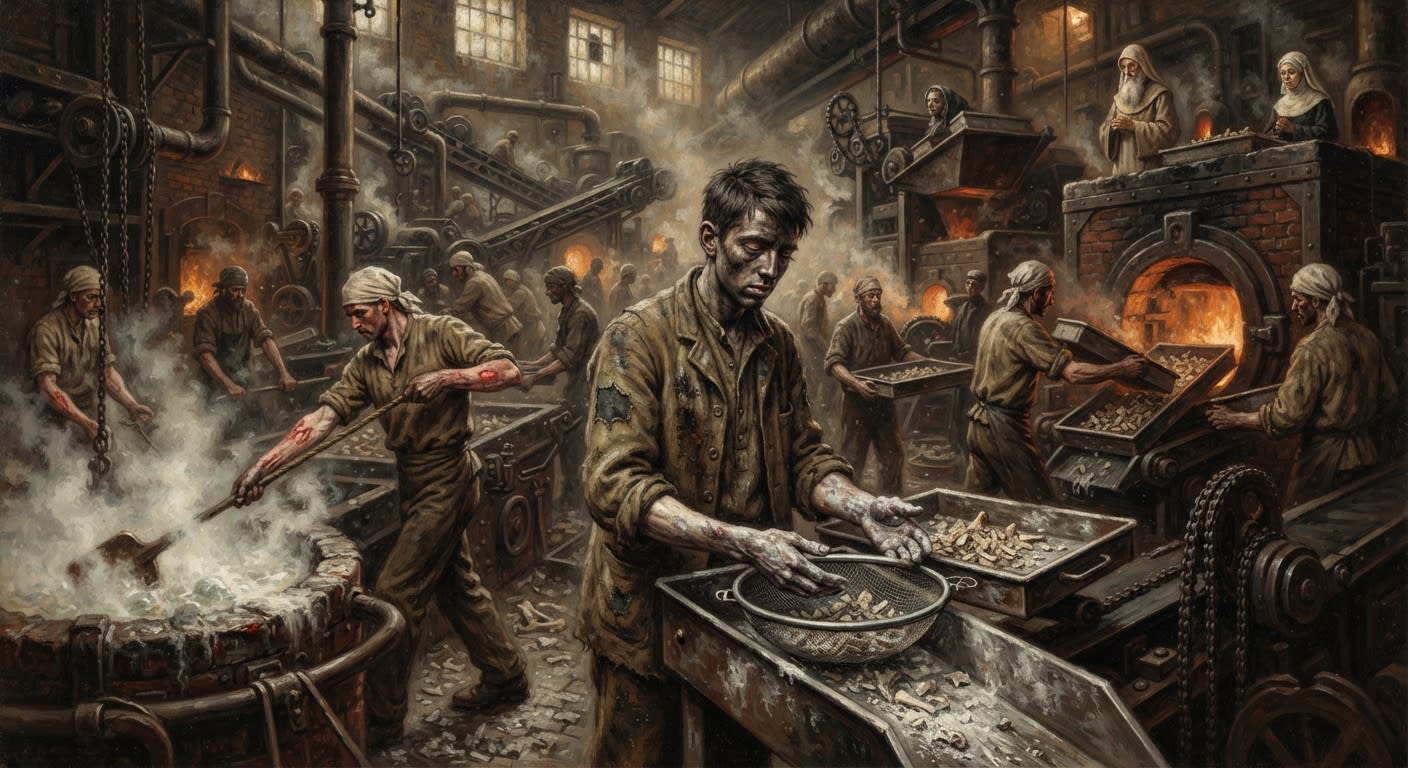
The formal registers call them intake labourers, feed attendants, or sifting personnel, depending on which Bureau is paying for the ink. The yard calls them Ash-Hands, and the yard means it literally. After a season at the intake table the skin of the palm goes the colour of a cooled crucible. The knuckles split along white seams. The eyelashes turn to chalk. By the second year no glove, however much vinegar goes into it, will make the hands look like they belong to someone who has not handled the calcined dead.
The rank exists in every licensed yard, from the ossuary annexes of the rear dioceses to the quick-kilns behind the forward curtain walls. Every faction of the trade uses them. The Siege Melters spend them fastest. The Additive Heretics give them the packets to carry. In the yards of the Purity Melters, though, the name has stopped being a description and become a discipline. There the Ash-Hand's body is the first document in the batch, and it is inspected like one.
#On the Feed
The work starts at the intake table. Crates come in from the ossuary processors and the Relic authenticators, carrying cord seals, provenance tags and Tier marks. The Ash-Hand breaks the cord once a Batch Scribe has signed for the break. The Ash-Hand lifts out the fragments, lays them on scrubbed slate in the order the tag prescribes, and steps back so that someone with authority can decide what they are.
That is the order of operations on paper. In practice the Ash-Hand has already held the fragment, weighed it by feel, smelled whether it was damp, and seen whether the tag matches the bone. Plenty of Ash-Hands have found a forgery before the Scribe did. The sensible ones keep quiet about it until asked, and they are never asked. Rank decides who may know a thing. The hands knew first.
The classification system has seven tiers, running from Cathedral Grade to Bulk Mineral. In Purity yards the vinegar basin stands at the end of the intake table, and every Ash-Hand washes in it at the start of the shift, at the end of the shift, and again whenever a fragment classed Tier Four or above has touched the slate. On a heavy convoy day that means a dozen washes. Diluted vinegar stings lime cracks the way a confessor's pen stings a guilty name. Nobody in the yard finds this interesting.
After intake comes the feed itself. Kiln Tenders handle the heat, and Ash-Hands carry the fragment trays to the kiln mouth, tip them in when the chant wheel reaches First Feed, and retreat before the draft reaches their faces. When the burn is finished they rake out the calcined ash, sift it through iron mesh, and break up the clinker with wooden mallets. They sweep up the fines, clean the tongs and crate the empties. A worker breathes more saint during a sifting shift than a pilgrim touches in a lifetime of processions.
"Don't breathe the sermon," the yard idiom goes. The masks issued by the Bureau of Engineering were written to a specification and tested against nothing. Any Ash-Hand who buys a better filter is committing a small crime so that their lungs last longer, and the filter is the first thing a Fume-Inspector confiscates when a yard needs someone to punish.
#On Slake and Obedience
The Ash-Hand is not a Slake Runner, and the distinction matters to both sides. The Slake Runner carries water to the pit and learns to fear it. The Ash-Hand holds the paddle rope, feeds the calcined lime in portions the Kiln Tender calls out, and stands downwind because someone has to. Neither of them owns the seal. The Master Melter or Purity Foreman owns the seal, stands upwind, and signs.
Slaking is the station that breaks people. When water hits calcined bone it roars, spits and heaves up steam hot enough to lift skin from a forearm in a single white sheet. The chant wheel paces the water, and in Purity yards the chant also paces the bodies. The Ash-Hand's arm moves on the stressed syllable. A hand signal from the Tender (palm flat, palm turned, fist) replaces speech during the loudest part of the reaction. A worker who moves off the beat has committed a doctrinal irregularity, whatever the steam has done to them. A worker who flinches is sent back to the rope until the flinch has gone.
The Purity Kiln Decree of A.S. 142 made continuous hymnal accompaniment compulsory and made deviation reportable. The officers who wrote it were thinking about Melters. They were not thinking about the Ash-Hand at all. Enforcement, which the Bureau of Purity drafted with its usual appetite, still reached the Ash-Hand before it reached anyone else, because the lowest body in the yard is the one standing nearest to where an irregularity starts.
Purity training primers state that the Ash-Hand station was established under the Purity Kiln Decree of A.S. 142.
Correction: Ash-Hands have fed kilns since the first licensed yards under the Saint-Bone Melting Acts of A.S. 96. The Decree standardised their washing, pacing and witness obligations in Purity yards. The primers reversed the order because a rank the Decree created would owe its whole existence to Purity, and that reading was preferred.
#On Blame
When a batch fails, the yard works out who was standing closest to it.
Underburned lime gives a soft wall. Overburned lime gives a brittle one. A bad slake gives an explosion, and a contaminated slake gives a seam that sweats. Every one of these failures can be traced to a Master Melter's judgement, a Tender's heat, a Scribe's numbers or a Foreman's decision to hurry. Every one of them can also be traced to an Ash-Hand who dropped a tray, missed a wash, carried a packet or coughed during the Rising Heat verse. The second kind of trace costs less.
The trade's own guidance says it plainly: when pressure rises, give up the Ash-Hand who was caught with contraband filters, or the Scribe who "miscopied." The Scribe can read, so the Scribe can make trouble. The Ash-Hand has a station number.
Black lime is worse. When a seam darkens, the Black-Lime Containment Leads and the Purity Foreman follow the same first liturgy: seal the pit, stop the chant, cover the seam, separate personnel by station. In practice, separating personnel means separating the Ash-Hands. They are marched to different rooms, questioned apart, and forbidden to talk to one another until the statements have been compared. The procedure protects the witnesses from contaminating each other's accounts. It also makes sure the blame arrives at one man instead of being shared out among six.
STATEMENT REVIEW — PURITY YARD ██, BLACK-LIME RESPONSE Ash-Hand, Station 4: "The ash was warm on the mesh after it should have cooled." Ash-Hand, Station 5: "The ash was warm." Ash-Hand, Station 6: "I heard it tick in the sieve. Three times. Like counting." Station 6 reassigned to nonverbal labour pending review. Stations 4 and 5 returned to feed. Finding: sifting irregularity, Station 6.
A Purity yard needs somebody low enough to punish without disturbing the ledger above him. That is doctrine applied to staffing, and I will not call it cruelty. A Foreman's disgrace unsettles the certification schools. A Scribe's disgrace unsettles the numbers. An Ash-Hand's disgrace settles everything: the mortar was sound, the hymn was sound, the heat was sound, and one pair of white hands failed to wash.
#On Advancement
A careful Ash-Hand who survives the burns, keeps the cadence and goes unchosen when blame is handed out may be promoted to Kiln Tender. After that comes Batch Scribe, if they can read or learn to. Some go further. Several Black-Lime Containment Leads began at the intake table, and they have a particular way of watching an Ash-Hand wash, as if they were counting the cracks.
The other exits are these: the lungs give out, the worker is reassigned to the trench quick-kilns, the worker is erased as a wall-heretic after a filter or packet turns up in their bedroll, or a noble house buys out their indenture to run its private kiln. The Bureau of Mercy revised its tables in A.S. 199, and they give nine years of service life for a kiln-yard Melter and four for trenchline. The tables do not list Ash-Hands separately. They are counted as Melters, and that is the only place in the Synod's paperwork where they are.
The yard knows which box gets ticked most often. The yard also knows who fed the wall that is still standing over the city tonight.