
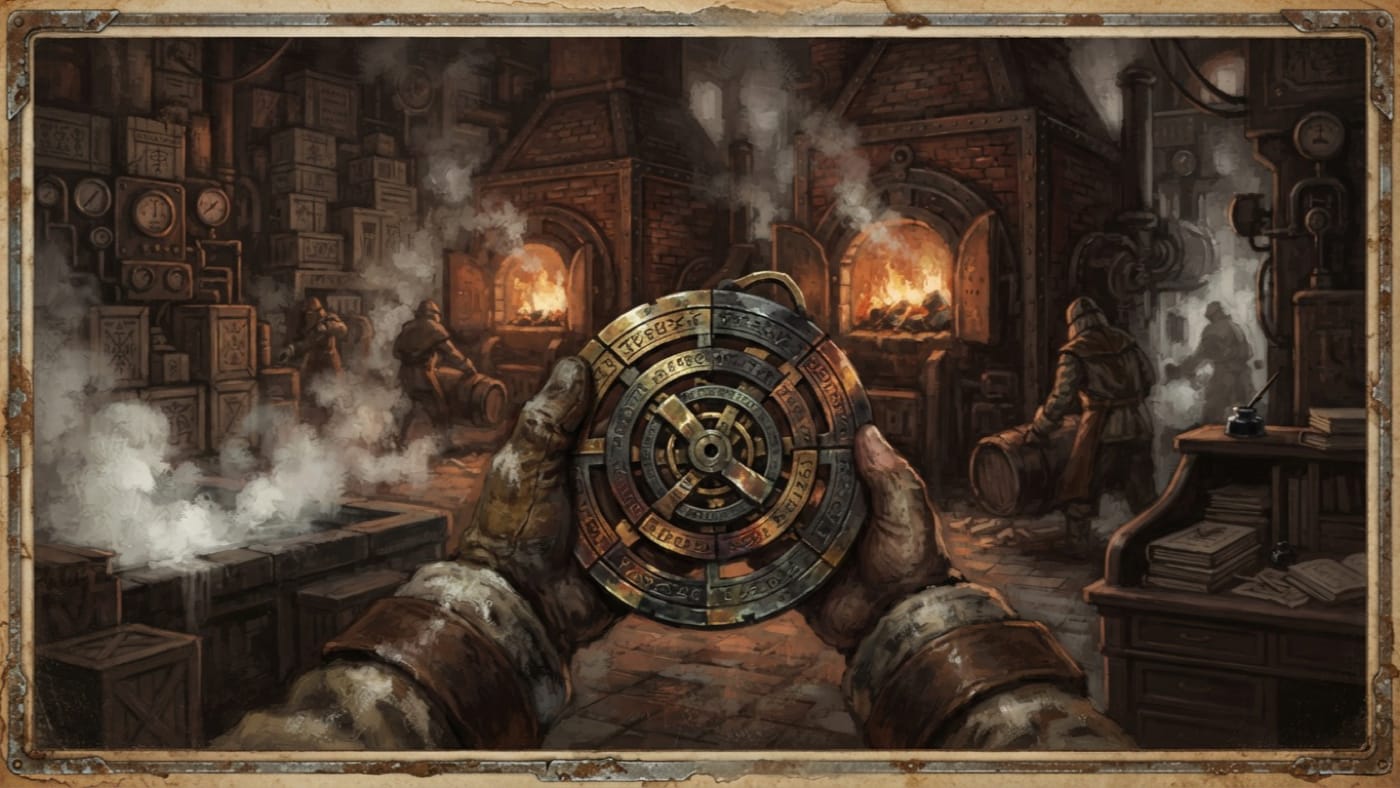
#On the Wheel in the Yard
The chant wheel is the smallest instrument of law in a kiln yard, and the one most often held in a burned hand. It is a rotating ring of prescribed litanies, marked off by the stages of the burn, and the Saint-Bone Melter turns it one stage at a time while fragments of the holy dead become lime. The face holds the sequence. The thumb holds the place. The voice does everything else.
Every Melter carries one. The commentaries on the Decree record wheels of brass, of bone, of card, and of cheap tin in yards where repairs have eaten the budget. They fit in a pocket, an apron loop, the cuff of a white-limed glove. A Kiln Tender reading colour at the spyhole can find the next stage by touch alone. An apprentice who cannot find it is not yet trusted near the spyhole.
The yard confuses three objects that the courts never confuse. A senior Melter's bone-ring is etched with batch numbers and stands for a career. The batch stamp presses wax onto a barrel and stands for a product. The chant wheel certifies nothing at all. It tells the mouth what comes next and leaves the clerks to decide what the mouth has done.
#On the Approved Cycle
The Saint-Bone Melting Acts of A.S. 96 made relic fragments into renderable stock and licensed a trade to render them. They did nothing to make that trade sing in unison. For decades afterward the yards burned to local hymnals, family custom, and whatever cadence a Master Melter had learned from someone who still had ten fingers. No record names the first person to cut a ring of litanies and turn it beside a kiln. Several Melter houses claim the honour, and none of them can produce the wheel.
Uniformity arrived in A.S. 142. The Purity Kiln Decree was issued jointly by the Bureau of Rites and the Bureau of Engineering. Its Appendix IV-C fixed the seven-stage cycle and gave each stage a hymn, a heat window, a witness mark and a variance threshold. Rites owned the words and Engineering owned the heat. The Bureau of Purity received enforcement, which in practice means the right to arrive unannounced.
Kiln-yard usage calls the Appendix IV-C cycle "the Purity wheel" and holds that the Bureau of Purity issued it at the petition of the Purity Melter houses.
Correction: the cycle belongs to a Rites–Engineering instrument. Purity enforces it and the Purity Melters revere it. Neither fact makes either of them its author, though both have said so in print, and one of them said it under seal.
#On the Seven Stages
The ring reads, in order: First Feed, Rising Heat, White Glow, Full Calcination, Cooling, Slake Preparation, Final Set. Nobody may reorder them, abridge them or improve them, and on the floor copies a Purity Foreman will cross out a pencilled improvement with the same stroke used for a forged seal.
First Feed governs the entry of fragments into the fire. The crate seal is broken in front of a witness and the classification is read aloud. When the wheel reaches the stage, the Ash-Hands tip their trays into the kiln mouth and step back before the draft reaches their faces. The hymn is short. The Decree forbids private additions at this stage, because grief is the most reliable cause of overspent fuel.
Rising Heat accompanies the climb of the fire and the first whitening of the bone. The chant climbs with it in measured intervals. "Interval" is an Engineering word, and Rites puts up with it the way a cathedral puts up with scaffolding. A slip of tone here has its own disciplinary category, tonal negligence, which tells you that Purity reads the hymnal as a charge sheet.
White Glow marks the most dangerous state of the burn. Bone stops resembling bone, and the yard's safety rests on the Tender's judgment of colour. Full Calcination is the stripping point, where the burn to ash-lime is completed. The Decree demands continuous hymnal accompaniment through calcination. Underburned lime makes weak mortar and overburned lime makes brittle mortar. The wheel cannot tell the two apart; only the Tender's eye can. What the hymn tells everyone in earshot is that the eye was supposed to be open.
Cooling follows the burn. What the mouth does during Cooling is disputed. One commentary on the Decree calls Cooling the first silence, while the Purity floor copies insist that accompaniment never lapses. I decline to settle the question. Both parties draw pensions, and I have to dine with them.
Slake Preparation governs the approach to water. It is the stage at which an apprentice learns whether their courage extends to cold water meeting calcined saint. Final Set closes the liturgical sequence. In the commentaries' phrase, it binds the batch to wall-service. It cures nothing on the spot. Mortar sets on its own timetable, and Form R-14 promises with grim patience that the wall will have set after thirty days. The hymn only declares the sequence finished.
These seven stages must never be mistaken for the seven operations in the batch book: intake and classification, cleansing, calcination, slaking, mixing, stamping, and delivery and application. The two lists are the same length and do not line up as pairs. As the bone-lime commentary puts it, one list belongs to the hymnal and the other to the ledger. The quiet hour belongs to cleansing. It comes before calcination and has no chant, no bell and no witness. It is a requirement of the yard and has no place on the wheel's face.
#On Keeping Cadence
The wheel matters most in the body. A cantor or a singing Tender carries the line, and the yard keeps time to it. During slaking the chant sets the pace at which water is added. If the pace runs fast, the pit roars and spits steam hot enough to lift the skin off a forearm in one white sheet. If it drags, the paste sets unevenly and the barrel carries the flaw to the wall. A veteran times the reaction by heartbeat and an apprentice times it by screaming. The wheel exists to make the two agree.
In Purity yards the cadence also paces the workers. The Ash-Hand on the paddle rope moves on the stressed syllable. During the loudest part of the reaction the Tender signals with a flat palm, a turned palm or a fist, since no voice can be heard over it. A worker who moves off the beat has committed a doctrinal irregularity, whatever the steam has just done to them. A worker who flinches goes back to the rope until the flinch is gone.
Every turn of the wheel ends up on paper. Witnesses mark each stage. The Batch Scribe enters the hymn log beside the heat notes, and the log goes with the batch until someone wants to read it. Inspectors check the seals first, then the ratios, then the hymn logs. The Purity floor copy of the Decree spells out the sequence of guilt: deviation must be recorded before slake, an unrecorded deviation counts as unclean handling, and unclean handling counts as wall-risk.
#On Deviation and Wall-Risk
The Purity Melters hold that correct cadence protects the wall. In their doctrine a wrong hymn is a crack delayed, and the chant wheel is the instrument through which correctness enters the lime. They polish their wheels. They also approve everyone else's.
The Siege Melters know the same seven stages and can recite them half-deaf and bleeding. Under bombardment they shorten the rites, because a widening crack does not pause while Appendix IV-C clears its throat. Many of them scratch private corrections on the backs of their wheels. The Purity reading is that every shortened rite is a debt the wall will collect later. The Siege reading is that a wall which falls tonight never gets the chance to collect anything.
Wheels also serve less honest ends. Additive Heretics have been found with packets of illicit binder hidden behind the litany ring, carried into the yard on the same object that announces their obedience. A Purity Fume-Inspector who smells chant variance may halt a batch, seize its ash and order a re-chant. The Fume-Inspector may also demand an explanation in writing, which hurts longer than the re-chant does.
The wheel's authority has limits, and Purity guards them carefully. A correctly sung hymn gives no permission to burn a protected fragment. It does not clear a disputed fragment or lift a hold. A provenance failure stays a provenance failure even if the cantor sang like a choir school. The Aurelite kiln prayer is voluntary and cannot stand in for any prescribed stage hymn, however sincerely it is muttered.
Black lime is where the wheel's limits become a matter of terror. Reports describe bloom, failed set and seams that misbehave after application, and the causes are still disputed. Purity's instruction to treat every incident as a procedural defect is an administrative choice, and nobody has proved it physically true. When black lime appears, the first response is to seal the pit and stop that batch's chant. The wheel goes quiet before anyone can ask whether it was turned correctly. A clean hymn log proves only that the log is clean.
The case cited most often, at Bastion-Irongate in A.S. 161, had nothing to do with the wheel. A quick-kiln omitted the quiet hour under an emergency order. The mortar set within specification, and the seam then exuded clear fluid for seventy-one hours. Rites called it condensation. No stage on the ring was implicated, and no one has classified the seam as black lime. Purity Melters still cite it in every argument about the wheel, because the wheel is what people remember and the quiet hour leaves nothing behind to remember.
#On Present Custody
As of A.S. 201, the Purity Melters approve chant wheels and dominate certification, training and post-incident review. Their schoolrooms drill the ring by rote until an apprentice can name the stage from the heat on their face. Wheels are inspected and returned. Some come back to their bearers with a reprimand attached.
At the end of a shift the Melter burns the scrap labels, seals the slake pit, rubs chalk on their eyelids and locks the chant wheel. Yards differ on how the lock is made. None of them omits it.