
#On the Novice with Ash on the Tongue
An Ash Chorister is the lowest licensed throat in the Iron Choir. The rank holds drone notes, learns breath pacing, carries the slates and gets blamed when the room goes wrong. The Bureau of Purity keeps it in the Directorate of Acoustic Enforcement, beside the tongs and the ledgers, which is where a candidate learns what the profession thinks of him before he has sung a note.
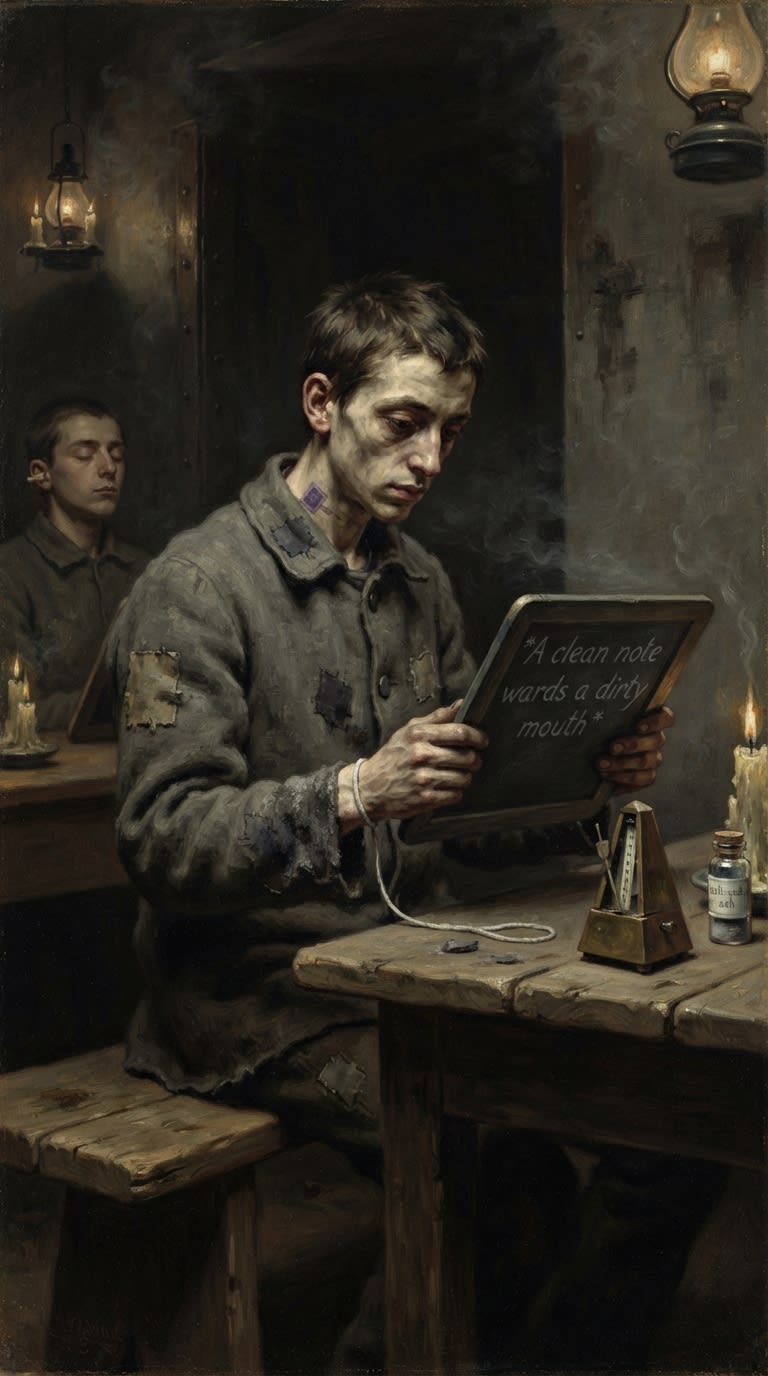
The name comes from the morning rinse. Every Chorister starts the shift with salt and ash, swills until the gums sting, spits into a basin, then touches ribs, throat and slate in that order. Licensed Brand-Singers do the same. The difference is that the novice is inspected afterward. A Cantor-Marshal checks the tongue for grit, because a clean mouth is taken as proof of obedience and a gritty one as proof of sloth, and a Chorister soon learns to fear both.
The uniform is the Brand-Singer's with the honour taken out. The mantle is the same iron-grey and the cuffs are ash-stained from the first week. A throat seal is stamped in violet every seventh day and corrected in red when the examiner is displeased. The white wrist cord of licence is issued unbraided, one strand where a full Singer wears three. A strand is added after each passed examination and taken back after each failure. There are Choristers in Strasbourg whose cords have been rebraided so many times that the fibre is grey.
The technique comes from the Bureau of Orison and Song. The licence belongs to Purity. That settlement has held since the corps took its Writ 14-C form, and Orison has resented it every year since.
An Orison circular on vocational placement describes Ash Choristers as "choirboys of the Cloister of Calibrated Breath, loaned to Purity for the duration of their formation."
Corrected. Ash Choristers are Purity novices. They are enrolled, housed, disciplined and buried under Purity licence. What Orison lent was a breathing method some decades ago, and it has been claiming the children taught by it ever since.
#On Training the Drone
Training begins in the smoke rooms under the eastern warm-up corridor. The air is kept thick on purpose. Candle-tallow and damp straw are burned until the novice cannot take a deep breath without coughing, and he is then told to take a deep breath without coughing. The method is simple. Most of the Bureau's methods are.
The first year is spent on the drone, one low note held for a full bell-hour, then two, then through a meal the novice is not allowed to eat. The metronome token clicks on the table. Screams from a real rite are let through the wall, since the Directorate sees no point in hiring actors when the penitence halls supply the sound for nothing. If a Chorister's pitch drifts, the Cantor-Marshal strikes him in the ribs with a tuning rod, just below the sternum. The blow is meant to teach where the tempo is kept. Keep the bell in your ribs. Most novices take the phrase literally for the first several months, because the bruise is there to remind them.
Between drills the novices copy. Saint Orla's motto, A clean note wards a dirty mouth, goes onto the slate in chalk until the knuckles cramp, then onto a clean slate in the Chorister's best hand for inspection. A misspelling earns a rod stroke. A flourish earns two. Purity dislikes a flourish in anything, and in a novice most of all.
In the second year the Chorister learns to be the hazard. Silentist candidates cannot be trained without distraction, so the Ash Choristers are lined up behind them and ordered to sing wrong intervals: flat thirds, drifting fifths, a mother's cradle-song half a tone off. The candidate has to hold tempo through it. So the novice is taught to keep a note straight in the morning and paid to bend one in the afternoon. The Directorate insists this does no harm. The infirmary records show otherwise.
The family-name reading is the drill novices remember longest. A confessor-booth clerk sits in the next room and reads surnames from the condemned registers in a flat voice while the Choristers hold the drone. Sooner or later a novice hears his own name, or his village, or his mother's maiden name, because the registers are large and the clerks are thorough. Candidates who drift at that moment are failed. Candidates who weep and hold the note pass, as they do in Orla's Line.
#On Usefulness Before Competence
A Chorister is sent into a working rite long before he is fit to lead one. The Bureau counts this as training, and it is cheap labour as well.
In the iron chapel the novice stands at the second threshold, behind the licensed Singer and ahead of the scribe. He holds the base drone under the Opening Hymn so the Brand-Singer's voice is free for cues. He counts the condemned's breaths aloud under his own, in the hush-cadence the Brand-Smiths have learned to follow when the lead voice climbs. He brings fresh slates, fetches ash-water, dampens bucket rims and listens for pitch breaks. He is also the first to hear the room if it does anything the protocols do not name.
He also carries blame, and that is his most important duty. When a brand misaligns, the audit has to assign the fault to singer drift, smith misalignment, subject collapse or room response. A Brand-Singer with a clean seal and ten years of quotas behind him does not drift. A Brand-Smith has a guild steward and a grudge. The condemned is usually dead or certified by then. The room cannot be questioned without Doctrine. That leaves the Chorister at the second threshold. It is always possible that his drone wavered, and no one will be surprised to hear it.
The Bureau of Records prefers the arrangement because it closes the file. The Lictors prefer it because a novice punished in public teaches the corridor faster than a circular. The penalty is small on paper, usually a strand taken from the cord and a week of silence, but it is entered on the throat seal, and a seal carries its corrections for good.
ROOM-RESPONSE AUDIT — WESTERN ANNEX, STRASBOURG Attending Singer: licensed; cleared of drift Attending Chorister: ███████████, second threshold Rite stage: Closing Tone, heartbeat ███ of fourteen Chorister's final note: sealed by order of ███████████████ Audit finding: novice drift Supplementary note in a second hand: "The drift began before he sang."
#On Orla, Vell, and the Schools
Saint Orla is the patron of the whole corps, but the Ash Choristers are the ones she is used against. Cantor-Marshals quote her motto during the Opening Hymn at any novice whose pitch wanders, then use the rod. Her icon hangs in the smoke rooms at eye level for a seated child. The Bureau says the height is chosen for humility. Everyone else notices that it puts her gaze on the novice's throat.
Master Cantor Vell was an Ash Chorister first. He appears in the Strasbourg acoustic rosters in A.S. 124, licensed under the post-Writ examinations, and nothing in his file before that date is useful. Cantor-Marshals point to him as proof that the rank is only a starting grade. Choristers point to him as proof that getting out of it takes a man who later made seven rooms confess in one breath. Both are right, which does little for the novice.
The three schools start recruiting early. Mercy Tone singers look for Choristers whose drone slows a subject's pulse. Judgment Tone prefects look for the ones who hold pitch while the smith curses. Silentists look for the novices who flinch at their own voices, since flinching can be trained into caution. A Chorister may be claimed by all three in one year. Purity allows it, because a novice fought over by three schools will not be complaining about his wages.
#On Bell-Sickness and Promotion
The token is issued to train silence. Novices are told to sleep with it under the tongue so the jaw learns stillness. Within a year most of them are humming in their sleep, counting steps in bell-time, refusing to sit beneath paired bells, and dreaming of a woman in grey who tells them to breathe through stone. The Bureau of Medicine records this as bell-sickness. The Bureau of Doctrine records it as occupational devotion. The first entry brings an infirmary allotment and the second brings nothing, and the Choristers' families argue over which word appears on the certificate.
A Chorister can leave the rank in five ways. The fortunate get a full cord and a Brand-Singer's licence. The cautious take the Silentist turn and give up their voices early. The damaged become Scar-Voices at an age when civilians are still being fitted for their first coats. The failed are sent back to drone work in the Mainz cages, where the road wardens need throats and do not check the files. The remainder go into Instructional Silence or into the ledger's final column, and the paperwork for the two is identical.
The rank has a further use. Under Writ 14-C a suspended Brand-Singer may be reassigned to Ash Chorister instruction. The corps sends its disgraced Singers to teach its youngest, so every novice has his first lessons from someone who has already been punished.
The drone continues. The token clicks. At the second threshold of every iron chapel in Strasbourg, a novice with ash in his mouth keeps the note steady. If the note fails, the audit will name him.