
#On the Revision That Pretended to Clarify
Approved Hymn Protocols Revision 14 is the current rulebook for every licensed Iron Choir Brand-Singer serving under the Bureau of Purity, Directorate of Acoustic Enforcement. It was sealed in A.S. 199. It supersedes all prior protocols. A singer found working under Revision 13 or earlier is classed "acoustically non-compliant" and reassigned. That is a gentle phrase for a throat the Bureau no longer trusts.
It is not a founding document, whatever the cover sheet implies. The parent instrument remains Writ 14-C, sealed in A.S. 104 after ten years of Purity borrowing choirs from Orison and returning them damaged. The seal remains Standing Order 22-S, born the same year in the Strasbourg Iron Chapel where Saint Orla held her note under an answering wall and died in the fourteen heartbeats that followed. Revision 14 gives these old instruments new teeth, new margins, and a fresh quarterly form.
The preamble calls its purpose "harmonisation of practice across the corps." I admire the verb. The whole corps has been trained never to harmonise, and its governing document opens by promising to do exactly that.
#On the Pressures of a Century
A century of Writ practice produced drift, as centuries do. Strasbourg halls counted fourteen heartbeats against the Singer's ribs. Some Mainz rooms counted them against the bell-hour token and nobody else's pulse. At Bastion-Shipka, time-fog raised the question of whether fourteen beats stay fourteen when the room has forgotten their order. At Bastion-Przemyśl, discipline-ward singers learned to pitch over wire hiss and rail thunder, and they brought home habits no Strasbourg examiner could stand to hear. At Bastion-Brest, Judgment cadence carried across the bridge-forts until sailors took it for order bells.
The schools had their feuds. Anomaly reports kept arriving in greater numbers and worse handwriting. Counting fraud had been proven in Mainz: three 22-S sheets with identical timings across three subjects, two Singers and one power failure. No single catastrophe produced Revision 14. The files did, slowly, the way damp brings down a vault. By A.S. 199 the Synod was anxious in every chancery, and Purity chose to put its own anxiety into numbered clauses.
#On What Was Tightened
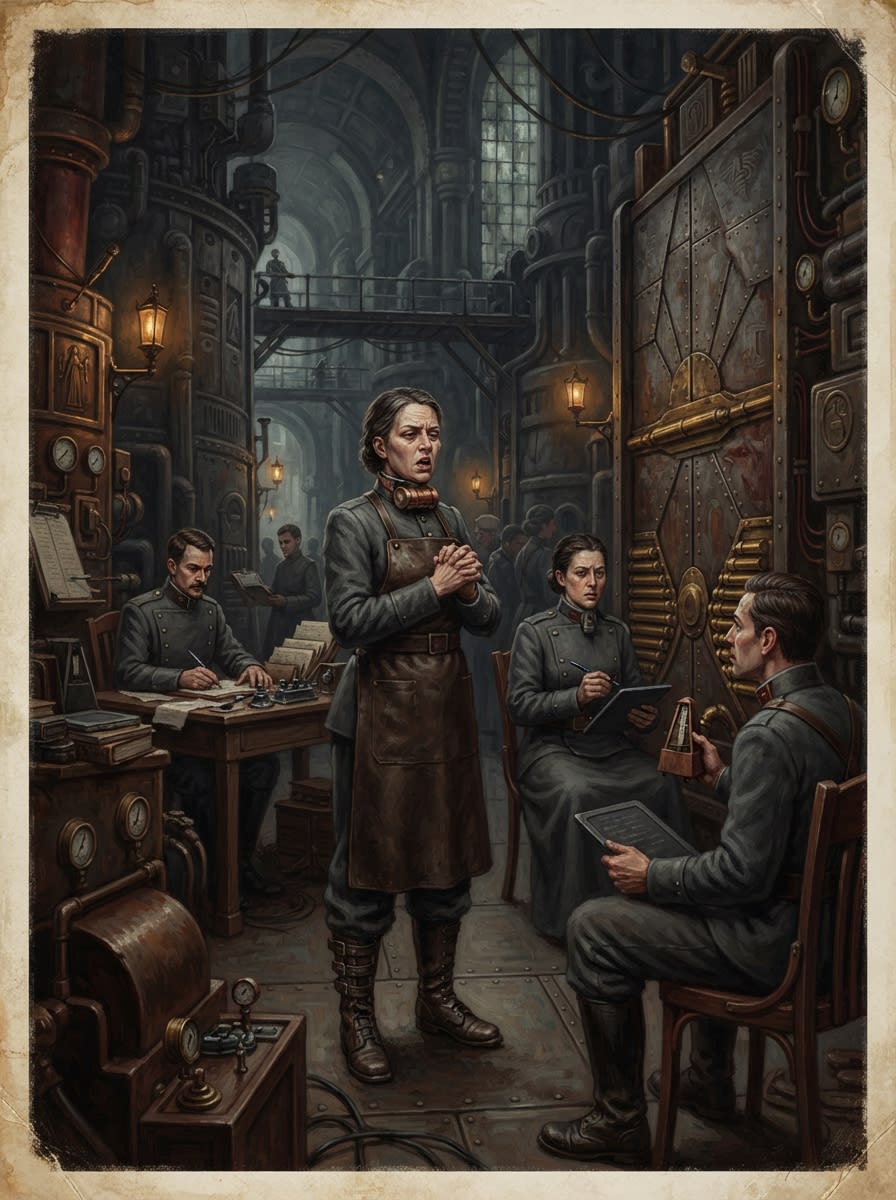
The witness chain came first. Under the old practice a Singer could count the Closing Tone silence against her own pulse and swear to it herself. Revision 14 forbids this. Her pulse may still be the measure, but a throat-witness must now certify it. Purity has noticed that frightened hearts run fast, dutiful hearts run slow, and hearts on quota run at whatever speed the prefect wants.
The scribe must now record why any count restarted. It might be a cough, a sob, iron hiss, an unscheduled bell, the subject praying, or an answer from an unlicensed source. The old ledgers showed restarts as bare slashes. The new ledgers show a slash and its cause, so an auditor can see which rooms interrupt themselves and how often.
Lictors must keep irons out of water until the silence closes. This was always the intention of 22-S. Revision 14 made it an offence, because intention has never stopped a Lictor from cooling his iron.
Bell-hour metronome tokens must be calibrated every quarter against Purity Standard C, with a calibration slip kept alongside the licence slate. A token that has drifted a hair's breadth in a damp cellar is now the Singer's fault, not the cellar's.
#On the Three Schools Under One Sheet
Revision 14 did what no Cantor-Marshal had managed. It gave all three schools a single page and made each of them resent a different line on it.
Mercy Tone may still preserve the condemned with slow sustained drones before the Closing Tone. After the first descending note, it may add nothing. Mercy singers call this a mutilation of the long descent. Purity calls it a deadline.
Judgment Tone may cut as sharp as its throats allow during the rite, but it may not speed up inside the fourteen-heartbeat seal. Judgment men argued that some rooms answer more slowly than a fast cadence and should be outrun. The drafting committee noted that some rooms had also learned knives from them, and moved on.
The Silentists may use minimal substitutes before the Closing Tone: tap cadence, breath marks and slate signals. Full silence is still required after the final note. They won the fewest concessions because they asked for the fewest, which is the most irritating way to win.
#On Echo Weather Grades
Before A.S. 199, the grading of echo weather lived in the throats of old Scar-Voices and the margins of chamber ledgers. Revision 14 made those grades compulsory reporting codes. Every licensed Singer must now log any pitch anomaly by grade, before leaving the room, in a sealed slip.
Grade I is sympathetic hum. Grade II is delayed return, the classic half-beat echo. Grade III is anticipatory return: the room produces the note before the Singer finishes it. Grade IV is borrowed voice, carrying accent, age or personal address. Grade V is lexical intrusion, where the room supplies content. Grade VI, directive response, appears in the protocol as a number followed by a withheld classification. Most Singers learn it exists by noticing that the column is there.
The instruction under every grade is the same: do not harmonise. Do not correct, chase, complete, bless, curse or question the response. Saint Orla said it more briefly, and the protocol cites her by name, a rare courtesy from Purity to anyone dead.
REVISION 14 — ANNEX G, GRADE VI HANDLING On directive response the attending Singer shall ███████████████ at once and shall not ███████████████ in any register. The throat-witness shall ███████████████ the Singer's mouth. The scribe shall close the sheet at ███████████████ and deliver it unread to ███████████████. All personnel present are to be treated as ███████████████ until Purity determines whether the instruction was ███████████████.
Doctrine still classes the whole phenomenon as residual liturgical resonance. Revision 14 does not argue. It simply requires five grades of paperwork for a resonance, plus one grade no one may name.
#On Orison's Reduced Hand
The Bureau of Orison and Song licenses voice across the Synod: choirs, cantors, bell-psalms, funeral chant, the whole tuned apparatus of public devotion. The Brand-Singer corps grew from Orison's borrowed choirs, and Orison has never forgiven Purity for keeping them.
Before Revision 14, Orison held advisory rights over acoustic practice in penitential rites. It sent notation reviewers and origin commentators, and it proposed copper listening horns, which Purity later filed under "experimental nuisance." Revision 14 keeps Orison's advice on notation, on the historical origin of approved intervals, and on training in the choir schools. It removes Orison's right to advise inside a live penitential rite, or on any chamber carrying an open anomaly grade. Orison may tell a Singer where a hymn came from. It may no longer tell her what to do when the wall answers back.
Early Orison circulars and at least two local prefect bulletins described Revision 14 as "a cooperative modernisation undertaken jointly by the Bureaus of Orison and Purity."
Withdrawn by Purity notice. Orison was consulted on notation, and on nothing else. Its signature appears once, on the interval appendix, under a line that reads "received." Receiving a document is different from writing it.
The Bureau of Doctrine approved the restriction without comment.
#On Fraud, Compliance, and Punishment
Making anomaly reports compulsory produced a flood of them. A bad Singer blames Grade II for a missed cue. A scribe with a spoiled sheet claims Grade I hum. A family seeking appeal swears the condemned heard a mother's voice through the grille. Revision 14 anticipated this, and so it punishes any report that "causes disorder disproportionate to its grade." The Singer must report everything, and will be punished for reporting anything that frightens the wrong people. Truth is now both mandatory and costly.
The counting frauds are named one by one: short count, long count, the omitted cough, the "unvoiced vocalisation" by which a witness decides a sound never happened, and the fabricated anomaly used to seal a botched file from civilian review. The penalties rise with how much of the Singer remains. Suspension and pitch audit come first. After that come throat quarantine, then three silence weeks, then reassignment to road-cage maintenance or Ash Chorister instruction. Past those lie the sealed categories, which Revision 14 cites by number only.
The Brand-Smith is not spared. Striking during the silence counts as acoustic contamination. Touching water before the close is now a separate charge, so one careless Brand-Smith can be convicted twice for a single hiss.
#On Present Use, A.S. 201
As of A.S. 201, Revision 14 governs every Purity penitence hall in Strasbourg, the Mainz iron rooms, every repaired chamber with prior response on file, road cages classed as answering sites, and the forward discipline wards at Brest, Przemyśl and Shipka. Singers train under it, get audited under it, and are reassigned under it. Its sheets are printed on better paper than any before it.
It works, in the sense Purity uses the word. Rites close. Counts are witnessed. Tokens are calibrated. Anomalies are graded, sealed and filed. The rooms continue to answer, and it is only because they keep answering that the protocol is still worth enforcing.