
#On the Bones Before the Fire
Relic 31-C(α–γ) is three phalanges, the small jointed bones of the human finger, attributed to three apostles whom no surviving record names. The Bureau of Relics files them under Greek letters because the apostles left no labels. A clerk faced with a missing name will reach for the alphabet of a dead empire before he admits ignorance. So they are alpha, beta and gamma: three fingers, no hands, no owners disclosed, and no provenance before Cologne that the Bureau will defend in public.
That last omission offends pilgrims. They want to know which apostle pointed with alpha. They want a shoreline, a martyrdom, a famous gesture. Doctrine gives them a shelf in the crypt of Saint Gereon, Cologne, and a label written by a parish clerk. The bones are older than the label. The label is what the Synod can prove.
Bone is ordinary matter: lime, marrow-channel, the brown film of centuries. The Rationalist Republic could not tolerate these three because of whom they were attributed to. Maldrake could not tolerate them for a reason the Republic did not survive long enough to classify. Their file must be kept apart from the saint who carried them. Saint Ignatius has a feast, a patronage and a brass inscription. The phalanges have a custody chain, a combat record and a glass case. Hagiography prefers the man, because men have faces. Relics prefers the bones, because bones do not revise their testimony.
#On Bread, Beer, and Custody
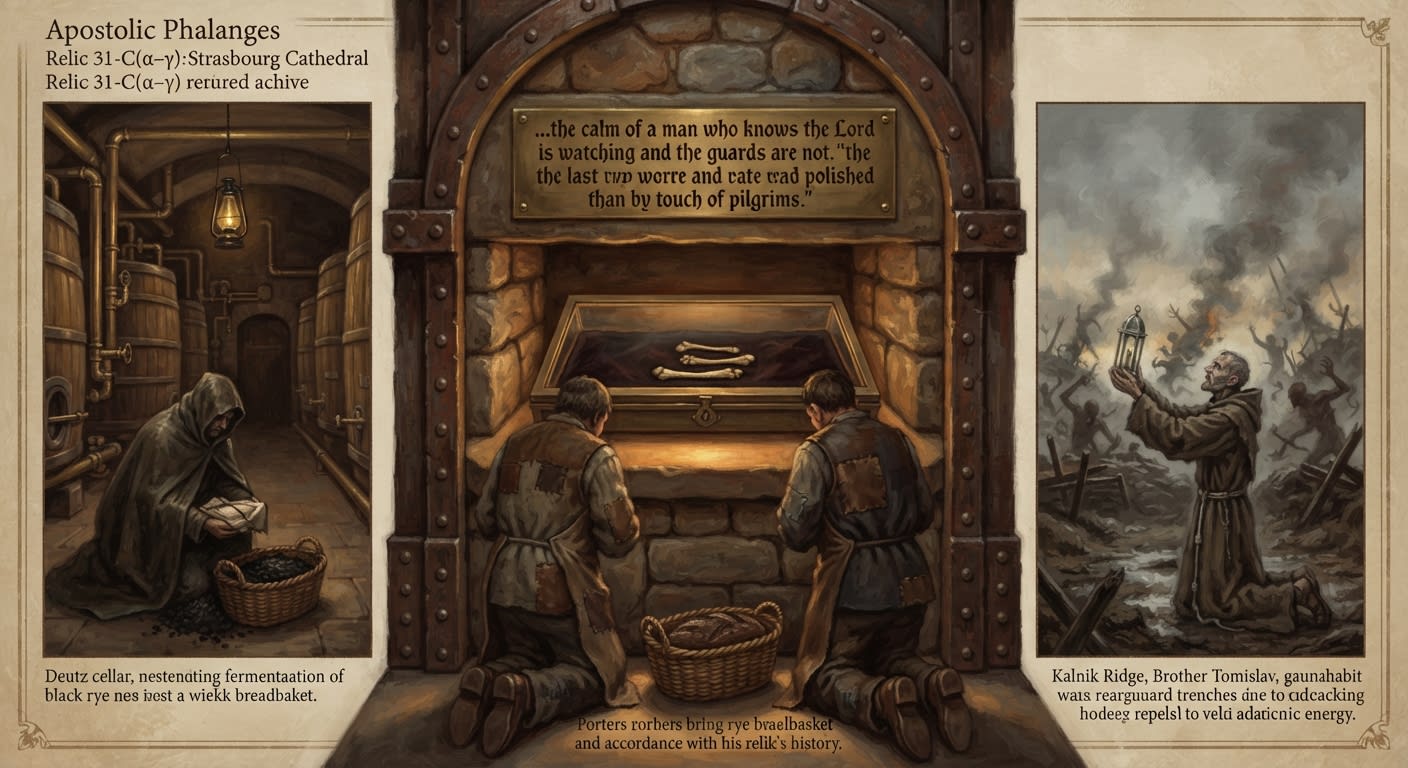
In A.S. 31 the Rationalist Architecture Committee condemned Saint Gereon, and eleven days lay between the sentence and the hammer. Ignatius Brenner, parish clerk, went down into the crypt he had catalogued for nineteen years. He took the three phalanges from their reliquary and laid them under black rye in a wicker breadbasket with a checked cloth. He left the reliquary behind. Gold draws inspectors. Bone under bread draws flies.
He crossed from Cologne to Deutz past the 14th Rhine Customs Brigade and told a Philosophical Prefect he was taking bread to his sister. At the landing a guard lifted the cloth, saw rye and put the cloth back. The crossing-sheet reads: "male, clerk type, bread, Deutz, passed." It is the first document in which Relic 31-C appears, and it does not know it.
Brenner had no sister in Deutz. He had Aldric Hartmann, brewer and Cellar Saint contact. Hartmann took the bones without ceremony, wrapped them in oilcloth and sealed them in a foundation crypt beneath his fermentation vats. The receipt went into a hollowed copy of the Principia Rationis. Hartmann died of lung fever in A.S. 38. Custody passed through the brewery line to Klara, surname unrecovered, who kept the crypt shut until A.S. 45 and was then filed like a smudge.
For fourteen years the bones lay under beer. The phalanges did nothing in that time, and keeping it that way was the whole achievement of everyone around them. The Thread, the Cellar Saints' rule of two links and no triangles, made sure no single carrier knew enough to make torture efficient. Relic 31-C became its standard custody example because it is the one that later caught fire. The Bureau remembers the cases that paid.
#On the Road to Kalnik
The Sundering of 1 November A.S. 45 broke the Republic's roads along with its categories. Brenner came back through the Thread to Deutz and took the phalanges out of Klara's sealed stone. He carried them south to a Koblenz waystation behind the Sign of the Bent Oar, where he handed them to an unnamed military chaplain attached to the 7th Rearguard Column. The handover took under six minutes. The chaplain hid the packet under fever compresses in a medical cart, since guards search gold and keep away from sickness.
There Brenner leaves the chain. The bones went on without him. They crossed the Column's middle miles of mud, ration fights and one sergeant's rifle butt, and reached Brother Tomislav, the half-blind Franciscan, near the Croatian approaches. They went into the casket he already carried.
Several pilgrim route cards, and at least one older Archive guide, state that the apostolic phalanges "blazed at the Sundering." A popular catechism has Brenner placing them directly into Tomislav's hands.
Corrected. The Sundering is A.S. 45. The phalanges manifested at Kalnik Ridge in A.S. 48. Between Brenner and Tomislav stood a chaplain and a column. Devotion squeezes three years and two custodians into one handshake because a handshake fits on a medal. The Bureau of Relics keeps the whole chain. A relic without one belongs to whichever parish shouts loudest.
#On the Blaze
At Kalnik Ridge in A.S. 48, Tomislav raised the Reliquary of Saint Isidore over a rearguard that had no artillery and two crates of flour labelled ammunition. Seventeen relics had gathered in or around that casket through years of Cellar Saint smuggling: martyr splinters, sealed ash, a chain link from a burnt chapel, the original Isidorean bone, and Relic 31-C(α–γ). All seventeen ignited at once. Maldrake's Wrathforged vanguard recoiled.
Brenner was not there and never saw it. The bones no more needed their rescuer present than a cannon needs its foundryman.
That last line was written by a clerk with more honesty than career sense. Every other authentication in the Archive rests on documents, provenance strips and Examiners breathing through vinegar gauze. This one rests on a demon host stepping backward. No Bureau existed to witness it. The Bureau inherited the result and stamped it afterward.
Kalnik did not end the Great Retreat, which ground on until A.S. 65. The ridge proved that the Enemy could flinch. An army that has seen the Enemy flinch stops routing and starts withdrawing in order, one grudging mile at a time. Tomislav left only his kneeling ash on the cairn. The phalanges came down the ridge whole.
#On the Case in Strasbourg
The Bureau authenticated Relic 31-C in A.S. 104, the year the Fourth Doctrinal Congress canonised Brenner as Saint Ignatius the Carrier. The authentication confirmed what Kalnik had already shown, much as a notary confirms that a man who has walked into a room is standing in it. Relics holds, with a straight face, that its stamp is what makes a bone authentic. Kalnik holds nothing. It simply happened, fifty-six years before the stamp. Both positions are canonical. The Bureau has never found this uncomfortable, which is its great gift.
The phalanges now lie in the Relics Archive beneath Strasbourg Cathedral, above the Vault of Sacred Custody, in a shallow case lit from below. They are the colour of old ivory. Over the entrance hangs the brass inscription attributed to the Carrier: the calm of a man who knows the Lord is watching and the guards are not. Pilgrims have polished the last word brighter than the rest.
On 17 Octobris the case is opened. "Opened" is a technical term. The glass is raised three finger-widths behind a secondary screen, and the tray stays sealed. Two porters chosen by lot carry bread down the aisle and set it beneath the inscription. The loaves are counted before and after. In A.S. 188 one loaf vanished, seventeen men were questioned, and the Bureau of Purity found nothing. In A.S. 196 an Archive observer recorded undeclared objects under feast loaves that were allowed onward under "devotional concealment tolerance." I would frame that phrase if framing were permitted below the seventeenth step.
As of A.S. 201 the case is open by licence, watched, profitable and acoustically sensitive. Porters kneel first, then supply-runners, then smugglers, who wait until the guards are tired. Nobody lifts the bread.