
#On the Term
Anticipatory acoustic resonance, mechanism undetermined. Five words and a comma. The Bureau of Bells entered them in the Königsberg file with the care of a sacristan laying out vestments for a corpse. They have lain there ever since, pressed and starched, and no living man could wear them.
Each word earns its salary. Anticipatory admits that something arrives early without saying who sent it. Acoustic carries the matter out of the chapel and into the workshop. In the workshop a frightening thing becomes a measurable thing, and a measurable thing becomes the property of engineers. Resonance is the masterstroke. The word comes from the tuning-fork drawer, and every bellman in the Synod knows it. It suggests sympathy between two bodies of metal and says nothing whatever about a mind. Mechanism undetermined closes the lid. It admits ignorance in the only form a Bureau can survive, which is the form that promises an answer later.
Strip away the starch and the term describes this. At Bastion-Königsberg, the fog has twice sung an authorised hymn before the men appointed to sing it reached the bar.
The Bureau might have called that prophecy. It might have called it memory, theft, mockery or worship. Every one of those words needs a speaker. The office chose a word that needs only a room.
#On the Returned Hymn
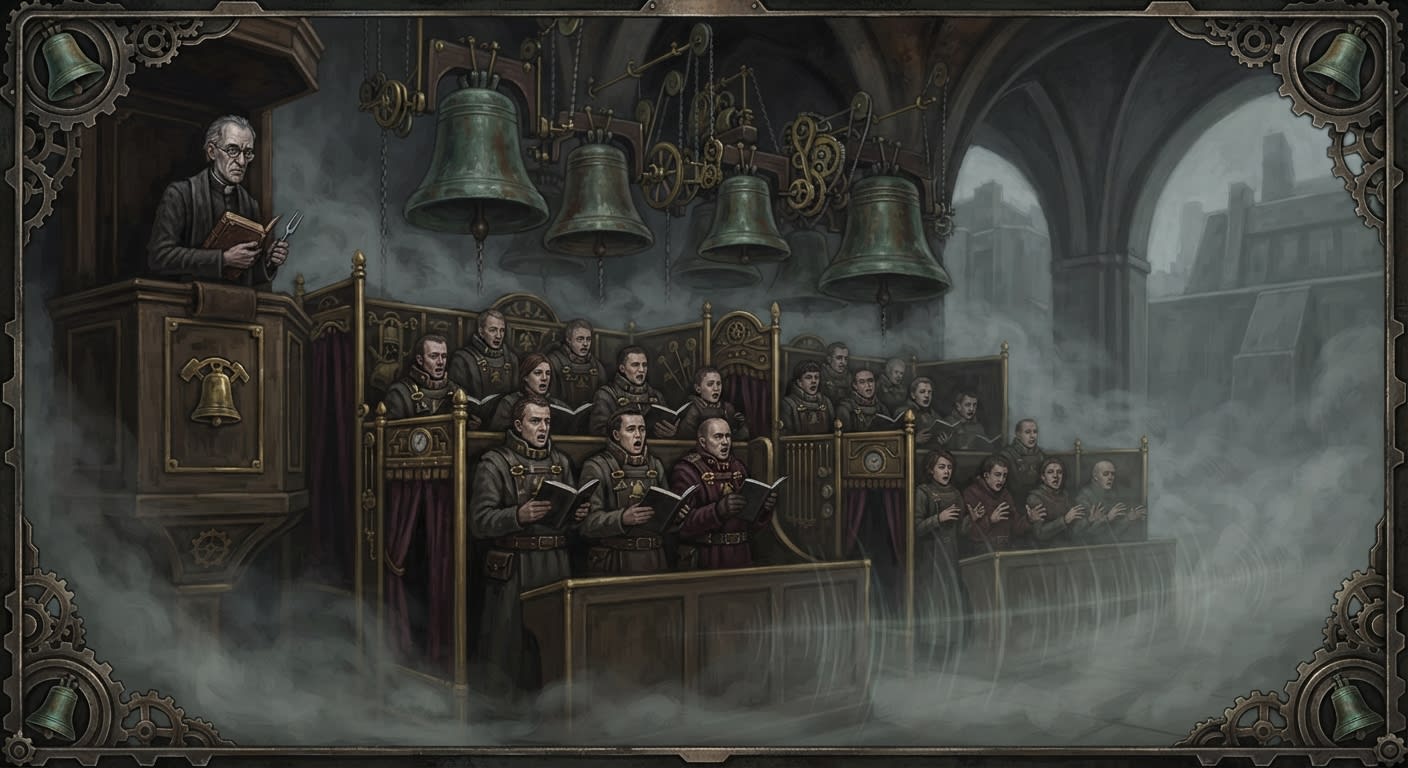
The Northern Carillon hangs in the Cathedral Close. It has forty-one bells of Prussian gun-bronze, cast A.S. 97 to 107 and tuned to Northern Standard Resonance. Beneath them sits the Choir of the Northern Standard, established A.S. 188. It keeps twenty voices in continuous rotation, twelve hours on and twelve off, and fills the intervals between peals with hymnody that Doctrine has approved and Bells has calibrated. The bellmen have logged an answering shift since A.S. 190. The Grey has been answering the Choir for most of that time.
The Line knows hostile sound of old, and the Codex keeps a catalogue of its manners. Morwen's echoes come back corrupted, the verse bent toward want. Syrion's fog returns the note late and dragged, as if sung through cold honey. Maldrake's heat hammers a hymn flat. Kargath's hosts eat it. Common Prayer-Jam strangles the signal in the throat, so the bells misfire and obedient men march briskly into error. Each of these attacks the hymn. Each can be named, logged and answered with a counter-peal.
The Grey returns the hymn perfectly. It matches the Choir note for note, word for word and timbre for timbre, in voices so close to the singers' own that experienced men have lost their place. They have stood open-mouthed inside a verse they could no longer prove was theirs. The fog finds nothing to correct and nothing to devour. It hands back the exact coin it was given.
On two documented occasions it handed the coin back first.
The Grey file records the second occasion in A.S. 199. The first sits earlier in the same file, somewhere after A.S. 190, and I will not date it more closely than the record allows. On the substance both entries agree. The returned melody arrived several bars ahead of the Choir. These singers were trained to hold pitch through foghorn and frost-crack. They found themselves following a hymn that was already being sung beyond the Sea Wall, by something wearing their voices.
A Bureau of Bells field summary classified the Königsberg returns as "Morwen-class echo-replication, aggravated by sympathetic resonance under abnormal atmospheric load."
Withdrawn. Morwen's echo corrupts what it repeats. The Königsberg return is faithful and, on two documented occasions, early. Atmospheric load does not account for a hymn heard before it is sung. The approved term is anticipatory acoustic resonance, mechanism undetermined. The Bureau regrets having briefly known what it was.
Harmonic-isolation screens were installed around the choir stalls about A.S. 197. They are handsome things, lacquered, baffled and blessed. They reduce the echo but do not remove it. The Bureau records the reduction as progress. The Choir records that the answer now sounds as if it stands on the other side of a curtain.
#On Grau's Discipline
Rector-Chaplain Wendelin Grau has held the rectorate since A.S. 186 and has kept the Choir since its founding. He has three rules for the returned hymn and enforces them with the patience of a bone-setter.
Finish the verse. A singer who stops has handed the interval to whatever is filling it.
Do not correct toward the answer. If the returned line and the sung line differ by a hair of pitch, the singer holds the authorised pitch and leaves the fog to be wrong, or right, alone.
Do not harmonise. This is the worst temptation of the three. The returned voice is beautiful in exactly the way a boy's own voice sounds beautiful to him. A tired throat leans toward it as a tired body leans toward a warm wall. Grau takes out of rotation any singer caught leaning.
The discipline keeps the Carillon useful, and the singers pay for it. Grau keeps a list of men withdrawn for echo-sickness. This is a local form of bell-sickness in which the patient stops hearing the authorised hymn as his own. Some weep after rotation. Some bleed at the lip. One asked Grau in confession whether he had spent eight years singing or only agreeing. Grau absolved the fear and refused the interpretation. That is his method. A man may confess terror, but he may not build doctrine from it at the choir stall.
Over bad spirits in A.S. 201, Grau also told me that the Grey knows hymns not yet written. He meant it plainly. Cadences have come back from the fog that he later found, half-formed, in draft memoranda from the Bureau of Orison and Song. None of those melodies had been approved, and some never were. He keeps the rejected drafts sealed in a separate chest. He has not told Orison.
SEALED CONVERSATION NOTE — DRAX/GRAU, A.S. 201 (EXTRACT) Subject asserted: returned hymnody includes unapproved and unwritten forms Custody note: rejected Orison drafts held apart by Rector-Chaplain; Orison not informed Grau's final phrase: ███████████████████████████████ Classification: VERMILLION — denied tier
#On the Offices That Prefer Mechanism
Every office concerned has found its own reason to like the word mechanism.
Bells likes it because a mechanism can be tuned, screened, recast or re-clappered, and Bells owns tools for all four. The Bell Codex, ratified A.S. 115, has no chapter for a peal answered before it rings. Bells would sooner amend the atmosphere than the Codex.
Orison likes it because the alternative points at its drafting room. If the Grey returns hymns before they are approved, then something is reading Orison's desks, or something is reading what Orison has not yet decided to write. Neither flatters an office whose authority rests on knowing the words first.
Doctrine likes it because mechanism carries no theology. The word lets Doctrine file the matter without ruling on it. It need not decide whether the Grey predicts or remembers, causes or overhears. It need not decide whether the Grey stands in time at an angle unknown to the Ledger, or sings with the Choir rather than against it. Each of these is a heresy waiting for a sponsor. Doctrine has listed them as possibilities and forbidden anyone to promote them.
Records likes it because undetermined is a lawful status. It may stay open forever without a single clerk being blamed.
Castellan-Warden Ingrid Halvorsen has commanded since A.S. 191 and likes nothing. Her unofficial northeast logs record which peals drew the fog closer and which sentries on the Sea Wall saluted absence. They also record which nights the Choir was answered early. She gives the phenomenon no name. She records its hours. Of everyone at Königsberg, only her method would survive the discovery of an answer.
Investigation 447-N was dispatched in A.S. 199, after the northern sea demonstration of A.S. 193. It carries the Königsberg returns as an appendix. The appendix is longer than the investigation.
#On Adjacent Horrors
The Codex holds parallels, not explanations. I set these side by side only as a clerk sets similar seals on one table to see which wax runs.
At Bastion-Brest, Booth 77 repeats confessions before the penitent speaks them; see the Confession Echo. The apocryphal Lyon Codex, a rival to the Bell Codex, mapped peals that had not yet rung and was filed twice for its trouble; see Lyon. The Master Hymnal Plates show that whoever holds custody of a hymn can revise the mouths that sing it, turning yesterday's correct verse into today's error by decree. Across the water, the Fractured North keeps old bells against det grå vattnet by rules that Strasbourg did not write and has not licensed.
None of these proves the others. Laid side by side, they make the Bureau's comfortable word look lonely.
#On Present Holding
As of A.S. 201 the phenomenon is active, classified, useful and unresolved. It is useful because the returns mark the Grey's approach more reliably than the sentries, whose hands salute before their eyes can report. It is unresolved because every office that could resolve it has found a reason to prefer a label.
The Choir keeps its rotation. The screens hold back part of the answer and let the rest through. Grau's chest grows heavier with rejected drafts. Halvorsen's logs grow longer. Somewhere past the Sea Wall a hymn not yet approved is waiting, note for note and word for word, in a voice the Choir will recognise.