
#On the Need for a Yearly Absence
A dead city needs no confirmation. Rome's older ruins go uninspected for centuries without anyone doubting their emptiness, and the plague villages of the lower Sava rot in peace, recorded only by their smell. A city requires annual certification of its absence only when the absence is in doubt, and when the doubt sits four hundred metres across the Danube from a Bureau garrison with a clear view of its windows.
The Annual Confirmation of Vacuity is the rite by which Pest, the eastern bank of Budapest, remains legally classifiable as Vacated. It derives from the A.S. 120 declaration that closed the evacuation of the eastern districts, and it is performed in present form as of A.S. 201. No founding ordinance names its first night, its first captain, or its first listener. The Bureau prefers it this way. A rite without a first performance has no anniversary, and a rite with no anniversary cannot be accused of aging.
"Vacuity" is a doctrinal term. It should be kept apart from the vulgar adjective. Empty is a claim about rooms, stairwells and larders, and it can be refuted by any child with a lantern. Vacated is a legal state conferred on a place by an office, and it can be refuted only by another office, which will first have to find the folio.
The rite exists because Pest refuses the ordinary decency of ruin. Its rooflines are sharp. Three spires stand. The market halls keep their glass. A lost city that looks lost can be mourned once and filed. A lost city that looks patient must be told, every year, in the presence of witnesses and under seal, that it is not there.
#On the Boat
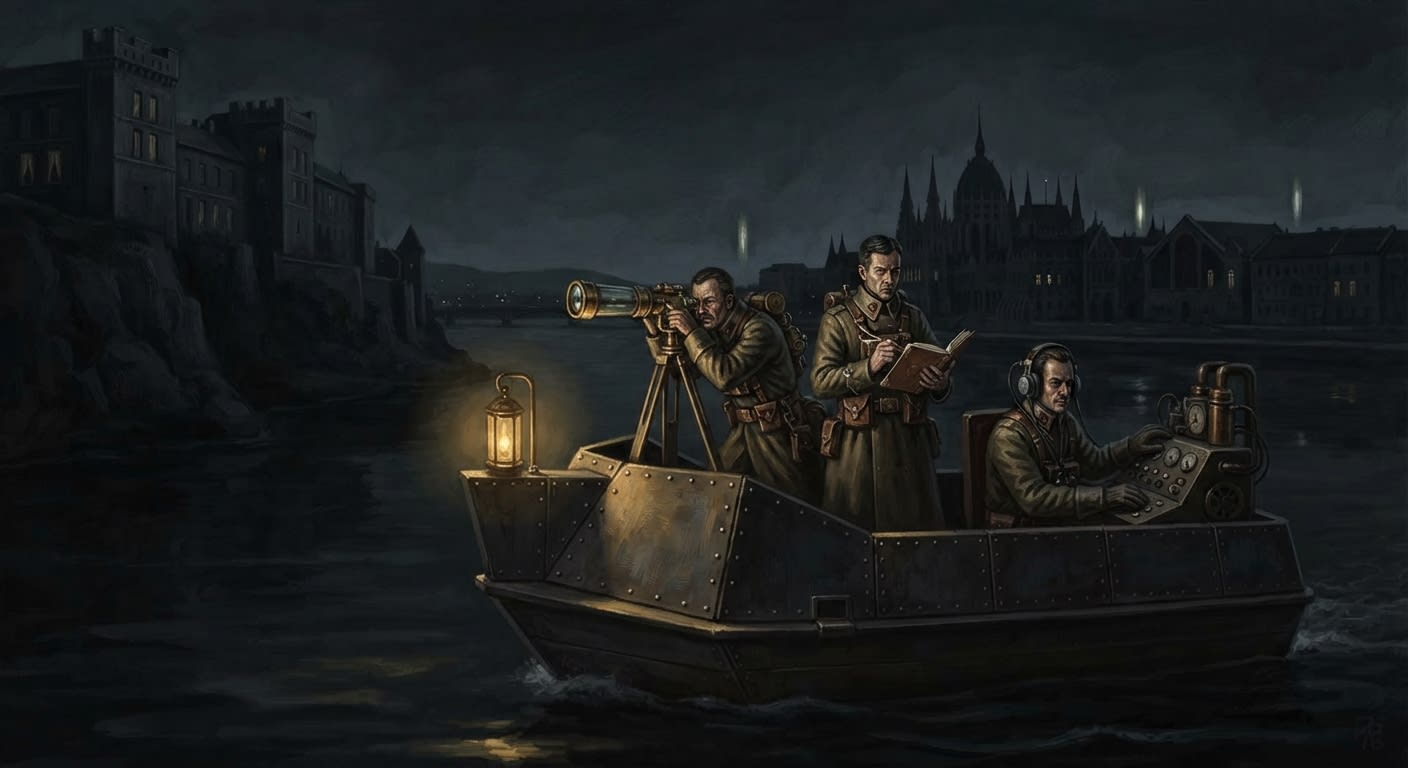
The Bureau of War schedules the crossing and supplies the vessel. It is an ordinary river-patrol boat, flat-bottomed and shielded with reliquary plate. For every other night of the year its lamps are hooded while it sweeps the water between dusk and dawn. On the night of confirmation it crosses the midline after midnight and uncovers a single reliquary lamp at the bow.
It makes three passes along the eastern shore and never lands. Landing would imply a destination, and a Vacated bank has none. The stamp does not permit a gangplank.
Crews rotate every forty-five days under Quartermaster-General Hofer, whose Central Corridor Command holds night authority over the Danube patrols. His reasoning is recorded plainly in the rotation file: longer service produces reports. A man who has made the crossing once reports weather. A man who has made it for a season reports a kitchen, then a name, and then asks for leave to go back.
The crew are instructed to keep their eyes on the water, the lamp and the oar-stroke, and never on the windows. Doctrine calls this discipline. The crews call it rowing blind past their grandmothers' streets, and they say so only after rotation.
At dawn the boat returns west. Nobody records the journey back. The rite considers itself finished once the boat turns its stern to the east.
#On the Listener
The Litany-Engineer sits astern. The Bureau of Engineering provides him with reluctance and a short list of complaints, which it resubmits every year and which has never been answered.
His task is harmonic examination. Stone, iron, glass and water each give back a tone when a cant is set against them, the way a generator vault answers a correct ignition verse and screams at a wrong one. The Litany-Engineer sings low across the river and listens for the reply. A sound quay wall answers as a quay wall should. A dead bell-frame gives a dull note. Foreign tones are logged.
The logs show that Pest answers.
The Engineering annexes list what answers: stone hums a quarter-tone flat, iron rings back in the wrong key, and glass returns a sound that three consecutive listeners described as attentive. Water under the eastern embankment carries the cant back a half-beat late, as though it had to be passed hand to hand before anyone could reply. Whatever has learned to imitate civic silence gives an answer more correct than the silence of an actual dead city. Engineering's complaint concerns that correctness. A real ruin is untidy in its acoustics, and Pest is tidy.
#On the Count
The rite records five categories: window count, bell response, surface disturbance, mirror flare, and voice occurrence.
Each is admissible because none of them uses the word people. A window count counts panes lit or unlit, and a pane has no soul to register. A bell response records whether any bell answered the Engineer's cant and makes no claim that a hand rang it. Surface disturbance is measured in the water, where anything may disturb anything. Mirror flare is logged as optical return and sent to the Bureau of Shadows. A voice occurrence counts voices and never speakers, which lets the Bureau enter a thousand words spoken on the eastern bank in a year and still find no one saying them.
The categories were drafted with the skill of a man building a cage around an animal he refuses to name. They are exact. What they measure is known to everyone and written down nowhere.
Public summaries of the Annual Confirmation state that the rite "establishes the eastern bank to be empty of habitation."
Corrected. The rite establishes that Pest remains administratively classifiable as Vacated. Habitation is not an entry category, so no quantity of it can be recorded against the finding. The rite has never measured emptiness and has never needed to.
#On the Offices
The boat carries four interests, and they agree on almost nothing.
War wants a threat with masonry, because a visible enemy bank justifies riverside guns, patrol fuel and a line on the Central Corridor budget that no Treasury auditor dares strike through. Shadows wants the useful truths, which it keeps in the private annex the public never sees. Doctrine wants a seal, and it gets one every dawn, a clean abstract fit for the bathhouse noticeboards of the western districts.
The Bureau of Records never boards and still holds the largest share. From A.S. 118 to A.S. 125 the Mothers of Plenty processed evacuees through the western warehouses and could not reconcile the names. Between sixty and ninety thousand residents of Pest are carried in the Great Ledger of Souls under administrative review. They include the eight hundred who were still on the Chain Bridge when it fell in A.S. 122, filed as transferred, destination pending. If Records declared them dead, estates would have to be settled and prayers said by name. If it declared them living, someone would have to cross the river and rescue them. The Confirmation lets Records avoid both. Each year's seal lets the review go on without end, and the Ledger accepts this as a courtesy.
Engineering wants the stone, glass and water to stop answering. It is the only office aboard that wants anything to change.
#On False Emptiness
The rite is complicated by the fact that its three passes are made past a bank the Bureau has already assessed as occupied.
In A.S. 199 the Bureau of Shadows filed a field assessment of Budapest-East. It found coordinated movement patterns. It confirmed Velmora assets in three commercial structures. It revised the unaccounted population estimate upward. It then recommended that the classification VACATED be maintained, and Doctrine concurred without a homily. The Confirmation that followed that assessment went out as usual. It made its three passes, recorded its five categories and returned at dawn to deliver a clean abstract.
Greed has a patience that commercial structures suit. Velmora's servants have no need to storm a bank the Synod has formally let go. They can keep ledgers there, hold debts, and count what they count. The rite cannot enter a debt as an occupant, and an unowned city is a very large and very quiet asset.
The older infection is Velkara's. In A.S. 117 the Budapest Perfume Fog came up from the Shattered Courts of Belgrade, reached both banks, and lay over the city for eleven days. Its scent stayed for months, and Purity sealed its assessment. Velkara's arts do not work like the puppet-strings of village sermons. They alter attachment, so that the wrong room feels like home and the wrong face feels beloved. Scholars have misread Morwen's pressure along the Danube approaches as a claim on Pest itself, which it is not. That pressure does account for the mirror flare in the fifth column and the reports of reflected windows showing a life the observer recognises as his own.
Lust, Greed, Envy, War and Records all hold claims on the same dark windows, and the claims cannot all be true. The Confirmation does not resolve them. It enters each night's measurements under columns that make no ruling.
BUREAU OF WAR / SHADOWS — DIRECTIVE 88-E CROSSING ANNEX Documented western-to-eastern crossing attempts: eleven. Associated sighting, most frequent: lit room; familiar domestic interior. Recovered: █████. Recovered statement, excerpt: "It was my mother's kitchen. She had set my ██████." Occupant of kitchen, per observer: ██████████████. Doctrine correction issued: kitchens across the river are not yours.
Pastoral Directive 88-E/BUDAPEST advises all persons on the western quays to face west. The advice is posted and the eleven attempts are on file. The boat goes out regardless, and for three passes a year its crew face east because the rite requires it.
#On Present Use
As of A.S. 201 the Annual Confirmation of Vacuity continues. Pest remains visible, inaccessible, contested, and classifiable as Vacated. The rite is a sacrament of refusal. It gives the Synod one bounded night, one repeatable file, five admissible columns and a public conclusion that can be stamped before breakfast without anyone naming the city across the water as inhabited.
The western city draws its curtains on the east side. The coffee houses serve at the windows facing Buda. Children are told that the boat goes out to bless the river, and the Bureau has declined to issue a correction.