
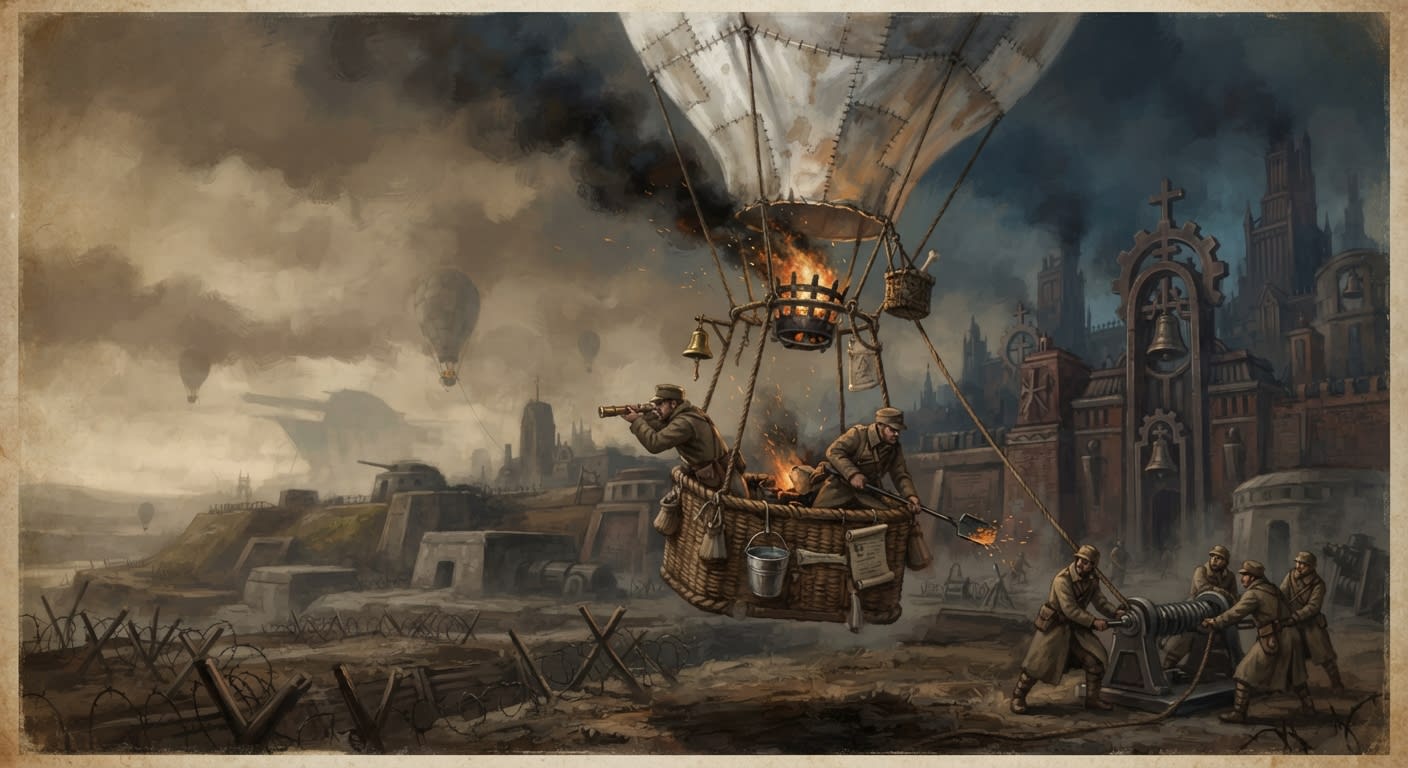
#On the First Machines That Rose Badly
From the early aerial files of the Bureau of Records, kept in a drawer lined with tin. The reader will understand the tin shortly.
The Angelus Engines were the first machines the Church sent into the sky on purpose. Everything that went up before them went up by accident or through the ordinary courtesy of physics: smoke, bell-noise, prayer, the occasional sapper and his mine. The Engines went up by order. They came down by other means.
No first-flight date survives. Records holds three candidate years. Each was asserted by a different clerk, and each is supported by a different heap of ash. I decline to choose among them. It is enough to say that the Engines belong to the first decades of the Line. The fleeing armies had stopped fleeing, and the earthworks had become defensible without becoming finished. The frontier had walls, bells, trenches and relics. It also had a sky that belonged to no one.
That emptiness was the problem. A trench can be manned. A convoy road can be picketed. The air above both was open ground, and the enemy had noticed. Convoys arrived lighter than they departed. Sappers turned up where no watchman had seen them walk. Things "with wings or the pretence of wings," as the early files put it, crossed the Line at dusk and went uncounted, because no one stood high enough to count them.
Early Line command reasoned as early commands do: quickly, and with borrowed equipment. If the watch could not see far enough, the watch must stand higher. No tower stood high enough. The watchman would have to float.
#On Silk, Heat, Relic, and Prayer
An Angelus Engine had four parts. Later offices have turned each of them into something close to a sacrament, which is what the Church does with any object that killed enough people to deserve a liturgy.
The envelope was silk: altar silk, vestment silk, silk requisitioned from the trunks of officers' widows. It was stitched in panels, sized with glue and sprinkled with blessed water. The water did nothing to help silk resist fire. It was felt to be the thought that counted.
The firebox was an iron brazier slung beneath the mouth of the envelope and fed with straw, pitch and whatever the quartermaster would release. It heated the air that lifted the whole machine. The heated air had no theology. It had one habit, rising, and the silk had one weakness, burning. An Angelus Engine was a running negotiation between those two facts, conducted at the height of a church spire.
The relic rode in a basket-reliquary lashed to the rigging. It might be a finger-bone, a strip of cloth or a splinter, whatever the chaplaincy would part with for a machine it expected to lose. Its purpose was permission. Early Rites clerks held that nothing should rise over consecrated ground without consecrated company, and the relic satisfied the clause. The files do not say whether it added anything to the lift. They do record that no Engine was allowed to ascend without one. They also record that several ascended with one and burned regardless. Rites put this down to the relic declining to intervene. At no point did Rites put it down to the relic failing.
The crew was two men in a wicker gondola the size of a confessional. One observed. The other stoked. Between them they carried a spyglass, a hand-bell, a chalk slate, a bucket of water and prayer. The bell signalled the ground. The prayer covered everything else. Later official histories list the prayer as the Engine's armament. It was the only armament the gondola could carry without breaking its weight allowance, which made it the most effective weapon in its class.
#On the Crashes
The Engines rose when the weather permitted and went wherever the weather preferred. They could not be steered. Each was tethered by a rope to a windlass worked by men on the ground. In calm air the rope held the Engine over its assigned sector like a censer on its chain. In anything stronger than calm, the rope became a suggestion. Engines drifted over the enemy's lines. Engines drifted over their own lines and fired on nothing, having nothing to fire. A Bells officer's log records one Engine that broke its tether and drifted for most of an afternoon. It was last seen heading east "in good order and good voice." The crew had begun the long litany at the moment the rope parted, and the officer noted that their diction was excellent.
And they burned. They burned so regularly that burning stopped being recorded as an incident and began to be recorded as a stage of flight. It might start with a spark from the brazier, a gust folding the silk into the firebox, or a crewman's sleeve. Sometimes it was a hymn-scroll pinned to the rigging for devotional purposes and set alight for no purpose at all. The silk went up in less time than a short collect takes to say. The gondola came down more slowly than the silk, and faster than the men inside it would have liked.
The solution came from the festival clerks, whom later histories dignify as the Bureau of Festivals. Grief, the clerks observed, is bad for morale. Ascension is good for it. The crews had, in every observable sense, ascended. Their proposal classified each crash death as an Ascension of the Faithful, Category: Expedited, to be marked with a short procession, one bell and a pamphlet. It was never ratified in full, and it was never withdrawn. The phrase reached the trenches within a season and has not left them. Men on the Line still use it for any death that arrives from above, including their own artillery's.
Earlier catechetical primers state that the Angelus Engines were retired "with full honours, having fulfilled their holy purpose."
Corrected. The Angelus Engines were never retired. They ran out of silk. The vestment stores refused the last documented requisitions because the chaplains had started saying Mass in wool. Honours were issued afterward, to whoever could still be found.
#On Supersession
What replaced the Engine learned from it and never admitted the kinship. The Sky-Censer Mantles were gliders stitched from relic-cloth. They carried no brazier and trailed censers of sanctified smoke over trenches and convoy roads. They kept the relic and dropped the fire, or rather moved it behind the aircraft, where it could reach the enemy first. The pilots swore the fumes choked Abominations. Wardens below reported their own comrades coughing in the same holy haze. In aerial theology, progress has always meant moving the danger somewhere else.
Then came the Vigil Arks. They had hulls built to cathedral geometry, gondolas that were chapels, Sermon-horns, censer-racks and eleven crew. The Sanctissima Vox settled into the Blightmarsh in A.S. 147, and the Marsh took it slowly, without a spark. The Saint Barachiel, commissioned in A.S. 168, finally rose on an envelope that needed no flame. It is filled with Compound 7, drawn from the Third Ossuary beneath Constantinople through the valve installed that same year. The gas does not burn. Every Angelus crewman prayed for that one property. They prayed for it aloud and at altitude, and none of them received it.
The Saint Gabriel keeps the northern approach. The Saint Uriel sits in its drydock beside a tooth that will not grant permission. Each of them carries a relic in its chapel for the same reason the first Engine carried a finger-bone in a basket: nothing rises over consecrated ground without consecrated company. The clause is older than the Arks and older than the Bureau of Bells and its Bellway doctrine. It is older than any office now arguing over who owns the sky. As far as Records can tell, it was drafted by a chaplain holding a bucket.
#On What the Engines Proved
Their tactical record is thin. The observers' slates logged enemy movement on the days when the wind agreed and the chalk stayed dry. The Bureau of War, which inherited the files and none of the crews, rates their contribution to the defence of the Line as "observational, intermittent, and mostly combustible." I have read the full run of slates. The assessment is generous.
They proved other things. They proved that the sky could be requisitioned: altitude could be entered in a ledger, assigned to a sector and charged to a budget. They proved that a relic could be made to ride, and that a riding relic changed what the men below believed about the air above them. Soldiers who had looked up at nothing now looked up at something. They saw a silk shape, heard a thin bell and watched two men wave down from a basket. A sky with Church property in it was a different sky, and the men in the trenches felt the difference before any theologian had named it. The Engines also proved that sanctity plus flame is still flame. The Vigil Arks were built on the first proof. Their crews fly in fear of the last.
I have stood on the Barachiel's observation deck at five thousand feet. I have smelt the incense thin out and felt the confidence of a gas that will not burn and a hull that will not fold. It is a comfortable place to pray. The two men in the wicker had no such comfort. They prayed anyway, with a bucket of water between their knees and the silk ticking overhead as it warmed. The Synod has been drawing interest on their nerve ever since and has never once sent a statement.