
#On the Record of the Breach
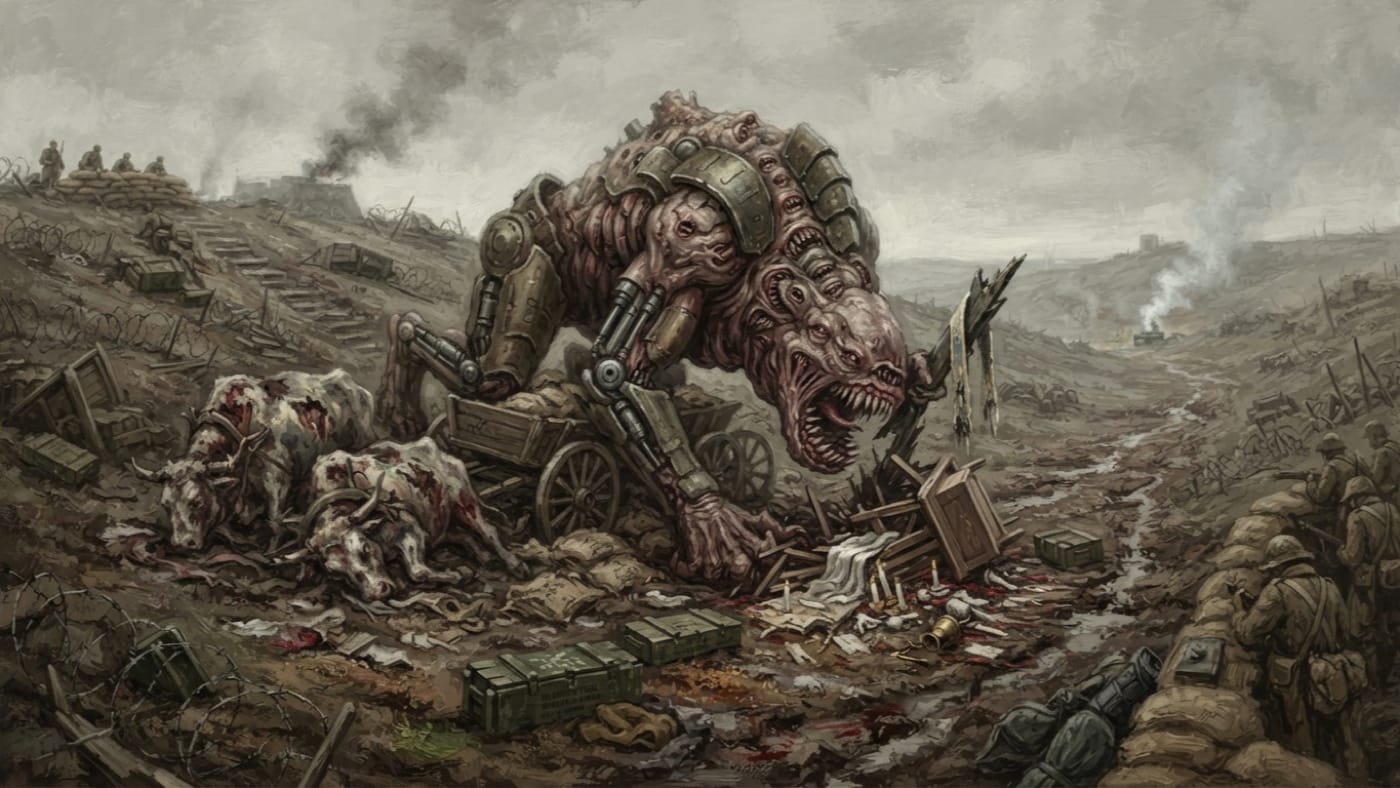
The Ration Slope Breach of A.S. 181 (1891 CE) comes down to the Codex as one sentence of inventory and one paragraph of testimony. That is more than most men eaten on the southern approaches ever received, and less than any of them deserved. A Maw-Born, one of Kargath's primary consumption demons, fed on the Slope. The record keeps what it ate and the order in which it ate it.
The order is what makes the record unusual. Losses in the southern theatre normally survive as totals: so many carts, so many men, so many crates written off against the quarter. Ration Slope survives as a sequence. A wagon of barley. Two oxen. A field altar. Six ammunition crates. One chaplain. The chaplain's brass travel-censer. Someone watched closely enough to count them, and lived long enough to be asked.
On the Bastion-Constantinople approaches, supply is the long quarrel of the southern end of the Sagittal Line. Kargath besieges stomachs more readily than walls. Grain feeds the garrison. Oxen move the grain. Crates arm the men who guard it, and the altar blesses all of it under the Doctrine of Enough, which teaches that the sealed portion is sufficient. On the Slope those four necessities stood within reach of one mouth, and the mouth made no distinction among them.
#On the Order of Consumption
The barley went first. Grain is the softest thing in a supply column and the most honest about what it is. The Maw-Born turn toward consumable matter, and nothing on a southern road is more consumable than a wagon of barley in sacks. The two oxen went next. They were the means by which the barley had come and the means by which anything else might have left. The column lost its bread, and then it lost its legs.
The field altar comes third, a placing the Bureau of Doctrine has never liked. An altar is timber, linen, wax and oil. The creature took it after the oxen and before the crates. The record shows no hesitation and no injury to the creature. Those who expected consecration to stand against the creature like a rampart will find no comfort in the list. Sanctity entered the account as matter, in the same column as the oxen.
The six ammunition crates came after the altar. I will not guess what powder and lead do inside a throat that the Bureau of Engineering has measured as longer than the body around it. The record says only that the crates went, and the record has better discipline than I would. A post that loses its grain, its draught, its altar and its cartridges in one feeding has lost, in miniature, the four things the southern anchor exists to keep: food, movement, blessing and fire.
Then the chaplain. Then his censer.
The sequence holds a cruelty that a total would have hidden. The censer outlasted its owner by one place in the list. The man went before his instrument, and the instrument followed for the same reason the barley had gone first: it was there.
This is the record's list, not a certified return. No one has certified one. It does not count the dead, and I will not count them for it.
Early theological papers described the Maw-Born as "insensate hunger without perception."
Withdrawn, as the parent file records. A creature without perception does not take a wagon, then the beasts beside it, then the altar, and then turn toward the smell of soup. The Maw-Born perceive by edibility. On Ration Slope, edibility was the only rank anyone held.
#On Father Anselm
The human evidence is a single deposition fragment, already held in the parent file. I reproduce it entire, because cutting it down would be a second consumption.
DEPOSITION FRAGMENT — RATION SLOPE, A.S. 181 "It was crying while it took him. Father Anselm kept blessing it. He had both hands on the upper gum and was blessing it while the lower teeth came up. I heard him say, 'poor thing,' and then I heard his ribs. I do not want that written. I know you are writing it." — Pvt. █████ ████, 6th Southern Line Company
The witness was a private of the 6th Southern Line Company. Their name is redacted; their rank and unit are not. The fragment says nothing about the company's strength on the Slope, its position or its losses. I will not build those out of one soldier's presence.
Of Father Anselm the record keeps a title, a first name and one act. It gives no surname, no parish and no year of ordination. The Codex already holds another clergyman of that name, Anselm Gries of the A.S. 147 Pécs file, who died by hanging in another place and in another matter. A clerk who finds a shared name convenient must not shelve the two together. The Anselm of Ration Slope died with both hands on a gum.
Consider what the private reports. The creature was crying. Anselm was blessing it. His hands were on the upper gum. The deposition does not say whether he braced them there or laid them there, and I will not choose for it. The lower teeth came up. He said "poor thing." Then the ribs.
Doctrine has ruled the Maw-Born's intent absent, and nothing in the fragment unsettles the ruling. Nothing in it suggests the creature knew it held a priest. Whatever Anselm meant his blessing to reach, the mouth took it as it had taken the barley. His pity reached the creature by the shortest route there is. The creature had only one organ to receive it with, and it used that one.
No petition for his veneration is recorded, and I propose none.
The private did not want it written, and it was written. Both facts are now in the Codex, in the order the witness gave them. Keeping what witnesses beg it to forget is the discipline of the Bureau of Records, and on occasion its sin.
#On the Turn East
After the censer, the Maw-Born turned east, toward the smell of boiling soup from its own lines.
Kargath's lines kept a kettle. The record does not say whose kettle it was, who it fed or how far off it stood. It says soup, boiling, east, and its own lines. That is enough. The creature had eaten a wagon, two beasts, an altar, six crates, a man and a brass vessel, and its first recorded act afterward was to turn toward more food. Feeding did not end the danger on Ration Slope; it moved the danger east.
Allegiance did nothing for the cooks. A Maw-Born does not check the standard over a kettle before facing it. So far as Doctrine has been able to describe Kargath's hierarchy, it depends on lesser servants keeping their speed and their distance from greater ones. The smell of soup carried no password. Whether the creature reached the kettle, the record does not say. I have read the fragment, the parent entry and the timeline's inventory row, and none of them goes further east than the turn.
Soldiers in the barracks of the southern anchor have taken a sour pleasure in this part of the story, as though the Great Deceiver's own cooks had been punished. Nothing so tidy is on the record. No one punished anyone. A hunger that cannot be filled smelled something it could eat and turned to face it. Kargath's servants are as exposed to their master's gift as the men they are sent against.
#On Later Field Application
The countermeasures now issued against the Maw-Born were not written on Ration Slope. Nothing in the record shows that the breach caused any of them, and nothing shows that any of them was tried there. The southern-theatre field advisory that carries them is dated A.S. 201, twenty years after the breach. Set the two side by side, though, and the advisory reads like the Slope's inventory in reverse.
Keep range. Maw-Born jaws close fast inside reach and almost never beyond it. On the record, everything that was lost was within reach.
Deny loose livestock. Draught animals are food that walks toward the guns.
Blacken food stores. A wagon of barley smells like what it is. The advisory prefers that grain stop smelling like grain.
Fire at the hinge and the throat, where jaw meets body and where appetite has had to borrow anatomy. Engineering and Purity have argued over consecrated iron for decades. On this point they agree, which is rare enough to deserve its own seal.
Do not retrieve swallowed comrades by hand. The advisory says nothing about blessing.
Do not interpret weeping as surrender. Every chaplain on the Line has had this instruction read to them, and some of them have argued with it in their sermons. The deposition does not tell us what Father Anselm believed the crying meant. It tells us where his hands were.
The Bureau's verdict on the Slope has never been longer than the advisory, and I see no reason to lengthen it.