
#On the Appendix
The Przemyśl Cadet Incident survives as one paragraph, and a short one. It sits in a sealed appendix to the Bureau of Purity's collective dossier on Van Hoorn, Lemstra and de Waal, and the appendix is dated A.S. 187, which the old calendar renders 1897. The Codex files the incident under that year for one reason: the paper is dated. The episode the paper describes is not. The record gives no year for the placing of the bone, and no month or bell either. I will not lend it one as a courtesy to the shelving clerks.
Readers raised on sermons expect an incident to come with a cast. This one comes with a title, two objects, a mark, a sentence and an assessor with no name. The appendix calls the occasion "the Przemyśl cadet incident" and names no cadet. It sets the matter at Przemyśl and names no room. Whoever wrote it was either more disciplined than his office usually is, or more frightened than it usually is. I have read enough Purity appendices to know that both produce the same prose.
#On the Bone and the Letter
Jan de Waal was the third of the Amsterdam three and the one who kept the invoices. He handled addresses, money and copyists for the Year of Letters. That was the campaign of A.S. −32, old calendar 1678, which sent the Bone Census across forty cities to count the relics of Saint Aldebrand and let the shrines do the subtraction themselves. Van Hoorn made the table. Lemstra made it polite. De Waal made it arrive. Of the three he is the one I respect most, which means he is the one I would most have liked to see burned.
He died before the Sundering, of nothing the Bureau could put to doctrinal use. The registers disagree about the year, and I will not referee them here. His grave was later opened during a canal extension. The dossier reports that the bones were ordinary. It also reports that Purity weighed them anyway. The record does not say when the grave was opened, who held the spade, or how any part of him reached the Carpathians. I mention these gaps so that no reader fills them with a procession.
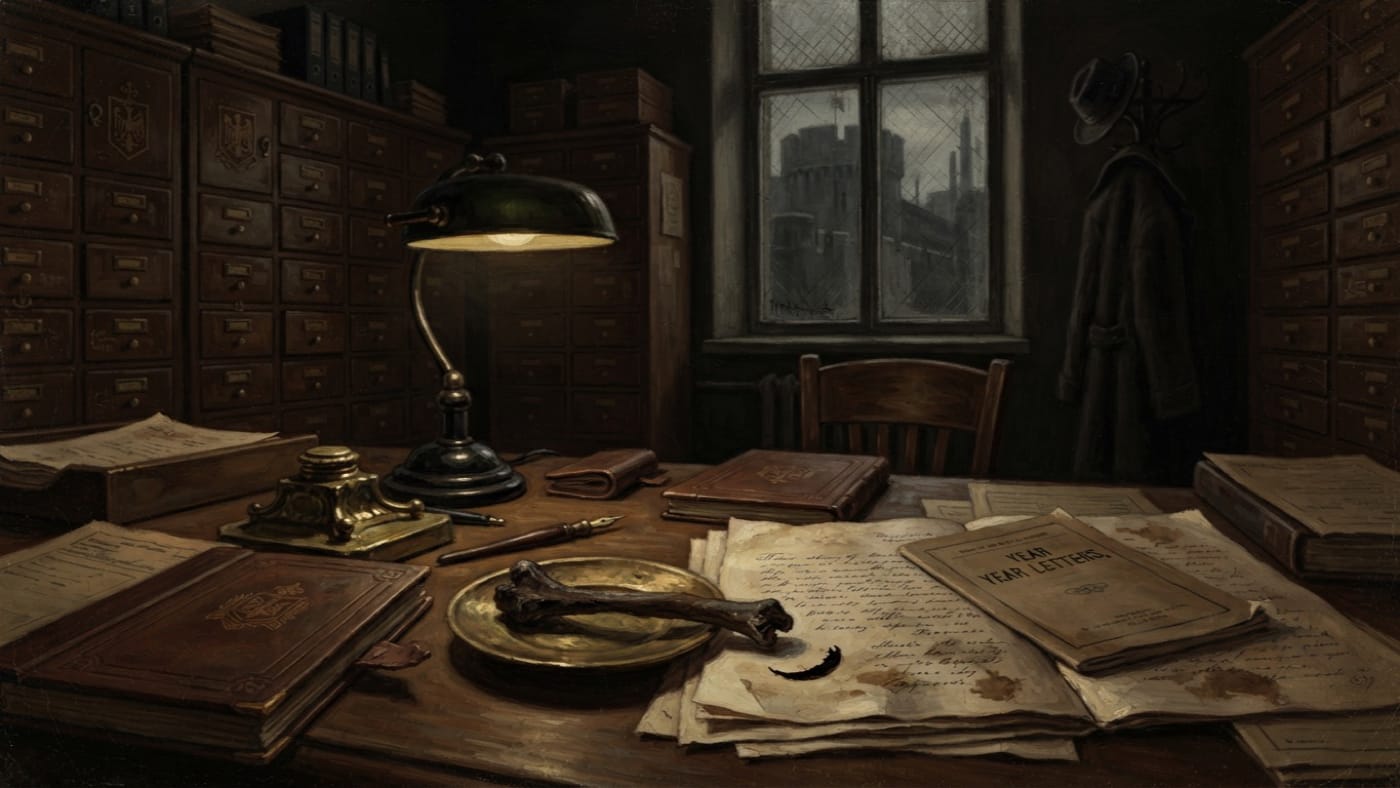
The appendix names two objects. The first is one recovered de Waal finger-bone, kept, in the appendix's own phrase, "for comparative handwriting superstition." The second is a confiscated Year of Letters copy. That is all the identification either object receives. Nobody calls the copy a first printing, an autograph, or a sheet de Waal ever handled. It is a seized document from his campaign. The bone is a piece of the man who paid that campaign's postage.
The joke is in the arrangement, and the joke is on us. De Waal's crime was comparison: inventory set against inventory, femur against femur, until the reliquaries of the old Church could not hold their own arithmetic. An office of the Church condemned that method for two centuries. Then it kept the man's finger so it could compare things.
#On the Crescent Mark
According to the appendix, the finger-bone was placed near the confiscated copy, and a black crescent mark appeared. The mark resembled a bitten fingernail.
That is where the description ends, and I will say exactly where it stops, because the edges of a record are part of the record. The appendix does not say what surface took the mark. It might have been the paper, the table, the bone or the assessor's cuff, and the appendix declines to choose. "Near" is its only measurement. It records no contact, no second attempt, no procedure and no witness beyond the writer, whose presence is implied by the fact that he wrote. It names no ink, soot or other substance. The crescent is black and curved and shaped like the work of a nervous mouth. That is everything the Bureau holds.
Purity seminaries have a vulgar instinct to finish an account like this one for it: to say the dead clerk answered his own pamphlet, signed in the only hand he had left, and corrected his copyist from the grave. The appendix makes none of those claims. It records a mark. It does not record a reply, and I will not turn the one into the other. A heretic's finger beside a heretic's letter has produced a smudge in the Bureau's most expensive ink, which is fear. Whether the Creator, the Great Deceiver or a careless lamp made the smudge is a question for a tribunal that was never convened. I note only that the mark was a fingernail's shape and not a word's. The man who taught forty cities to read left, if he left anything, a gesture of the teeth.
#On the Academy's Other Record
Przemyśl had another file open in A.S. 187, and careless readers will want to staple the two together.
Classification Amber records that a complete copy of De Vera Luce was found among officer cadets at the Bastion-Przemyśl academy that year. The academy belongs to the Wire Orchard, the bastion guarding the western Carpathian passes on the Sagittal Line. Three cadets had memorised the Preface. Their instructors said they had been studying the enemy. Purity was unpersuaded, and the case went into the Index Damnatus. The cadets were reassigned to instructional terrain and struck from the academy rolls, but their names were kept in the Amber Book. Standing Order 14-V followed, and Rationalist residue passed into Amber's punitive watch, enforced by the Lictors.
Older Purity manuals define Amber as "heightened pastoral concern."
Struck, as the Amber record itself strikes it. Amber is punitive watch under suspended warrant. A shepherd's vocabulary was never fit for it.
Now separate the folders. De Vera Luce is the Academy's manifesto of A.S. 0. The Year of Letters copy belongs to a pamphlet campaign thirty-two years older. They are different documents, written by different hands in different centuries. The Amber account mentions no bone, no assessor and no crescent. The bone appendix mentions no Preface, no three cadets, no Amber Book and no Standing Order. One shared town and one date on a cover sheet make the two files neighbours, not accomplices. Nothing in either record says the finger-bone had anything to do with the reform. I will not teach the Bureau to file a coincidence as a cause, because the Bureau learns that lesson eagerly and forgets it badly.
#On the Assessor's Retirement
The appendix ends on one line: "The bone is laughing." The dossier adds what followed: the assessor retired by noon.
I file the line as a sentence, because sentences are my jurisdiction. It is the appendix's own wording, set down by someone in that room in that ink. The line does not say whether anyone heard a sound, or whether the writer meant a likeness, a judgement, or his own nerve giving way on the page. A finger-bone has no lungs, and the appendix does not argue the point. Laughter belongs to whoever laughed, and the paper names no one.
Final line, as filed: "The bone is laughing." The assessor retired by noon.
The assessor has no name in the file, no rank, no age and no stated reason. The record does not say when that morning began, so "by noon" measures nothing except the speed of a departure. In other Bureau papers "retirement" has meant things I will not repeat in a public edition. In this file it means retirement. It will keep meaning that until some other record says otherwise, and none does. A man finished his duties, stood up and left the office before the midday bell. I have known better clerks to do it for less, and worse clerks to stay for more.
The finger-bone is a finger-bone in every ledger I countersign. The Year of Letters copy is contraband. The crescent is a mark of unrecorded substance on an unnamed surface. The line is a line. Noon is the only hour the file records, and nobody wrote down the rest of that day.