
#On the Book That Does Not Close
The Amber Book is the register in which the Bureau of Purity keeps the names it has not finished with. It lies beneath the northern range of the Ashen Cloister in Strasbourg, one stair below the desks where the Chromatic Office sorts suspicion by colour. The chamber shares its damp with the Vault of Silences and hears the chains of the master Index Damnatus through the wall. Novices call it the Honey Ledger when they think no Inquisitor is listening. They are wrong about that as well.
Cologne keeps confusing the Book with the Index, so the difference must be set down plainly. The Index records what is forbidden. The Amber Book records who is still permitted, provisionally and on terms. A name entered in the Index has been judged. A name entered in the Amber Book has been postponed, and in Purity's grammar postponement is a sentence served in instalments.
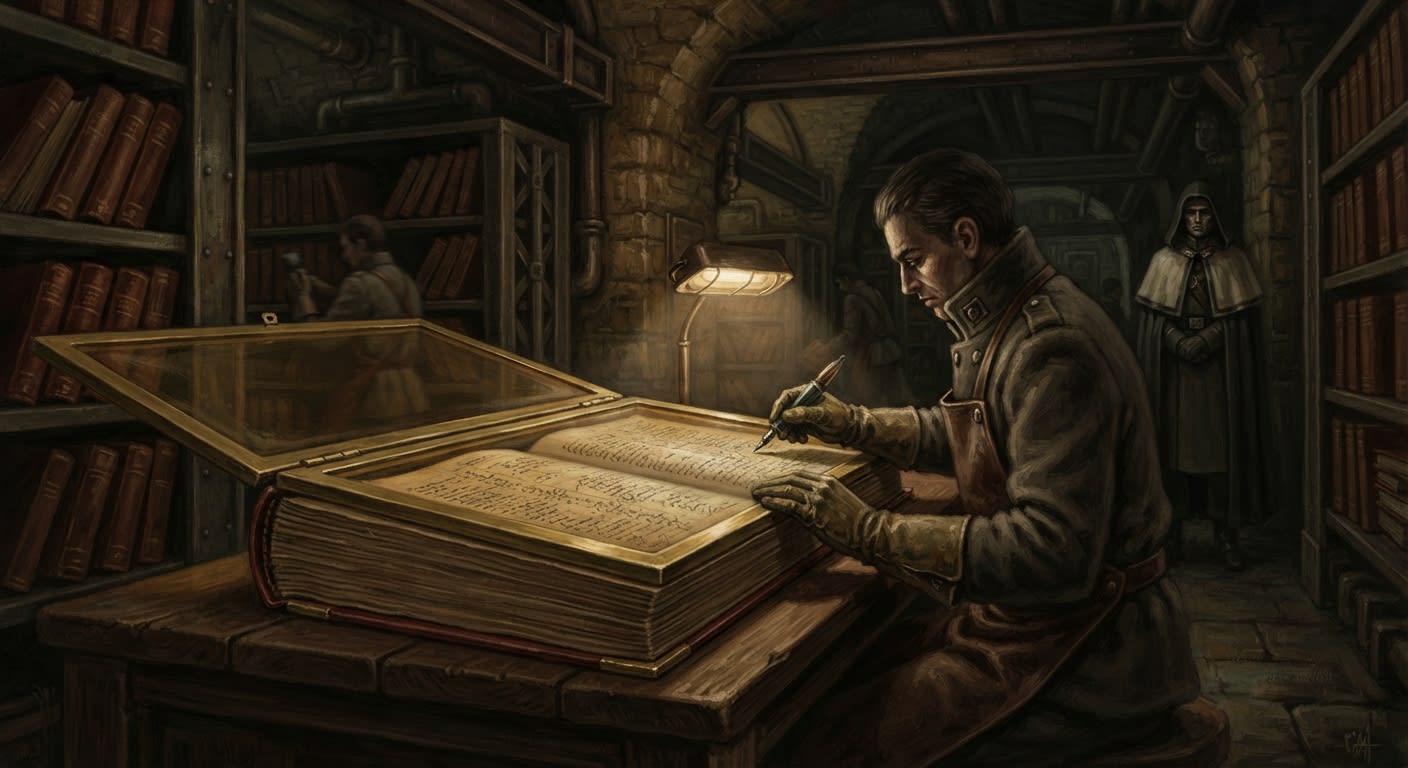
It is one book, which is more than the Index can say of itself. It has one spine of oxblood leather, many times rebound, and gatherings that grow as the Office sews new quires into the back. The binder's awl assigned to it has never been retired. Every opening lies under a hinged pane of pale amber glass, so the clerk reads each name through the colour the Standing Colour Table prescribes. The entries are written in resin ink that never fully cures. The Chromatic Office says the ink stays tacky so later annotations will bond. The clerks say it stays tacky so the names never quite set. Both answers are correct, and only one of them is filed.
#On the Przemyśl Entries
The most famous leaves in the Book belong to A.S. 187, the year Classification Amber took its modern meaning. That year a complete copy of De Vera Luce was found among the officer cadets at the Bastion-Przemyśl academy. Three of the cadets had memorised the Preface. Their instructors said the young men had been studying the enemy. Purity observed that study without revulsion is appetite wearing spectacles, and it wrote the file accordingly.
The cadets were reassigned to instructional terrain. Their names were struck from the academy rolls and entered in the Amber Book in the same week, in some cases by the same courier. A man may be removed from honour and preserved for warning. The Bureau of Records has never forgiven this. Under Records doctrine, a struck name ought to cease entirely, down to the memory of his kin, and a struck name that survives elsewhere is a leak in the Ledger. Purity answers that the name has simply changed its address.
A Doctrine guidebook of A.S. 194 states that the Amber Book "was opened in A.S. 187 to receive the Przemyśl cadets."
Struck. The Przemyśl entries were written into a book that was already open. A.S. 187 is the year Amber received its present definition under Standing Order 14-V. It is not the year the Book received its first page. The Chromatic Office declines to certify the date of that first page to Doctrine, to Records, or to me. I requested the first leaf in writing. I was shown the receipt for my request.
The Przemyśl gatherings are thicker than the entries of three cadets could justify. Every instructor who had heard the Preface recited without reporting it has a column there. So do the cadets' bunkmates, the latrine orderly who heard "Reason was not entirely wrong" and treated it as weather, and the chaplain whose sermon that winter used the word inquiry twice. Amber attaches by proximity, and at an academy everyone sleeps close together.
#On What Is Written There
An entry in the Amber Book resembles a census return drawn up by a man sharpening a knife. The Chromatic Office's rubric is fixed, and every column is filled even when it has to be filled with a dash, because a dash is a finding.
- the subject's name, parish, trade, and bell-district;
- the trajectory, meaning the repetition, association, tone, absence, fragment, or curiosity that raised the subject from Yellow;
- every Yellow contact within the relevant bell-cycle quarter;
- the adjacency table, covering spouse, apprentice, household, guild, lodging, and in Prague the tavern table, until the taverns removed their tables;
- the Lictor permissions granted: dawn interview, shelf-seal, tongue-impression with its ash-tablet number, and wrist-glyph status, marked fresh, fading, or aching;
- any Penitential Shadow placed in the household, by assignment number only;
- attendance at the Procession of Tongues, with row and blink count;
- the reference number of the anticipatory confession, signed blank and held in a separate drawer;
- review failures, dated;
- a final column headed Charge to Follow, ruled and left empty.
The last column is the one that matters. Every other column records the past. Charge to Follow records a future that Purity has already budgeted for. When a subject escalates to Red, the charge is written in, the anticipatory confession is brought from its drawer, and the two documents are found to agree. They always agree.
AMBER BOOK, PRZEMYŚL GATHERING, LEAF ██ Subject: Cadet ███████, struck from academy roll A.S. 187 Trajectory: memorisation of proscribed Preface; recitation in the dormitory Adjacency: mother (Lublin), Amber-Adjacent; instructor ███████, Amber-Adjacent, "study without revulsion"; bunkmate ███████, Yellow, under review Disposition: instructional terrain Charge to Follow: ██████████████████ Annotation in second hand, ink matching no Bureau stock: "already agreed"
#On the Book's Custodians
The Book is kept by the Chromatic Office, whose Amber desks were over capacity in A.S. 201 and are therefore, by the Office's own measure, thriving. Its clerks work in shifts of four hours so that no single hand grows fond of any particular name. The White-Mantled Inquisitors review entries at every quarter-day. A review never closes an entry. It confirms the entry, extends it, or prepares it for escalation. Lictors may read only their own permissions column. The column is shown to them through a slotted brass mask laid over the pane, much as one reads a cipher, or shows a hungry dog only its own bowl.
Clerks from Records are admitted under controlled access. That means one clerk at a time and one leaf at a time, with a Lictor standing at the clerk's left shoulder and gloves dusted in ash for the page corners. Records sends them to reconcile struck names against its own registers. Purity admits them so that it can watch them reconcile. Both bureaus consider the arrangement a victory. The Bureau of Doctrine complains that names enter the Book before any heresy has been defined. The Bureau of War complains that cadets enter the Book before graduation and are no use to anyone in a column. The Hierarch of Purity receives each complaint and has it entered, with the complainant's name, in a register whose colour I was not told.
#On the Usefulness of Keeping Names Alive
A Red case consumes its subject. A Black case severs the name and the ledger closes over the wound. An Amber entry keeps the subject breathing under the pane, where the parish, the guild, and the family can all see how close the knife sits. This is why Rationalist residue stays in Amber in most districts rather than rising to Red. Burning makes martyrs, and martyrs make pamphlets. A name kept tacky in resin makes neighbours lower their voices, teachers skip questions, and printers burn their drafts before bed. The Book punishes a few hundred people. It instructs everyone else.
Some columns outlive their subjects. The families of the A.S. 187 cadets remain entered and are reviewed at every quarter-day, though none of them ever held the pamphlet. A bookbinder in Ghent whose grandfather sold unlicensed paper for Rationalist pamphlets submits his glue receipts quarterly, and a clerk copies them into his grandfather's column, in which the grandfather is still technically the subject. The glue has never been found wanting. The ancestry sticks.
A private Seal Amber on the Guillaume line after the Betrayal of Aachen is held in certain archives. Whether the Amber Book is one of those archives falls under the Synod's prohibition on inquiry into that family's present whereabouts. I did not inquire. I record here that I did not inquire, so the record will show it if anyone later asks.
The Index Runners bring new names to the Cloister gate every morning. Most of them go into the Index. The ones that go down the northern stair go to a clerk with warm gloves and a pen that never dries.
The Book cannot be shut, because its pages would stick together.