
#On the Harbour and the Western Water
Plymouth is a harbour of the British Crown. It has bells, and Lantern-Ringers serve them. That is all the Synod's files hold on the place by direct record. I put it first, and plainly, so that no clerk in Strasbourg later mistakes the rest of this entry for a survey conducted in wet boots. I have crossed the Channel once, to Dover, and came home without my notebooks. I have never stood on a Plymouth quay. Neither has anyone in the Bureau who would admit to it.
The record has no streets, but it does have a position. The British bell-watch is a chain of answers. Canterbury answers Dover, Dover answers the Chainworks, Edinburgh answers the northern stones, and Plymouth, in the phrase the British themselves use, answers the western water. Dover faces France and the narrow Strait, where every enemy can at least be seen from a parapet. Plymouth faces the open sea. Beyond it lie the western approaches, the Bay of Biscay, the long grey road the convoys travel, and a great deal of water the Creator made and the Great Deceiver has since handled.
An island bell-watch has to face somewhere. Plymouth's harbour-bells face the quarter from which ships come home late, or come home wrong, or do not come home. That is the town's office in the British order of things. It earns the place a Codex entry even with the street plan missing.
#On the Harbour-Bells and Their Servants
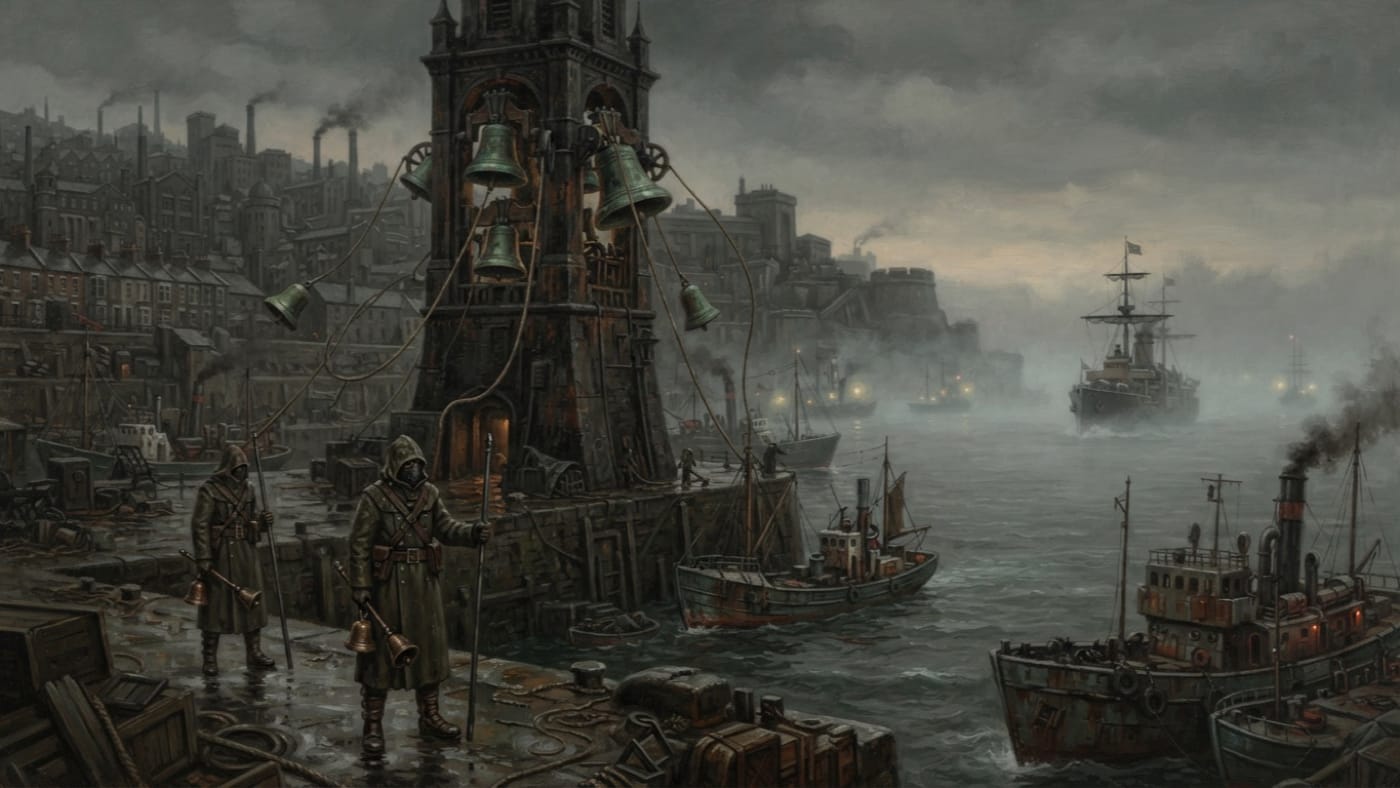
Each Lantern-Ringer is sworn to a single bell and scarred in the palm. Each carries a mace cast from that bell's bronze. When the bell is founded, a portion of its metal is held back before consecration and poured for the weapon, so bell and mace hear the same first silence. I give the order's general rule here because I know of no particular Plymouth casting. I have no bell-name, no founder and no date, and I will not invent one to flatter the page.
What a Ringer does is better documented than what a Ringer is called. He rings the hours. He rings the alarms. He rings the dead into the sea. He enforces the parish with the same arm that pulls the rope, and he regards these as one duty performed at four different speeds.
In a harbour the arithmetic is sharper. A fishing family in a British port takes its whole day from bronze: the hour for the nets and the hour for prayer, the closing of the harbour against weather, a ship's departure, the summons to judgment. On the coasts, when a parishioner dies, the tower tolls while the body is washed, named, wrapped and carried to the tide-stone. It goes on tolling until the water touches the shroud. The British say this keeps the dead from hearing the wrong summons. A harbour town hears that toll more often than an inland one. The sea collects its parishioners with indecent regularity.
The Ringer's vow ends with a clause Strasbourg has never managed to turn into a form: never permit silence to enter the tower unchallenged. In a harbour facing the open sea, the clause reads less like poetry and more like a standing order. Fog on the western water swallows lamps, confuses compasses, and offers the lights of harbours that are not there. The bell keeps sounding. Of all the faith's instruments, it is the one a drowning man can find with his eyes shut.
Sea-bell posts carry the longest training in the order: twelve years, against nine for cathedral carillons and seven for ordinary towers. I cannot tell the reader which class Plymouth's towers belong to. I can say that the British put their twelve-year men on the water, and that they are not a people who waste bronze.
#On Parish Authority
Plymouth lies under the Crown. The Crown sits at Canterbury, inland and beneath its cathedral, where King-Warden Aldric III governs through the Table of Nine. The Wardens of that Table hold the shires, the ports and the coastal watches by charter, and each holds military and church authority in one hand. The British have not told us which Warden answers for Plymouth, or through which officers. I decline to guess. A guess entered in the Codex becomes a fact by its third citation.
The general architecture is known. Under the Lantern Way, the parish is court, chapel, muster-roll and penitentiary at once. Between Lauds and supper a Warden may hear a petition, pronounce a penance, muster a militia and bless a keel, all without a routing slip. The bell-tower keeps his calendar. The Ringer is his arm.
The people under the bell pay for this. British penances run for months. Fasts are rung in and rung out. Shame is administered by neighbours, who know a man's name, his boat, his debts, and the hour he failed to appear. Under certain sentences the British brick dissenters alive into walls, and every account of the island agrees on that point. I have no Plymouth case to put before the reader, and I do not need one. A harbour town under the Lantern Way lives within earshot of the same law as every other parish in the realm. Its children are taught, like children everywhere in Britain, which walls to walk past quietly.
The order's general reputation holds that smugglers approach Ringers with coin and leave with fractures. Smugglers live in ports. The reader may do the sum.
#On the Ships Beyond the Harbour
The Royal Fleet is the reason any Bureau cares which way Britain's harbours face. British patrols run from the Dover Strait to the Bay of Biscay, and British warships escort Synod grain convoys through the western approaches. Among them sail the Cathedral Ships. They carry guns and rams in the ordinary way, a consecrated chapel amidships, a bell-tower over the quarterdeck, and a reliquary sealed into the keel where no Synod inspector has been allowed to look. Lantern-Ringers serve aboard. Their bell-masts ring while the ship is under way, and convoy captains report that bad water clears ahead of the hull. The Bureau of Engineering has measured the fog retreating. It has not reproduced the effect.
The British have not said where these ships are built, berthed, refitted or crewed, and I will not station a squadron at Plymouth on the strength of a compass bearing. It is enough that the convoys the Synod depends on travel the western approaches, and that Plymouth's bells face them.
Strasbourg wants the tuning protocols, the alarm schedules, the bell-mast methods and the ordination formula. War wants them because they keep grain afloat. Bells wants them because it cannot bear a bell it has not registered. Neither can command them. Britain sits outside the Concordat and beyond every audit the Synod has devised. It escorts the convoys anyway, on its own terms and in its own coin. One does not subpoena the escort.
#On the Present Condition
As of A.S. 201, Plymouth remains a working harbour of an independent Britain in Zone 0. It lies under the Crown, keeps the Lantern Way, and is served by Ringers whose bells face west. The harbour appears in no Bureau register under its own name. The faith it keeps appears in several.
The Lantern Way is classified Schismatic Heresy, Category Two.
Revised A.S. 199 to Non-Standard Observance, Diplomatically Accommodated, after the Bureau of War reminded the Bureau of Doctrine who escorts the flour. Britain's bells did not change their peal for the occasion.
I find Plymouth intolerable in the way every competent foreign institution is intolerable: it does its work beyond my reach, and it does the work well. Every hour the western water is answered by men the Synod did not ordain, with bronze the Synod did not register, under a Crown the Synod cannot audit. Our grain comes home past that sound. The Bureau will request the schedules again, and Plymouth will go on ringing without them.