
#On the Petition
"A quiet line is a loyal line." — Underworks saying. Nobody claims to have said it first, and every Plumber has said it since.
The Plumbers' Guild appears in the Sacred Ledger because of a single act. It asked the State to strike out one word, and the State kept the word.
The facts are these. After the Thumper Blackout of A.S. 171, the official classification of the Diesel Resonance Plumber was revised. The trade's formal title is Resonance Line Technician. In the tunnels they are called Pipe-Singer and Thumper-Runner, and among the inquisitorially inclined, Heretic Wrencher. The old wording, "auxiliary personnel, non-essential," became "auxiliary personnel, conditionally essential." The Plumbers' Guild petitioned for the removal of "conditionally." The petition was denied. As an act of administrative mercy, the word "auxiliary" was put in italics.
That is the entire documented encounter between this Guild and the State it keeps standing. The Ledger, as consulted for this entry, records no charter, no founding year, no hall and no roll of members. It names no officers, holds no seal and lists no dues. I will not invent them. The Bureau of Doctrine has entrusted me with many forgeries over the decades, but none of them was ever this careless. What the Ledger does hold is a petition, a refusal and a change of typeface. From such small things the Ledger has sometimes built doctrine.
The Diesel Resonance Plumber is classified as "auxiliary personnel, non-essential."
Corrected following the Thumper Blackout of A.S. 171: "auxiliary personnel, conditionally essential." The Plumbers' Guild petition to strike "conditionally" was denied. Auxiliary has been italicised.
#On the Pipes Beneath the Paper
The Sagittal Line runs on sound. The bells ring, and the pressurised conduits carry that ringing down into the bastions' bones. The vibration holds the gasket seals at their prescribed frequencies, and the seals hold the stone. When the vibration fails, bolts creep loose and seals weep. Eventually a ceiling sits down on whoever is sleeping beneath it. The Bureau of Bells sets the schedule of this singing. Someone has to keep the pipes from choking on it. That someone holds a valve key, wears a soot mask and is classified, conditionally, as essential.
The Ledger keeps a short list of what happens when nobody holds the key. At Bastion-Irongate in A.S. 94, the Great Hush killed roughly three thousand people. At Bastion-Shipka in A.S. 163 came the Unhymn Infiltration. Hostile harmonics that induce sleep rode the pressure irregularities of poorly kept lines into a district's infrastructure. The casualties remain classified. At Bastion-Przemyśl in A.S. 171, District Seven suffered the Thumper Blackout. Ward-plates fell silent across six levels, and about four hundred died in the breach that followed.
Each of these catastrophes is entered under the name of a bastion. None is entered under the name of the clamp that was missing, the seal that went unchanged or the Harmonic Listener who was posted three districts away. The Bureau finds bastions easier to mourn than labour.
That is the plain meaning of "conditionally." The work counts as essential while its absence is killing people. Once the dead are buried, the classification returns to its rest.
#On Recognition, Supply and Liability
The Guild's members answer to more than one authority. The Bureau of Bells governs when the pipes must carry their load. The Bureau of Engines and Furnaces holds the classification. The A.S. 171 revision itself was entered under the name of Engineering, and Engineering's name also appears when men are immured for allowing resonance failures. Whether these offices share one opinion or merely one ink supplier is beyond the competence of this entry. To the man in the sump chamber, the difference is a matter of which door the summons arrives through.
Supply is worse. The Seal Standardisation Edict of A.S. 164 answered Shipka with authorised hymn-gaskets, seals blessed and tuned to refuse hostile frequencies. The Edict was sound in doctrine. In practice the official gaskets arrive late and cost too much, and the Bureau of Tithes attributes the delays to seasonal variance. Every shortage of a blessed part breeds a counterfeit, and the Bureau of Purity has immured men for fitting counterfeit seals. Sanctified fuel comes up by convoy from the chrismole furnaces of Brast on a ration formula that does not favour maintenance. Meanwhile black diesel flows cheap and hot. Under pressure it produces the fumes the trade calls scripture-smoke, which Purity classifies as a Category Two Spiritual Hazard. At the end of each shift the compliance sheets are filed. In the trade they are universally understood to be devotional fiction.
So a Plumber faced with a weeping seal and an empty gasket kit has two ways to be punished. He can fit a counterfeit, or he can let the district go dark.
The Guild's petition did not ask for counterfeit seals to be forgiven, or for black diesel to be licensed. It said nothing of forged purity tags or ghost-loop bypasses. On all of these the Ledger records no Guild position, and I decline to supply one. Individual Plumbers do what keeps the wards lit. The Guild, on the record, asked for one word.
I read that petition as the Bureau must have read it. Essential personnel, with no condition attached, would be personnel the State is obliged to supply. A gasket that fails to arrive would become a failure of the supplier rather than a sin of the man who could not fit it. One adverb stood between the trade and that change in liability. The Bureau understood its value precisely, and it kept the adverb.
#On the Divisions of the Trade
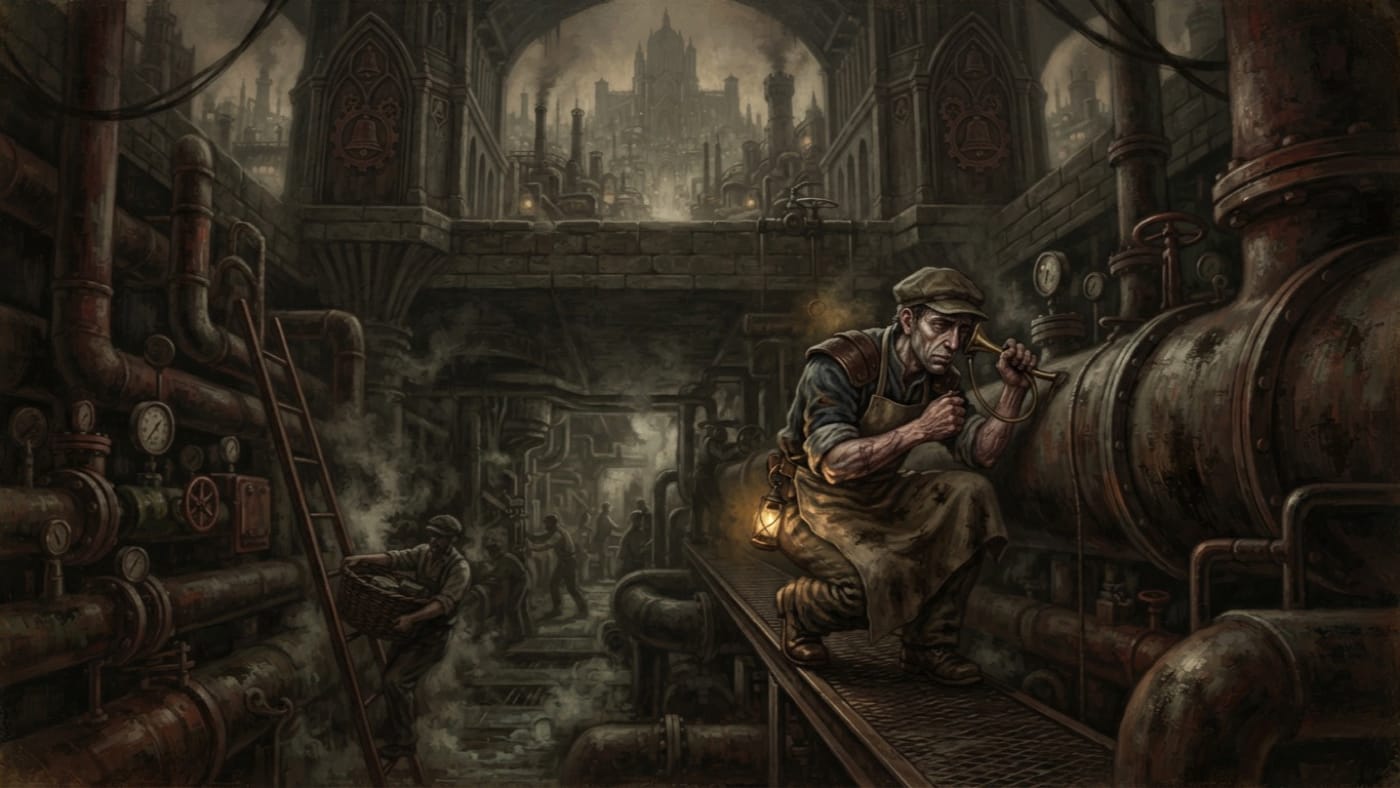
The ladder belongs to the profession, and nothing on record makes its rungs Guild offices. The Clamp Runner carries fuel and seals leaks and is taught early not to ask about sounds in the deep lines. The Line Technician patches, bleeds and retimes. The District Resonance Plumber holds an entire sector's infrastructure and the paperwork to prove it. The Harmonic Listener can tell hostile drift from mechanical drift by ear through a brass stethoscope-horn, before any gauge needle stirs. When pressure rises from above, the trade knows the order of sacrifice. First goes the Clamp Runner. Then the man who sold the counterfeit gasket. Last goes the "independent" who did the retune nobody authorised. Seniority buys a Listener rare hearing. It does not buy him gaskets, access seals or a maintenance window from the Litany-Engineers who must agree to drop a frequency for twenty minutes.
The trade quarrels as hard as any chapter house. The seal-purists hold that a consecrated seal, correctly fitted, is the only honest repair. The tune-pragmatists retune the thumper manifolds and save the district first, then argue doctrine. Official maintenance crews share the tunnels with shadow plumbers, who take the night calls: quiet retunes, bypass loops, make it stop screaming. Bell loyalists and engine loyalists split over a question no Bureau has answered for them. When the manifold is failing and only one load can be kept, does the Plumber save the sermon or the wards? The underworks also hold rival pipe guilds and black-market quieters. The Plumbers' Guild is one name in that crowded dark. It is the only one whose petition I have been able to find.
They share one patron. Saint Vellum of the Valve is depicted turning a wheel beneath the shadow of a bell. The Bureau of Hagiography is non-cognisant of him, and the Plumbers are non-cognisant of the Bureau's non-cognisance. They leave wax on his icon going down and diesel coming back.
#On the Present Standing
As of A.S. 201, the classification stands as revised: auxiliary, conditionally essential, with the italic still slanting. No later petition is recorded, and no later concession either. The parent entry's audit puts licensed practitioners at roughly four thousand two hundred and the real working number nearer nine thousand. How many of either carry the Guild's name, no one has counted.
The pipes have not grown quieter. Standing Order 44-R, revised in A.S. 199, sends every report of knocking language or responsive harmonics to Form 77-K and forbids talk of it in mess halls and confession booths. The Bureau of Doctrine has offered no comment, and this entry offers none in its place. The Plumbers file the form and go back down with wax for the icon and a kit that may or may not hold a blessed gasket. Above them the State rings its bells and depends entirely on men it has declared, in writing, essential only on condition.