
#On the House and Its Promise
"Come to where the cradle is held for you." Recruitment pamphlet, as quoted in the Halva file
A Plenty House is a pregnancy dormitory kept by the Mothers of Plenty. The name is singular, but there are many of them. No surviving record names the first House, its builder, its city or its year, and the Codex will not supply what the archive declined to keep. This survey describes the type as it stands in A.S. 201: its rooms, its residents, its staff, its stores and its paper.
The type is simple to describe. A pregnant woman is fed there at set hours and kept warm while the tenements are cold. She is washed, inspected, prayed over, delivered and counted, and every one of those mercies is written down. Four things govern her days: who holds the ladle, who assigns the bed, who carries the key and who writes the entry. She holds none of them.
#On Placement
A woman reaches the House by way of the ration hall. Once she declares her pregnancy, it enters the Mothers' register and changes her household's allotment. The Plenty classifications then sort her as fit mother, weak mother or debtor mother. The published account adds two more grades, dormitory recommended and dormitory required, and these two belong to the House. The sources do not say which earlier grade leads to which later one, or that any of them leads there automatically. A debtor mother may be pressed and a weak mother persuaded. For a woman marked "required", the persuasion has already been completed on her behalf.
The Empty Cradle Accord usually gets the credit for filling the dormitories. The Mothers' published history says that after the Accord, the Houses began receiving pregnant women whose households required "structured nourishment and moral oversight." The phrase describes consequences. No surviving text attaches a threshold, a term of residence or a right of appeal to it, and I add none.
The Halva file goes further. It says the House door "locks from the outside" and that women leave "when the Bureau of Records has completed their natal registration writ." That is one published account. I record it as such and do not make it law for every House. That residents live under guard is attested independently.
It is easier to say what placement costs than what it requires. A woman leaves her own room, her stove if she had one, the neighbour who knew which bread-seller cheated, and the midwife she might have chosen for herself. Her household's independence goes into the ledger with her. From the first meal she eats from the House's stores at the House's hour. A body that eats on schedule soon loses the habit of finding food any other way.
#On the Rooms and Their Keeping
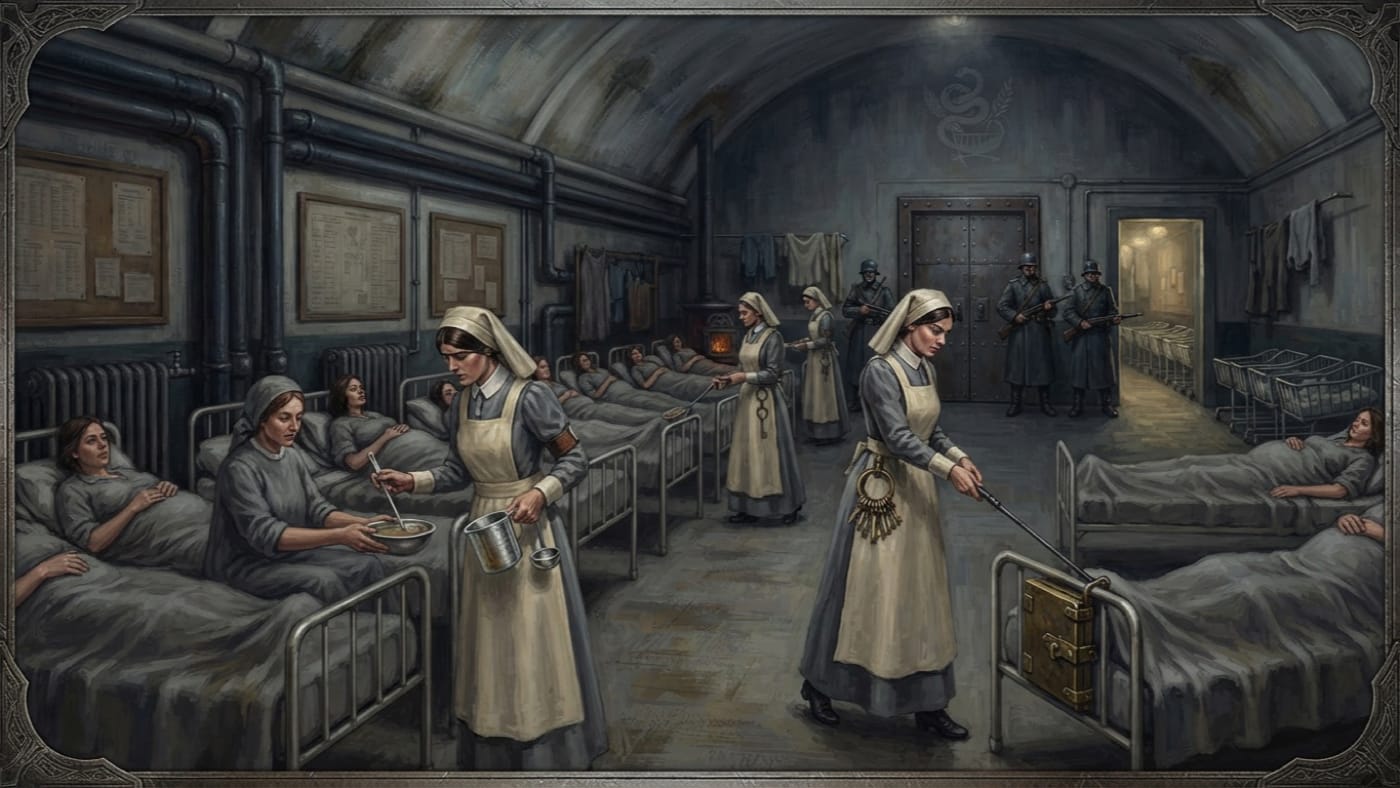
Begin with the floors, because the Mothers do. They are washed with lye before dawn, and the smell lies under everything else in the building. There is broth steam from the kitchen, disinfectant from the inspection room and sour milk in the cradle room. Residents dry what they arrived in on the stove rails, and the wet wool adds its own smell. The beds stand in rows. The linen is cradle-cream when new and greyer with each boiling. In winter a stove keeps the long room warmer than most tenements, and "warmer" is the honest word. Heat is rationed here as it is everywhere else. When fuel fails in the city, it fails in the House a few days later.
Meals come from measured pots at fixed hours. A Ladle Sister scrapes each measure level with a flat stick before she pours, and that scrape is the first sound a resident learns. There is milk when there is milk. Prenatal inspections run on a schedule the resident does not set, and prayers on another. The House keeps visiting hours, which means visits end when the hours do.
The curtained birth cubicles are at the back, each with a basin and a lamp. Beyond them is the cradle room, where the infants cry at dawn and the night staff count them at dark. The locked store holds flour, soap, linen and whatever reserve the Matron has managed to keep from the auditors. A guard stands at the threshold. The Mothers acquired their guards after Breadfire Week, and the Houses keep them still.
The Codex entry on the Mothers of Plenty states that after Breadfire Week, Doctrine "created the Mothers of Plenty as a public-facing mercy layer over quota discipline."
Corrected: Breadfire gave guards and enforcement authority to an office already at work in the ration halls. The Mothers' formal charter dates to A.S. 94. Neither event dates the first Plenty House, which remains undated.
The staff wear cream or white aprons over grey, with their hair bound tight, their cuffs stamped and a cord of keys at the hip. A Matron of Plenty holds seal authority. The Plenty House Prefect is an attested specialist rank, though no surviving roster gives a House's full staff. Some of the midwives at the cubicles belong to the Mothers and some do not. A fever or a haemorrhage may bring a Mercy Ward-Sister, whose treatment is rationed by the Bureau of Mercy on its own terms. Mercy's presence in a House does not make the House its property.
Children are born alive in these rooms who would have died in cold ones. Set that fact beside the guard and leave them both standing.
#On the Bedside Record
The published account describes "a locked ledger at the foot of the bed." I record that arrangement as attested and do not claim that every House keeps every resident's book in the same place. Where it is kept there, the resident sleeps beside pages she cannot open. Her Womb Ledger entry holds her household standing, her maternal fitness, her debts, her prior births and losses, every change to her allotment and a projected yield. Each bowl she accepts may be entered as a debt. The trade later converts prenatal debt into labour or future levy compliance, at a rate the resident never sees.
A birth in the House enters four records kept by four offices, and they must not be merged. The House ledger belongs to the Mothers. The attending midwife carries the liability of the natal registration writ to the Bureau of Records. That office's Womb Registrars are its own deputies and are distinct from Plenty staff with similar titles. The midwives' survey finds the clocks on that filing in disagreement, and I leave them so. Records keeps the child's identity, and the Bureau of Tithes calculates what the household owes. Baptism enters the child in the Book of Promise, which assigns futures in the levy, the choir and the clergy.
A boy's future levy designation travels to the Bureau of Conscription as a projection. No one musters an infant, but the paper keeps until he is old enough. Girls receive household continuity markings. The trade keeps "plenty talk" apart from "levy talk" so that no mother hears the whole machine at once. In a House, the two are kept a corridor apart.
#On Loss and Private Arithmetic
Under the Accord, miscarriages became audited statistics. The surviving accounts give no figure that triggers an inquiry and no automatic finding of fault. The parent account adds that stillbirths are recorded as failures "unless corrected by medical notation," and that a woman who loses too often becomes a subject of investigation. I quote that as institutional language. It is no finding of medicine. Why any pregnancy ends is a question for physicians, for the woman and for the Creator.
Three columns stay apart: the miscarriage, the stillbirth, and the live birth disguised as one of the other two. The third is the House's private arithmetic. Staff hide reserves in the store and shave rations at the pot. They lend Ladle Debt, which is extra broth today against a service recorded for later. They downgrade a risk score so that a woman keeps her allotment, or so that she never reaches the dormitory at all. They enter a living child as stillborn and send it somewhere else. Some do it to save a child, and some do it for a fee. The orphanage registrar and the Grain Keeper stand at the edges of these transactions. Depending on the night, either may be a buyer, a seller or a refuge, and neither is a department of the House.
PUBLISHED AUDIT EXTRACT — PLENTY HOUSE ███, A.S. 198: Seven stillbirths certified by the same Matron in a six-week period. Seven missing grave tags. Seven amended ration profiles. Seven cradle blankets cut from one bolt of blue cloth. The infants were not recovered. Sentence sealed.
The extract comes from the Codex entry on the Mothers. It does not name the House, and neither do I. I do not know where the infants went or what the Matron's sentence was. Anyone who claims to know either should bring the file.
#On Present Keeping
Audit pressure has been severe since A.S. 199. Inspectors check the measure cups first, then the reserve bins, then sample households. A House short of flour serves thinner broth to the same number of residents and records the same number of meals. When concealment is suspected, Purity arrives with its white cups. News of convoy losses reaches the House a week late, and the residents feel the shortage before the ledgers admit it.
The staff are divided the same way the profession is. Plenty House Purists hold that the dormitory is an instrument of enforcement and should be run as one. Mercy Ladlers feed whom they can and falsify what they must. Both wear the same apron. Within a week a resident learns which kind holds the key to her row. That knowledge is the only private property the House allows her.
The night count begins after the last prayer. The Matron walks the rows with a lamp and her cord of keys. She counts the women, then the cradles, then the cups. She unlocks each ledger she must amend, writes in it and locks it again. The residents who are still awake watch her hand.